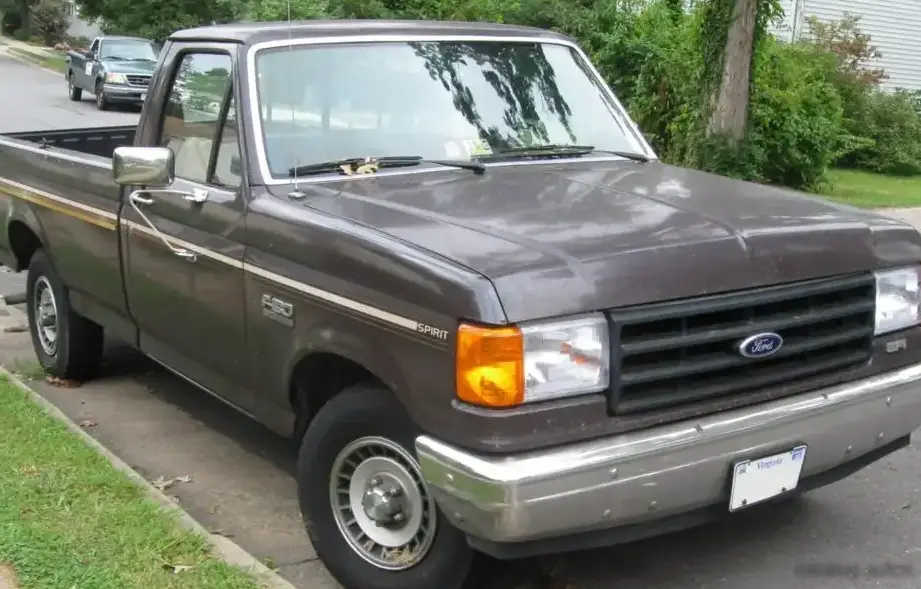
The Ford F-Series F-150 VIII Regular Cab, equipped with the 5.0-liter V8 Windsor engine and an automatic transmission, represents a significant iteration in the long and storied history of Ford’s full-size pickup trucks. Produced from 1986 to 1991, this configuration occupied a middle ground within the eighth generation (1987-1991) F-Series lineup, offering a balance between capability and affordability. It served as a workhorse for a broad range of buyers, from farmers and ranchers to contractors and everyday drivers needing a robust vehicle. This variant was particularly popular in the United States, where full-size pickups were, and continue to be, a dominant force in the automotive market.
Technical Specifications
| Brand | Ford |
| Model | F-Series F-100/F-150 |
| Generation | F-Series F-150 VIII Regular Cab |
| Type (Engine) | 5.0 V8 Windsor (185 Hp) Automatic |
| Start of production | 1986 |
| End of production | 1991 |
| Powertrain Architecture | Internal Combustion engine |
| Body type | Pick-up |
| Seats | 3 |
| Doors | 2 |
| Fuel Type | Petrol (Gasoline) |
| Power | 185 Hp |
| Power per litre | 37.4 Hp/l |
| Torque | 366 Nm / 269.95 lb.-ft. |
| Engine layout | Front, Longitudinal |
| Engine displacement | 4949 cm3 / 302.01 cu. in. |
| Number of cylinders | 8 |
| Engine configuration | V-engine |
| Fuel injection system | Multi-port manifold injection |
| Engine aspiration | Naturally aspirated engine |
| Max. weight | 2835 kg / 6250.11 lbs. |
| Fuel tank capacity | 62-72 l / 16.38 – 19.02 US gal | 13.64 – 15.84 UK gal |
| Length | 4917-5339 mm / 193.58 – 210.2 in. |
| Height | 1773-1775 mm / 69.8 – 69.88 in. |
| Wheelbase | 2967-3378 mm / 116.81 – 132.99 in. |
| Wading depth | 742-767 mm / 29.21 – 30.2 in. |
| Drivetrain Architecture | The Internal combustion engine (ICE) drives the rear wheels of the vehicle. |
| Drive wheel | Rear wheel drive |
| Number of gears and type of gearbox | 4 gears, automatic transmission |
| Front suspension | Independent coil spring |
| Front brakes | Disc |
| Rear brakes | Drum |
| Power steering | Electric Steering |
| Tires size | 215/75 R15; 235/75 R15 |
| Wheel rims size | 6J x 15 |
Powertrain & Engine Architecture
The heart of this F-150 variant is the 5.0-liter (302 cubic inch) Windsor V8 engine. This engine, a Ford mainstay for decades, is a pushrod engine with a cast iron block and aluminum cylinder heads. The 185 horsepower output was achieved through a multi-port fuel injection system, a significant upgrade over the carbureted engines of previous generations. This system improved fuel efficiency and throttle response. The engine’s valvetrain utilizes two valves per cylinder, operated by a hydraulic lifter camshaft. The automatic transmission paired with this engine was typically a four-speed unit, the AOD (Automatic Overdrive) transmission being a common choice. The AOD provided both automatic shifting and an overdrive gear for improved highway fuel economy. The engine’s longitudinal front-engine layout was standard for this generation of F-Series trucks.
Driving Characteristics
The 185 hp, automatic transmission combination delivered a driving experience geared towards practicality rather than outright performance. Acceleration was adequate for everyday driving and hauling moderate loads, but it wasn’t particularly quick. The automatic transmission, while convenient, did result in some power loss compared to the available manual transmission options. The four-speed AOD transmission offered reasonable gear ratios for both city and highway driving, with the overdrive gear helping to keep engine RPMs down at cruising speeds. Compared to the higher-output 351 Windsor V8 or the diesel options, this 5.0L automatic felt less powerful, especially when towing heavy trailers. However, it offered a smoother and more relaxed driving experience than the often-rough-riding diesel models.
Equipment & Trim Levels
The F-150 VIII Regular Cab with the 5.0L V8 and automatic transmission typically fell into the mid-range of available trim levels. Standard features generally included a basic vinyl interior, a simple dashboard layout with analog gauges, and a standard AM/FM radio. Options included upgraded interior trim packages with cloth or leather upholstery, air conditioning, power windows and locks, and a tilt steering wheel. The Regular Cab configuration offered a bench seat for up to three occupants. The exterior trim varied depending on the specific package chosen, with options for chrome bumpers, brightwork, and different wheel styles. The base models were fairly spartan, while higher trim levels offered a more comfortable and refined interior.
Chassis & Braking
The F-150 VIII utilized a body-on-frame construction, providing a robust and durable platform. The front suspension consisted of independent coil springs, offering a relatively comfortable ride for a truck of this size. The rear suspension employed leaf springs, which were well-suited for carrying heavy loads. Braking duties were handled by disc brakes in the front and drum brakes in the rear. Power steering was standard, making maneuvering the large truck easier. Tire sizes typically ranged from 215/75 R15 to 235/75 R15, depending on the trim level and optional packages. The chassis was designed to handle a significant payload and towing capacity, making it a versatile work vehicle.
Market Reception & Comparison
The 5.0L V8 automatic F-150 was generally well-received by buyers seeking a reliable and capable truck without the expense of the higher-performance or diesel options. Critics noted its adequate power and smooth automatic transmission, but also pointed out its lack of outright speed compared to other available engines. Fuel economy was considered average for a full-size pickup of the era. Compared to the 351 Windsor V8, the 5.0L offered better fuel efficiency but less power. The diesel options provided superior torque for towing but were often more expensive and less refined. The 5.0L automatic struck a balance between these extremes, appealing to a broad range of buyers.
Legacy
The 5.0L Windsor V8 engine, in general, has a reputation for being a durable and relatively easy-to-maintain powerplant. While not known for its cutting-edge technology, its simplicity and robust construction contribute to its longevity. The AOD automatic transmission, while reliable, can be prone to wear and tear over time, particularly if not properly maintained. Today, these F-150s are increasingly sought after by collectors and enthusiasts, particularly those looking for a classic American pickup truck. Parts availability remains good, making them relatively easy to keep on the road. The 1986-1991 F-150 with the 5.0L V8 and automatic transmission represents a solid and dependable workhorse from a golden age of American truck manufacturing, and continues to be a viable option for those seeking a classic pickup with enduring appeal.