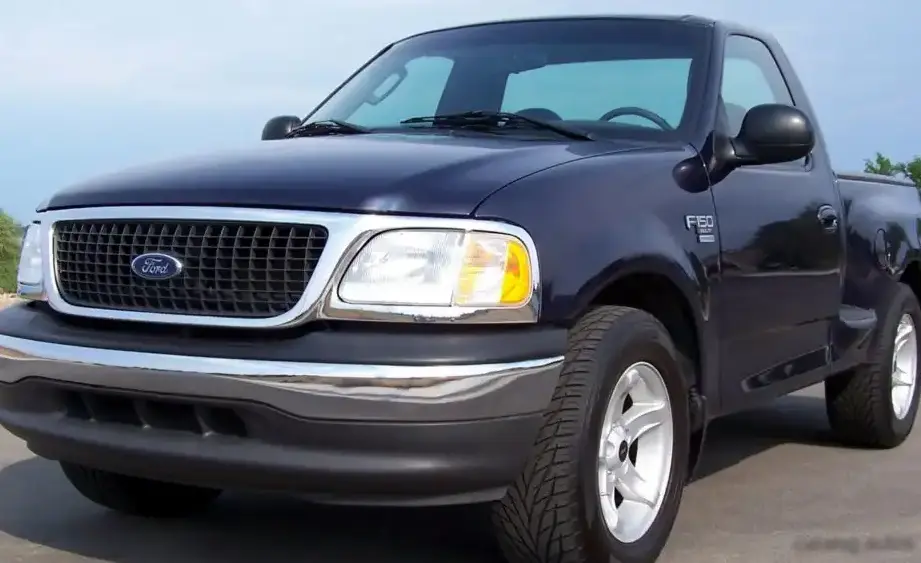
The Ford F-Series F-150 X Regular Cab, equipped with the 4.6-liter V8 Triton engine producing 220 horsepower, represented a work-focused configuration within the ninth generation of the F-Series (1997-1998). This generation marked a significant redesign for Ford’s best-selling pickup truck, introducing a more aerodynamic and modern aesthetic. The F-150 X Regular Cab with the 4.6L V8 served as a step up from the base 4.2L inline-six, offering increased power and towing capacity for buyers needing more than basic utility, but who didn’t require the higher cost and complexity of the 5.4L Triton or the heavy-duty F-250/F-350 models. It was positioned as a solid, reliable choice for both personal and commercial use.
Technical Specifications
| Brand | Ford |
| Model | F-Series F-100/F-150 |
| Generation | F-Series F-150 X Regular Cab |
| Type (Engine) | 4.6 V8 Triton (220 Hp) |
| Start of production | 1997 |
| End of production | 1998 |
| Powertrain Architecture | Internal Combustion engine |
| Body type | Pick-up |
| Seats | 3 |
| Doors | 2 |
| Fuel Type | Petrol (Gasoline) |
| Power | 220 Hp @ 4500 rpm |
| Power per litre | 47.8 Hp/l |
| Torque | 393 Nm @ 3250 rpm / 289.86 lb.-ft. @ 3250 rpm |
| Engine layout | Front, Longitudinal |
| Engine displacement | 4605 cm3 / 281.01 cu. in. |
| Number of cylinders | 8 |
| Engine configuration | V-engine |
| Compression ratio | 9:1 |
| Number of valves per cylinder | 2 |
| Fuel injection system | Multi-port manifold injection |
| Engine aspiration | Naturally aspirated engine |
| Valvetrain | SOHC |
| Engine oil capacity | 5.7 l / 6.02 US qt | 5.02 UK qt |
| Coolant | 19.5 l / 20.61 US qt | 17.16 UK qt |
| Max. weight | 2971 kg / 6549.93 lbs |
| Trunk (boot) space – minimum | 1659 l / 58.59 cu. ft |
| Trunk (boot) space – maximum | 2056 l / 72.61 cu. ft |
| Fuel tank capacity | 95-114 l / 25.1 – 30.12 US gal | 20.9 – 25.08 UK gal |
| Permitted trailer load with brakes (12%) | 1588 kg / 3500.94 lbs |
| Length | 5136-5608 mm / 202.2 – 220.79 in |
| Wheelbase | 3048-3531 mm / 120 – 139.02 in |
| Ride height (ground clearance) | 185 mm / 7.28 in |
| Wading depth | 826-947 mm / 32.52 – 37.28 in |
| Drivetrain Architecture | The Internal combustion engine (ICE) drives the rear wheels of the vehicle. |
| Drive wheel | Rear wheel drive |
| Number of gears and type of gearbox | 5 gears, manual transmission |
| Front suspension | Independent coil spring, Transverse stabilizer |
| Front brakes | Ventilated discs |
| Rear brakes | Ventilated discs |
| Power steering | Electric Steering |
| Tires size | 235/70 R16; 255/70 R16 |
| Wheel rims size | 7.0J x 16 |
Powertrain & Engine Architecture
The heart of this F-150 X was the 4.6-liter Triton V8 engine. This engine, designated as the modular engine family by Ford, featured a single overhead camshaft (SOHC) design with two valves per cylinder. The 4.6L Triton utilized multi-port fuel injection, delivering fuel directly into each intake port for improved combustion efficiency. The engine’s 9:1 compression ratio was a compromise between power and durability, suitable for the wide range of applications the F-150 was expected to handle. The 5-speed manual transmission was the standard offering, providing a direct connection between the engine and the rear wheels. This transmission was chosen for its durability and relatively simple design, prioritizing reliability over outright performance.
Driving Characteristics
The 220 horsepower and 289 lb-ft of torque provided by the 4.6L Triton and 5-speed manual transmission offered a noticeable step up in performance compared to the base 4.2L inline-six. While not a performance-oriented configuration, the 4.6L provided adequate power for everyday driving and moderate towing. The manual transmission allowed for greater driver control and potentially better fuel economy compared to an automatic, though the gear ratios were tuned more for work than for spirited driving. Acceleration was respectable, but the F-150’s substantial weight limited its overall quickness. The 5-speed manual offered a good spread of gears, allowing the engine to operate efficiently at highway speeds while still providing enough torque for hauling loads.
Equipment & Trim Levels
The F-150 X Regular Cab with the 4.6L V8 typically included standard features such as air conditioning, a basic AM/FM radio, and cloth upholstery. Power steering and manual windows were also common. The “X” trim level represented a mid-range offering, bridging the gap between the base models and the more luxurious trims like the XL and XLT. Optional extras included upgraded sound systems, power windows and locks, cruise control, and a sliding rear window. The interior was functional and durable, designed to withstand the rigors of daily use. The bench seat configuration provided seating for three passengers, though the cabin was relatively spartan compared to modern pickups.
Chassis & Braking
The F-150 X Regular Cab utilized a body-on-frame construction, providing a robust and durable platform. The front suspension featured independent coil springs and a transverse stabilizer bar, offering a reasonable ride quality for a pickup truck. The rear suspension employed leaf springs, designed to handle heavy loads. Braking duties were handled by ventilated discs on all four wheels, providing adequate stopping power for the vehicle’s weight. Power-assisted steering made maneuvering the large pickup easier, especially in tight spaces. Tire sizes typically ranged from 235/70R16 to 255/70R16, depending on the specific configuration and optional packages.
Market Reception & Comparison
The 1997-1998 Ford F-150 X Regular Cab with the 4.6L V8 was generally well-received by critics and buyers alike. It offered a good balance of power, capability, and affordability. Compared to the base 4.2L inline-six, the 4.6L provided a significant boost in performance, making it a more attractive option for those who needed to tow or haul heavier loads. However, it wasn’t as powerful or refined as the 5.4L Triton V8, which was available on higher trim levels. Fuel economy was typical for a full-size pickup truck of the era, averaging around 14-16 mpg in city driving and 17-19 mpg on the highway. Reliability was generally good, though some owners reported issues with the intake manifold gasket on the 4.6L Triton engine.
Legacy
The 4.6L Triton V8 engine became a mainstay of the Ford F-Series lineup for many years, proving to be a durable and reliable powerplant. While later iterations of the engine received updates and improvements, the basic architecture remained largely unchanged. The 1997-1998 F-150 X Regular Cab with the 4.6L V8 remains a popular choice among used car buyers looking for a capable and affordable pickup truck. These trucks are known for their simplicity, durability, and relatively low maintenance costs. However, potential buyers should be aware of the potential for intake manifold gasket leaks and other age-related issues. Today, these trucks represent a piece of American automotive history, embodying the work ethic and practicality that have defined the Ford F-Series for generations.