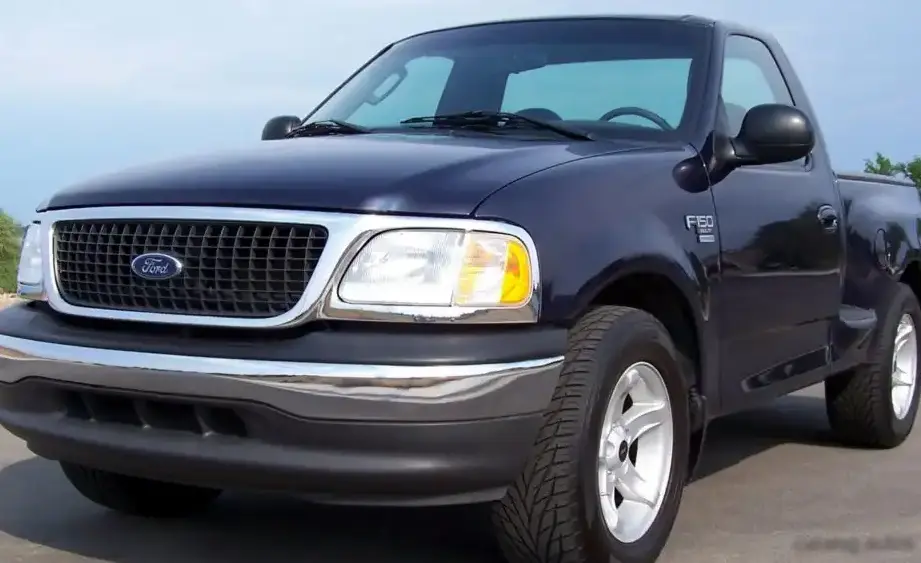
The Ford F-Series F-150 X Regular Cab, equipped with the 4.6-liter V8 Triton engine and a four-speed automatic transmission, was a mainstay of the American full-size pickup truck market from 1999 to 2004. This configuration represented a popular balance between capability and affordability within the tenth generation (1997-2003) F-150 lineup. Positioned as a work-oriented trim, it catered to buyers needing a robust truck without the added expense of higher-end features or the performance focus of larger engine options. It was a direct successor to the F-150 models of the previous generation, continuing Ford’s long tradition of providing durable and versatile trucks for both personal and commercial use.
Technical Specifications
| Brand | Ford |
| Model | F-Series F-150 |
| Generation | F-Series F-150 X Regular Cab |
| Type (Engine) | 4.6 V8 Triton (231 Hp) Automatic |
| Start of production | 1999 |
| End of production | 2004 |
| Powertrain Architecture | Internal Combustion engine |
| Body type | Pick-up |
| Seats | 3 |
| Doors | 2 |
| Fuel Type | Petrol (Gasoline) |
| Power | 231 Hp @ 4750 rpm |
| Power per litre | 50.2 Hp/l |
| Torque | 397 Nm @ 3500 rpm / 292.81 lb.-ft. @ 3500 rpm |
| Engine layout | Front, Longitudinal |
| Engine displacement | 4605 cm3 / 281.01 cu. in. |
| Number of cylinders | 8 |
| Engine configuration | V-engine |
| Cylinder Bore | 90.17 mm / 3.55 in. |
| Piston Stroke | 89.92 mm / 3.54 in. |
| Compression ratio | 9.3:1 |
| Number of valves per cylinder | 2 |
| Fuel injection system | Multi-port manifold injection |
| Engine aspiration | Naturally aspirated engine |
| Valvetrain | SOHC |
| Engine oil capacity | 5.7 l / 6.02 US qt | 5.02 UK qt |
| Coolant | 19.5 l / 20.61 US qt | 17.16 UK qt |
| Max. weight | 2994 kg / 6600.64 lbs |
| Trunk (boot) space – minimum | 1422 l / 50.22 cu. ft |
| Trunk (boot) space – maximum | 2056 l / 72.61 cu. ft |
| Fuel tank capacity | 95-114 l / 25.1 – 30.12 US gal | 20.9 – 25.08 UK gal |
| Permitted trailer load with brakes (12%) | 3221 kg / 7101.09 lbs |
| Length | 5255-5728 mm / 206.89 – 225.51 in. |
| Width | 2014 mm / 79.29 in. |
| Height | 1864 mm / 73.39 in. |
| Wheelbase | 3045-3518 mm / 119.88 – 138.5 in. |
| Front overhang | 983 mm / 38.7 in. |
| Rear overhang | 1227 mm / 48.31 in. |
| Ride height (ground clearance) | 203 mm / 7.99 in. |
| Approach angle | 18.5° |
| Departure angle | 16.2° |
| Ramp-over (brakeover) angle | 17.4° |
| Wading depth | 843 mm / 33.19 in. |
| Drivetrain Architecture | Rear wheel drive. Internal Combustion engine. |
| Drive wheel | Rear wheel drive |
| Number of gears and type of gearbox | 4 gears, automatic transmission |
| Front suspension | Independent coil spring, Transverse stabilizer |
| Rear suspension | Leaf spring |
| Front brakes | Ventilated discs, 308 mm |
| Rear brakes | Ventilated discs, 335 mm |
| Assisting systems | ABS (Anti-lock braking system) |
| Steering type | Cone worm with recirculation balls |
| Power steering | Electric Steering |
| Tires size | 235/70 R16 |
| Wheel rims size | 16 |
Powertrain & Engine Architecture
The heart of this F-150 variant was the 4.6-liter Triton V8 engine. This engine, part of Ford’s modular engine family, utilized a single overhead camshaft (SOHC) design with two valves per cylinder. The engine code varied slightly depending on the specific year, but generally fell within the range of engines produced during this period. The multi-port fuel injection system delivered fuel directly to each cylinder, optimizing combustion. The 9.3:1 compression ratio was a compromise between performance and the ability to run on readily available 87-octane gasoline. Paired with this engine was a four-speed automatic transmission, designed for durability and ease of use. This transmission featured electronic control for smoother shifting and optimized gear selection based on driving conditions. While not offering the most advanced gear ratios, it was well-suited for the truck’s intended purpose of hauling and towing.
Driving Characteristics
The 4.6-liter V8 with the four-speed automatic delivered adequate, though not exhilarating, performance. Acceleration was reasonable for a full-size pickup, but noticeably slower than the available 5.4-liter V8 or the diesel options. The automatic transmission’s gear ratios were geared towards maximizing fuel economy and providing sufficient torque for everyday tasks. The truck felt capable when towing lighter loads, but struggled with heavier trailers or steep inclines. Compared to the manual transmission versions, the automatic offered a more relaxed driving experience, particularly in city traffic. However, the manual transmission provided better control and fuel efficiency, appealing to drivers prioritizing performance or economy.
Equipment & Trim Levels
The F-150 X Regular Cab, in this configuration, typically came standard with basic amenities. The interior featured a vinyl bench seat, air conditioning, and an AM/FM radio. Power windows and locks were often optional extras. The dashboard was functional and straightforward, prioritizing usability over aesthetics. Optional packages could add features like cruise control, upgraded sound systems, and a tilt steering wheel. The exterior typically featured black bumpers and side moldings, reflecting its work-oriented positioning. The Regular Cab configuration offered a single row of seating, maximizing cargo space in the bed.
Chassis & Braking
The F-150 X Regular Cab utilized a body-on-frame construction, providing a robust and durable platform. The front suspension consisted of independent coil springs with a transverse stabilizer bar, offering a comfortable ride. The rear suspension employed leaf springs, designed to handle heavy loads. Braking duties were handled by ventilated discs on all four wheels, with ABS (Anti-lock Braking System) as standard equipment. The braking system was adequate for the truck’s weight class, but lacked the stopping power of more modern systems. The rear leaf spring suspension was tuned for load-carrying capacity, sometimes resulting in a slightly harsher ride when unladen.
Market Reception & Comparison
The 4.6-liter V8 automatic F-150 was well-received by buyers seeking a dependable and affordable full-size pickup. Critics generally praised its durability and ease of use, but noted its lack of refinement compared to higher-end trims. Fuel economy was average for the class, falling somewhere between the more powerful 5.4-liter V8 and the diesel options. Reliability was generally good, with the 4.6-liter Triton engine proving to be a relatively robust powerplant. However, some owners reported issues with spark plug breakage, a common problem with early Triton engines. Compared to the 5.4-liter V8, the 4.6-liter offered lower initial cost and slightly better fuel economy, but at the expense of performance. The diesel options provided superior towing capacity and fuel efficiency, but came with a higher price tag.
Legacy
The 4.6-liter V8 automatic F-150 remains a common sight on used car lots today. Its relatively simple design and proven durability have contributed to its longevity. While not a collector’s item, it represents a solid and dependable work truck that served many owners well. The powertrain, while not particularly fuel-efficient by modern standards, is generally reliable and relatively inexpensive to maintain. The availability of parts is excellent, making it a practical choice for those seeking an affordable and capable pickup truck. The 4.6L Triton engine, despite some known issues, has proven to be a workhorse for many years, and this F-150 configuration continues to offer value in the used vehicle market.