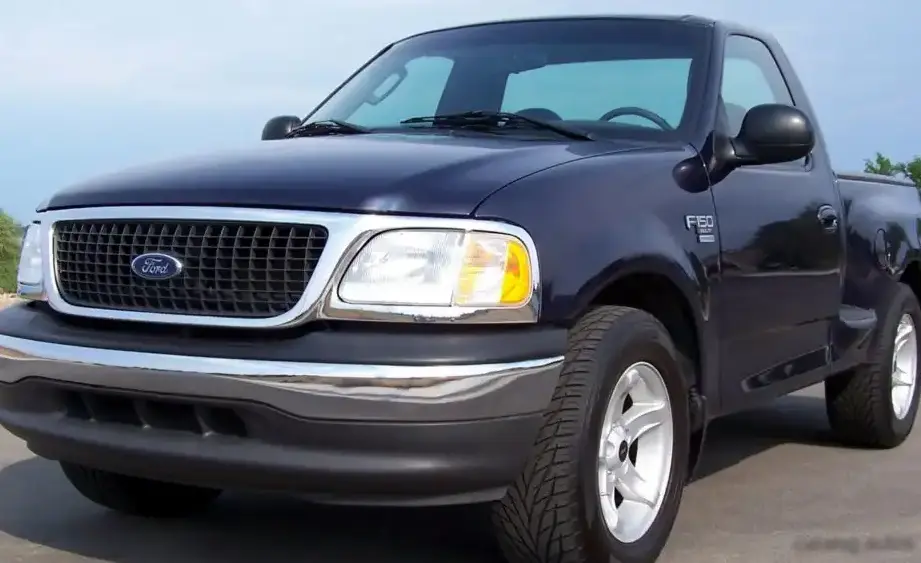
The Ford F-Series F-150 X Regular Cab, equipped with the 5.4-liter V8 Triton engine and a four-speed automatic transmission, was a mainstay of Ford’s full-size pickup truck lineup from 1999 through 2004. This configuration represented a mid-range offering within the tenth generation (1997-2003) F-150 series, positioned between the base models with smaller engines and the higher-performance, more expensive trims featuring larger V8s or the supercharged Lightning variant. The F-150, consistently a best-selling vehicle in the United States, served as a workhorse for both commercial and personal use, and this particular variant aimed to balance capability with affordability.
Technical Specifications
| Brand | Ford |
| Model | F-Series F-150 |
| Generation | F-Series F-150 X Regular Cab |
| Type (Engine) | 5.4 V8 Triton (260 Hp) Automatic |
| Start of production | 1999 |
| End of production | 2004 |
| Powertrain Architecture | Internal Combustion engine |
| Body type | Pick-up |
| Seats | 3 |
| Doors | 2 |
| Fuel Type | Petrol (Gasoline) |
| Power | 260 Hp @ 4500 rpm |
| Power per litre | 48.1 Hp/l |
| Torque | 475 Nm @ 2500 rpm / 350.34 lb.-ft. @ 2500 rpm |
| Engine layout | Front, Longitudinal |
| Engine displacement | 5408 cm3 / 330.02 cu. in. |
| Number of cylinders | 8 |
| Engine configuration | V-engine |
| Cylinder Bore | 90.17 mm / 3.55 in. |
| Piston Stroke | 105.66 mm / 4.16 in. |
| Compression ratio | 9:1 |
| Number of valves per cylinder | 2 |
| Fuel injection system | Multi-port manifold injection |
| Engine aspiration | Naturally aspirated engine |
| Valvetrain | SOHC |
| Engine oil capacity | 5.7 l / 6.02 US qt | 5.02 UK qt |
| Coolant | 22.6 l / 23.88 US qt | 19.89 UK qt |
| Max. weight | 2744 kg / 6049.48 lbs |
| Trunk (boot) space – minimum | 1422 l / 50.22 cu. ft |
| Trunk (boot) space – maximum | 2056 l / 72.61 cu. ft |
| Fuel tank capacity | 95-114 l / 25.1 – 30.12 US gal | 20.9 – 25.08 UK gal |
| Permitted trailer load with brakes (12%) | 3992 kg / 8800.85 lbs |
| Length | 5255-5728 mm / 206.89 – 225.51 in |
| Width | 2014 mm / 79.29 in |
| Height | 1864 mm / 73.39 in |
| Wheelbase | 3045-3518 mm / 119.88 – 138.5 in |
| Front overhang | 983 mm / 38.7 in |
| Rear overhang | 1227 mm / 48.31 in |
| Ride height (ground clearance) | 203 mm / 7.99 in |
| Approach angle | 18.5° |
| Departure angle | 16.2° |
| Ramp-over (brakeover) angle | 17.4° |
| Wading depth | 843 mm / 33.19 in |
| Drivetrain Architecture | The Internal combustion engine (ICE) drives the rear wheels of the vehicle. |
| Drive wheel | Rear wheel drive |
| Number of gears and type of gearbox | 4 gears, automatic transmission |
| Front suspension | Independent coil spring, Transverse stabilizer |
| Rear suspension | Leaf spring |
| Front brakes | Ventilated discs, 308 mm |
| Rear brakes | Ventilated discs, 335 mm |
| Assisting systems | ABS (Anti-lock braking system) |
| Steering type | Cone worm with recirculation balls |
| Power steering | Electric Steering |
| Tires size | 235/70 R16 |
| Wheel rims size | 16 |
Powertrain & Engine Architecture
The heart of this F-150 variant was the 5.4-liter Triton V8 engine. This engine, part of Ford’s modular engine family, featured a single overhead camshaft (SOHC) design with two valves per cylinder. The engine code varied slightly depending on the specific year, but generally fell within the range of the 4V or 2V designations. The 5.4L Triton utilized multi-port fuel injection, delivering fuel directly into each intake port. The engine’s 9:1 compression ratio was a compromise between performance and the ability to run on readily available 87-octane gasoline. Paired with the engine was a four-speed automatic transmission (typically the 4R70W), chosen for its durability and suitability for truck applications. This transmission featured electronic control for smoother shifting and optimized performance.
Driving Characteristics
The 5.4L V8 with the four-speed automatic provided adequate, though not exhilarating, performance. The 260 horsepower and 350 lb-ft of torque were sufficient for everyday driving and moderate towing duties. Acceleration from 0 to 60 mph typically took around 7.5 to 8.5 seconds, depending on the vehicle’s weight and configuration. The automatic transmission’s gear ratios were geared towards maximizing fuel economy and providing usable torque for hauling and towing. Compared to the smaller 4.6L V8, the 5.4L offered a noticeable increase in power, particularly when fully loaded. However, it lacked the responsiveness of the manual transmission options or the higher output of the larger V8s available in other F-150 trims. The ride quality was typical for a full-size pickup of the era – firm but generally comfortable, especially with a load in the bed.
Equipment & Trim Levels
The F-150 X Regular Cab with the 5.4L engine typically came standard with features like air conditioning, a basic AM/FM radio, and cloth upholstery. Power windows and locks were often included, but could be optional depending on the specific package. The interior was functional and durable, designed to withstand the rigors of truck ownership. Optional extras included upgraded sound systems, cruise control, a sliding rear window, and various towing packages. The “X” trim level generally represented a step up from the base XL trim, offering a slightly more refined interior and additional convenience features.
Chassis & Braking
The F-150’s chassis was a traditional body-on-frame construction, providing a robust and durable platform. The front suspension utilized independent coil springs with a transverse stabilizer bar, while the rear suspension employed leaf springs. This setup offered a good balance of ride comfort and load-carrying capacity. Braking duties were handled by ventilated disc brakes on all four wheels, with ABS (Anti-lock Braking System) as standard equipment. The braking system was adequate for the vehicle’s weight, but not particularly powerful compared to more modern trucks.
Market Reception & Comparison
The 5.4L F-150 was generally well-received by consumers and critics alike. It offered a good value proposition, providing a significant increase in power and towing capacity over the base engine options without the higher price tag of the larger V8s. Fuel economy was reasonable for a full-size pickup, averaging around 14-16 mpg in city driving and 17-20 mpg on the highway. Compared to the 4.6L V8, the 5.4L offered a noticeable performance advantage, but at the cost of slightly lower fuel economy. The 5.4L also proved to be a more reliable engine than some of the earlier iterations of the Triton family, though it was still susceptible to issues like spark plug breakage and timing chain wear.
Legacy
The 5.4L Triton V8, despite some well-documented issues, became a common sight in Ford trucks and SUVs for many years. The F-150 X Regular Cab with this engine remains a popular choice in the used car market, offering a relatively affordable and capable pickup truck. While not as sought after as some of the more powerful or rare F-150 variants, it represents a solid and dependable workhorse that continues to provide years of service for many owners. Maintenance costs are generally reasonable, and parts availability is excellent. However, potential buyers should be aware of the potential for spark plug breakage and timing chain issues, and should factor these into their purchase decision.