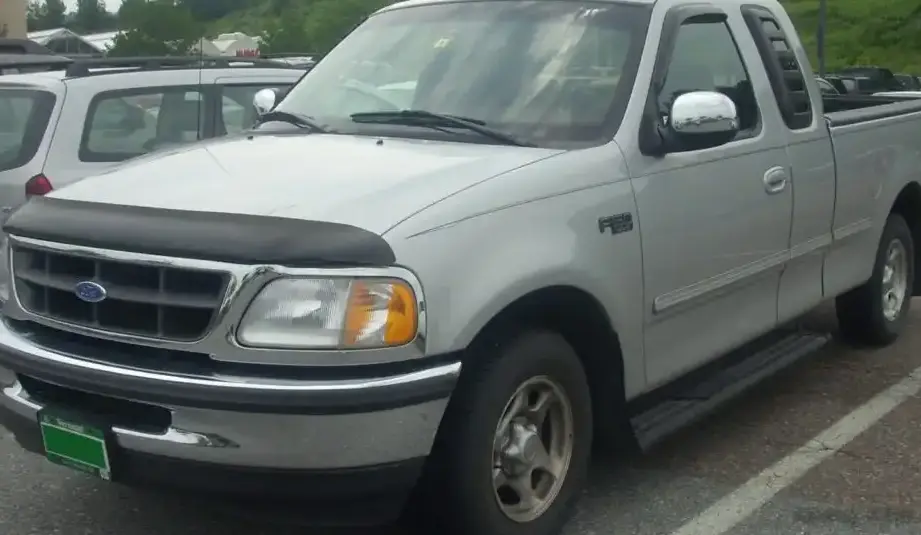
The Ford F-Series F-150 X SuperCab, equipped with the 5.4-liter V8 Triton engine producing 235 horsepower and paired with a four-speed automatic transmission and a 4×4 drivetrain, was a significant offering in the American full-size pickup truck market during its 1997-1998 production run. This variant represented a step up in power and capability from the base engine options, targeting buyers who needed a robust vehicle for both work and personal use. It fell within the tenth generation of the F-Series (1997-2003), a generation marked by a substantial redesign focused on improving interior space, ride quality, and overall refinement.
Technical Specifications
| Brand | Ford |
| Model | F-Series F-150 X SuperCab |
| Generation | F-Series F-150 X SuperCab |
| Type (Engine) | 5.4 V8 Triton (235 Hp) 4×4 Automatic |
| Start of production | 1997 |
| End of production | 1998 |
| Powertrain Architecture | Internal Combustion engine |
| Body type | Pick-up |
| Seats | 5-6 |
| Doors | 2 |
| Fuel Type | Petrol (Gasoline) |
| Power | 235 Hp @ 4250 rpm |
| Power per litre | 43.5 Hp/l |
| Torque | 447 Nm @ 3000 rpm / 329.69 lb.-ft. @ 3000 rpm |
| Engine layout | Front, Longitudinal |
| Engine displacement | 5408 cm3 / 330.02 cu. in. |
| Number of cylinders | 8 |
| Engine configuration | V-engine |
| Compression ratio | 9:1 |
| Number of valves per cylinder | 2 |
| Fuel injection system | Multi-port manifold injection |
| Engine aspiration | Naturally aspirated engine |
| Valvetrain | SOHC |
| Engine oil capacity | 5.7 l / 6.02 US qt | 5.02 UK qt |
| Coolant | 22.6 l / 23.88 US qt | 19.89 UK qt |
| Max. weight | 2722 kg / 6000.98 lbs |
| Trunk (boot) space – minimum | 1659 l / 58.59 cu. ft |
| Trunk (boot) space – maximum | 2056 l / 72.61 cu. ft |
| Fuel tank capacity | 95-114 l / 25.1 – 30.12 US gal | 20.9 – 25.08 UK gal |
| Permitted trailer load with brakes (12%) | 3493 kg / 7700.75 lbs |
| Length | 5646-6119 mm / 222.28 – 240.91 in |
| Wheelbase | 3531-3988 mm / 139.02 – 157.01 in |
| Ride height (ground clearance) | 185 mm / 7.28 in |
| Wading depth | 884-886 mm / 34.8 – 34.88 in |
| Drivetrain Architecture | The Internal combustion engine (ICE) drives the rear wheels permanently, and the front wheels are driven through an electrically or mechanically operated clutch if necessary. |
| Drive wheel | All wheel drive (4×4) |
| Number of gears and type of gearbox | 4 gears, automatic transmission |
| Front suspension | Torsion |
| Front brakes | Ventilated discs |
| Rear brakes | Ventilated discs |
| Power steering | Electric Steering |
| Tires size | 235/70 R16 |
| Wheel rims size | 7.0J x 16 |
Powertrain & Engine Architecture
The heart of this F-150 variant was the 5.4-liter Triton V8 engine. This engine, designated as the engine code 460, was a significant departure from previous Ford V8s, utilizing a modular engine design. The Triton featured a single overhead camshaft (SOHC) design with two valves per cylinder. Multi-port fuel injection delivered fuel to each cylinder, optimizing combustion and power delivery. The 9:1 compression ratio was a compromise between performance and the ability to run on readily available gasoline. The four-speed automatic transmission (4R70W) was chosen for its durability and suitability for truck applications. This transmission featured electronic control for smoother shifting and improved fuel efficiency. The 4×4 system employed an electronically controlled transfer case, allowing the driver to switch between 2WD, 4HI, and 4LO modes as needed.
Driving Characteristics
The 5.4-liter V8 and four-speed automatic combination provided a noticeable increase in performance compared to the base 4.6-liter engine. While not a performance-oriented truck, the 235 horsepower and 330 lb-ft of torque allowed for confident acceleration and towing capabilities. The automatic transmission, while smooth, wasn’t particularly quick to downshift, which could be noticeable when passing or climbing hills. The gear ratios were optimized for towing and hauling, rather than outright speed. Compared to the five-speed manual transmission available on other F-150 trims, the automatic offered greater convenience but slightly reduced fuel economy and a less engaging driving experience. The 4×4 system provided excellent traction in off-road conditions and inclement weather.
Equipment & Trim Levels
The F-150 X SuperCab with the 5.4-liter engine typically included features such as air conditioning, a basic AM/FM radio, cloth upholstery, and power windows and locks. The SuperCab configuration offered extended rear seating, providing more passenger space than the standard cab. Optional extras included a CD player, upgraded sound system, cruise control, power mirrors, and a sliding rear window. The “X” trim level generally represented a mid-range offering, positioned above the base XL trim but below the more luxurious Lariat trim.
Chassis & Braking
The F-150 X SuperCab utilized a body-on-frame construction, providing a robust and durable platform. The front suspension consisted of independent torsion bars, while the rear suspension employed leaf springs. This setup was designed to handle heavy loads and provide a comfortable ride. Braking duties were handled by ventilated disc brakes on all four wheels, offering adequate stopping power for the truck’s weight. Power-assisted steering made maneuvering the large vehicle easier. The tires, typically 235/70R16, were chosen for a balance of on-road comfort and off-road capability.
Market Reception & Comparison
The 5.4-liter F-150 was generally well-received by critics and buyers alike. It offered a compelling combination of power, capability, and value. Compared to the 4.6-liter V8, the 5.4-liter provided a significant boost in performance, making it a popular choice for those who frequently towed or hauled heavy loads. Fuel economy was comparable to other full-size trucks of the era, but slightly lower than the 4.6-liter engine. Reliability was generally good, although some owners reported issues with the spark plugs breaking during removal – a common problem with the early Triton engines. The 5.4L engine was often seen as a good middle ground between the base engine and the more expensive, and often more complex, diesel options.
Legacy
The 5.4-liter Triton V8 engine continued to be used in the Ford F-150 for many years, undergoing several revisions and improvements. The 1997-1998 versions, while not the most refined, represent an important step in the evolution of the Triton engine family. Today, these trucks are relatively affordable on the used car market, making them a popular choice for those seeking a capable and reliable work truck. However, potential buyers should be aware of the potential for spark plug issues and the need for regular maintenance. The 4R70W transmission, while durable, may require rebuilding after high mileage. Overall, the F-150 X SuperCab with the 5.4-liter V8 remains a testament to Ford’s long-standing commitment to building tough and capable trucks.