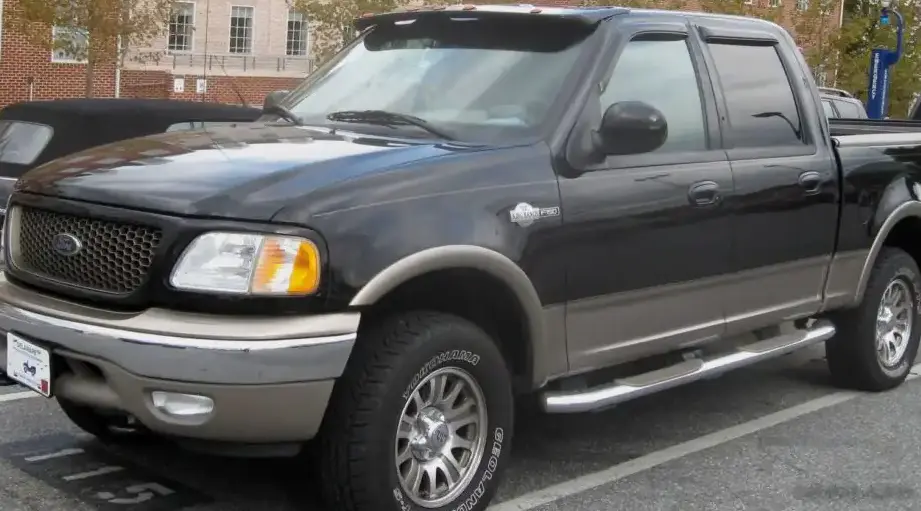
The Ford F-Series F-150 X SuperCrew, equipped with the 5.4-liter V8 Triton engine and a four-speed automatic transmission, was a significant offering in the American full-size pickup truck market from 1999 to 2004. This variant represented a blend of capability and comfort, aimed at buyers needing a versatile vehicle for both work and family use. It was part of the tenth generation of the F-Series (1997-2003), a generation that introduced the SuperCrew body style, offering a larger rear passenger area than traditional extended cab pickups. The 5.4L engine and automatic transmission combination positioned this trim as a mid-range option within the F-150 lineup, slotting above the base V6 models and below the higher-performance, larger displacement V8s.
Technical Specifications
| Brand | Ford |
| Model | F-Series F-150 |
| Generation | F-Series F-150 X SuperCrew |
| Type (Engine) | 5.4 V8 Triton (260 Hp) Automatic |
| Start of production | 1999 |
| End of production | 2004 |
| Powertrain Architecture | Internal Combustion engine |
| Body type | Pick-up |
| Seats | 5-6 |
| Doors | 4 |
| Fuel Type | Petrol (Gasoline) |
| Power | 260 Hp @ 4500 rpm |
| Power per litre | 48.1 Hp/l |
| Torque | 475 Nm @ 2500 rpm |
| Torque (lb-ft) | 350.34 lb.-ft. @ 2500 rpm |
| Engine layout | Front, Longitudinal |
| Engine displacement | 5408 cm3 |
| Engine displacement (cu. in.) | 330.02 cu. in. |
| Number of cylinders | 8 |
| Engine configuration | V-engine |
| Cylinder Bore | 90.17 mm |
| Cylinder Bore (in.) | 3.55 in. |
| Piston Stroke | 105.66 mm |
| Piston Stroke (in.) | 4.16 in. |
| Compression ratio | 9:1 |
| Number of valves per cylinder | 2 |
| Fuel injection system | Multi-port manifold injection |
| Engine aspiration | Naturally aspirated engine |
| Valvetrain | SOHC |
| Engine oil capacity | 5.7 l |
| Engine oil capacity (US qt) | 6.02 US qt |
| Engine oil capacity (UK qt) | 5.02 UK qt |
| Coolant | 22.6 l |
| Coolant (US qt) | 23.88 US qt |
| Coolant (UK qt) | 19.89 UK qt |
| Max. weight | 2994 kg |
| Max. weight (lbs) | 6600.64 lbs |
| Trunk (boot) space – minimum | 1252 l |
| Trunk (boot) space – minimum (cu. ft.) | 44.21 cu. ft. |
| Fuel tank capacity | 95 l |
| Fuel tank capacity (US gal) | 25.1 US gal |
| Fuel tank capacity (UK gal) | 20.9 UK gal |
| Permitted trailer load with brakes (12%) | 3583 kg |
| Permitted trailer load with brakes (12%) (lbs) | 7899.16 lbs |
| Length | 5738 mm |
| Length (in.) | 225.91 in. |
| Width | 2009 mm |
| Width (in.) | 79.09 in. |
| Height | 1877 mm |
| Height (in.) | 73.9 in. |
| Wheelbase | 3518 mm |
| Wheelbase (in.) | 138.5 in. |
| Front overhang | 983 mm |
| Front overhang (in.) | 38.7 in. |
| Rear overhang | 1237 mm |
| Rear overhang (in.) | 48.7 in. |
| Ride height (ground clearance) | 203 mm |
| Ride height (ground clearance) (in.) | 7.99 in. |
| Approach angle | 21.6° |
| Departure angle | 17° |
| Ramp-over (brakeover) angle | 14.7° |
| Wading depth | 813 mm |
| Wading depth (in.) | 32.01 in. |
| Drivetrain Architecture | Rear wheel drive |
| Drive wheel | Rear wheel drive |
| Number of gears and type of gearbox | 4 gears, automatic transmission |
| Front suspension | Independent coil spring, Transverse stabilizer |
| Rear suspension | Leaf spring |
| Front brakes | Ventilated discs, 308 mm |
| Rear brakes | Ventilated discs, 335 mm |
| Assisting systems | ABS (Anti-lock braking system) |
| Steering type | Cone worm with recirculation balls |
| Power steering | Electric Steering |
| Tires size | 255/70 R16 |
| Wheel rims size | 16 |
Powertrain & Engine Architecture
The heart of this F-150 variant was the 5.4-liter Triton V8 engine. This engine, part of Ford’s modular engine family, featured a single overhead camshaft (SOHC) design with two valves per cylinder. The engine code varied slightly depending on the specific year, but generally fell within the range of the 4V or 2V configurations. The 260 horsepower output was achieved through a multi-port fuel injection system, delivering fuel directly into the intake ports. The 9:1 compression ratio was a compromise between performance and the ability to run on readily available gasoline. The four-speed automatic transmission (typically the 4R70W) was chosen for its durability and suitability for towing and hauling. This transmission featured electronic control for smoother shifting and optimized performance. The longitudinal engine layout, common in rear-wheel-drive trucks, allowed for a more efficient drivetrain configuration.
Driving Characteristics
The 5.4L V8 with the four-speed automatic provided adequate, though not exhilarating, performance. Acceleration was reasonable for a full-size pickup, but it wasn’t as quick as the F-150s equipped with the larger 5.8L or 6.8L V8 engines. The automatic transmission’s gear ratios were tuned for towing and hauling, prioritizing low-end torque over outright speed. Compared to the five-speed manual transmission option, the automatic offered greater convenience, especially in stop-and-go traffic, but at the expense of some fuel efficiency and driver engagement. The power delivery was relatively smooth, making it a comfortable daily driver, but it lacked the responsiveness of the higher-output engines.
Equipment & Trim Levels
The F-150 X SuperCrew 5.4L Automatic typically came standard with features like air conditioning, power windows and locks, and an AM/FM radio. The SuperCrew configuration offered a significantly larger rear seat than the standard or extended cab models, making it a practical choice for families. Upholstery was typically cloth, though leather was available as an option. Popular optional extras included a CD player, upgraded sound system, power-adjustable seats, and a towing package. The “X” trim level generally represented a step up from the base model, offering a better balance of features and price.
Chassis & Braking
The F-150’s chassis was a traditional body-on-frame construction, providing robust durability and towing capacity. The front suspension utilized independent coil springs and a transverse stabilizer bar to improve ride quality and handling. The rear suspension employed leaf springs, a cost-effective and durable solution for supporting heavy loads. Braking duties were handled by ventilated discs on all four wheels, with ABS (Anti-lock Braking System) as standard equipment. The rear discs were slightly larger than the front, providing increased stopping power. The steering system was a recirculating ball type, offering a solid feel but lacking the precision of more modern steering technologies.
Market Reception & Comparison
The F-150 SuperCrew was well-received by the market, particularly by buyers who needed a pickup truck with ample passenger space. Critics praised the SuperCrew’s practicality and comfort, but some noted that the 5.4L V8 with the automatic transmission wasn’t the most fuel-efficient option. Compared to the 4.6L V8, the 5.4L offered more power, but at a slight cost in fuel economy. The 5.4L also proved to be generally reliable, though some owners reported issues with spark plug breakage, a common problem with the early Triton engines.
Legacy
The 5.4L Triton V8, despite some early issues, became a mainstay of the Ford F-Series lineup for many years. The 1999-2004 F-150 SuperCrew 5.4L Automatic remains a popular choice in the used truck market today, offering a good balance of capability, comfort, and affordability. While not the fastest or most fuel-efficient F-150 variant, it represents a solid and dependable option for those seeking a versatile full-size pickup truck. Regular maintenance, including timely spark plug replacement and oil changes, is crucial for ensuring the long-term reliability of this powertrain.