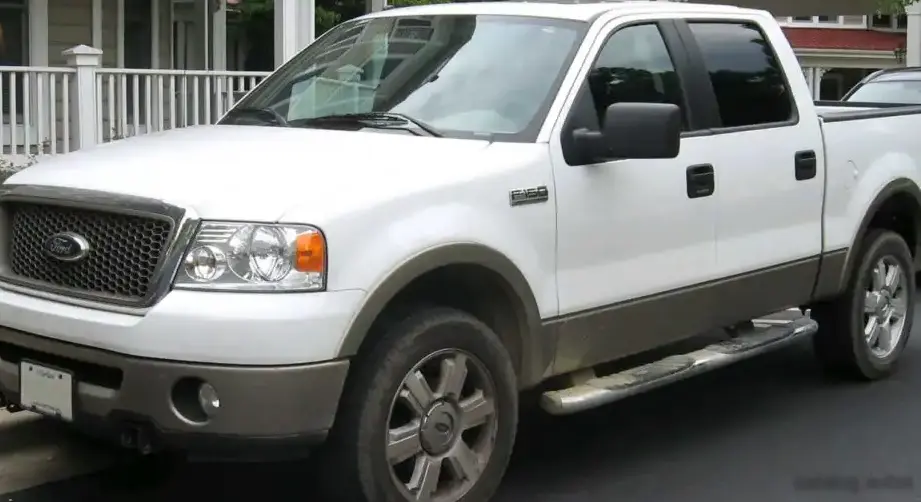
The Ford F-150 XI SuperCrew, produced from 2004 to 2006, represented a significant iteration of Ford’s best-selling F-Series pickup truck. This generation, designated the F-150 (though often referred to as the F-150 XI in some markets), saw a substantial increase in size and refinement compared to its predecessor. The SuperCrew configuration, specifically, offered an expanded rear passenger cabin, making it a popular choice for families and those needing both work truck capability and passenger comfort. Among the engine options available, the 4.6-liter V8 Triton engine paired with a four-speed automatic transmission occupied a middle ground in the lineup, balancing affordability with respectable performance.
Technical Specifications
| Brand | Ford |
| Model | F-Series F-150 |
| Generation | F-Series F-150 XI SuperCrew |
| Type (Engine) | 4.6 V8 Triton (231 Hp) Automatic |
| Start of production | 2004 |
| End of production | 2006 |
| Powertrain Architecture | Internal Combustion engine |
| Body type | Pick-up |
| Seats | 5-6 |
| Doors | 4 |
| Fuel consumption (urban) | 15.7 l/100 km (15 US mpg, 18 UK mpg) |
| Fuel consumption (extra urban) | 12.4 l/100 km (19 US mpg, 22.8 UK mpg) |
| Fuel Type | Petrol (Gasoline) |
| Weight-to-power ratio | 10.2 kg/Hp |
| Weight-to-torque ratio | 5.9 kg/Nm |
| Power | 231 Hp @ 4750 rpm |
| Power per litre | 50.2 Hp/l |
| Torque | 397 Nm @ 3500 rpm (292.81 lb.-ft. @ 3500 rpm) |
| Engine layout | Front, Longitudinal |
| Engine displacement | 4605 cm3 (281.01 cu. in.) |
| Number of cylinders | 8 |
| Engine configuration | V-engine |
| Cylinder Bore | 90.17 mm (3.55 in.) |
| Piston Stroke | 89.92 mm (3.54 in.) |
| Compression ratio | 9.3:1 |
| Number of valves per cylinder | 2 |
| Fuel injection system | Multi-port manifold injection |
| Engine aspiration | Naturally aspirated engine |
| Valvetrain | SOHC |
| Engine oil capacity | 5.7 l (6.02 US qt | 5.02 UK qt) |
| Coolant capacity | 19.4 l (20.5 US qt | 17.07 UK qt) |
| Kerb Weight | 2348 kg (5176.45 lbs.) |
| Max. weight | 3084 kg (6799.06 lbs.) |
| Max load | 736 kg (1622.6 lbs.) |
| Fuel tank capacity | 114 l (30.12 US gal | 25.08 UK gal) |
| Permitted trailer load with brakes (12%) | 3084 kg (6799.06 lbs.) |
| Length | 5690 mm (224.02 in.) |
| Width | 2004 mm (78.9 in.) |
| Height | 1867 mm (73.5 in.) |
| Wheelbase | 3518 mm (138.5 in.) |
| Front track | 1702 mm (67.01 in.) |
| Rear track | 1702 mm (67.01 in.) |
| Minimum turning circle | 13.7 m (44.95 ft.) |
| Drivetrain | Rear wheel drive |
| Number of gears | 4 |
| Gearbox type | Automatic transmission |
| Front suspension | Double wishbone |
| Rear suspension | Leaf spring |
| Front brakes | Ventilated discs, 330 mm |
| Rear brakes | Ventilated discs, 348 mm |
| Assisting systems | ABS (Anti-lock braking system) |
| Steering type | Steering rack and pinion |
| Power steering | Electric |
| Tires size | 235/70 R17; 265/60 R18 |
| Wheel rims size | 17; 18 |
Powertrain & Engine Architecture
The heart of this F-150 variant was the 4.6-liter Triton V8 engine. This engine, part of Ford’s modular engine family, featured a single overhead camshaft (SOHC) design with two valves per cylinder. The engine utilized a multi-port fuel injection system, delivering fuel directly to each intake port for improved efficiency and power delivery. The 4.6L Triton was known for its relatively smooth operation and decent low-end torque, making it suitable for everyday driving and light-duty hauling. The engine’s architecture was a 90-degree V-configuration, contributing to its balance and reduced vibrations. Paired with this engine was a four-speed automatic transmission, a common choice for trucks of this era. While not as sophisticated as modern transmissions with more gears, it provided adequate performance for most applications. The transmission was electronically controlled, optimizing shift points based on throttle position and vehicle speed.
Driving Characteristics
The 4.6-liter V8 with the four-speed automatic delivered a comfortable, if not particularly exhilarating, driving experience. Acceleration was adequate for merging onto highways and passing other vehicles, but it wasn’t as quick as the larger 5.4-liter Triton V8 or the performance-oriented models. The automatic transmission’s gear ratios were tuned for everyday usability, prioritizing smooth shifts and fuel economy over outright performance. Compared to the manual transmission options, the automatic offered greater convenience, especially in stop-and-go traffic. However, it did result in a slight reduction in fuel efficiency and a less engaging driving experience. The weight of the SuperCrew cab, combined with the engine’s output, meant that the truck felt substantial, but the suspension did a reasonable job of absorbing bumps and providing a comfortable ride.
Equipment & Trim Levels
The F-150 XI SuperCrew with the 4.6-liter engine typically came standard with features like air conditioning, power windows and locks, and an AM/FM stereo. Higher trim levels, such as the XLT and Lariat, added features like alloy wheels, upgraded interior upholstery (cloth or leather), a premium sound system, and power-adjustable seats. The SuperCrew configuration itself was a significant feature, offering a spacious rear seat capable of comfortably accommodating adults. Optional extras included a towing package, a sunroof, and a navigation system. The interior design was functional and durable, with a focus on practicality rather than luxury.
Chassis & Braking
The F-150 XI SuperCrew utilized a body-on-frame construction, a traditional design for pickup trucks. The front suspension featured an independent double wishbone setup, while the rear suspension employed leaf springs. This combination provided a good balance of ride comfort and load-carrying capacity. Braking duties were handled by ventilated disc brakes on all four wheels, providing adequate stopping power for the truck’s weight. An Anti-lock Braking System (ABS) was standard, enhancing safety by preventing wheel lockup during hard braking. The steering system was a rack-and-pinion setup with power assist, offering responsive and precise steering control.
Market Reception & Comparison
The 4.6-liter V8-equipped F-150 SuperCrew was generally well-received by critics and consumers. It offered a compelling combination of capability, comfort, and affordability. Compared to the larger 5.4-liter V8, it was more fuel-efficient, although it sacrificed some performance. The 4.6L engine was also considered more reliable than the 5.4L, which was prone to spark plug issues. Against diesel-powered F-150s, the 4.6L offered lower initial cost but lacked the diesel’s superior towing capacity and fuel economy. The SuperCrew configuration was praised for its spacious interior and family-friendly design.
Legacy
The 4.6-liter Triton V8, while not without its quirks, proved to be a relatively durable and reliable engine. Common maintenance items included regular oil changes and spark plug replacements. The four-speed automatic transmission also proved to be generally reliable, although some units experienced issues with torque converter failure. Today, these F-150s can be found in the used car market at affordable prices. They remain popular choices for those seeking a capable and comfortable pickup truck for everyday use. While not as technologically advanced as modern trucks, the F-150 XI SuperCrew with the 4.6-liter V8 represents a solid and dependable workhorse from a bygone era.