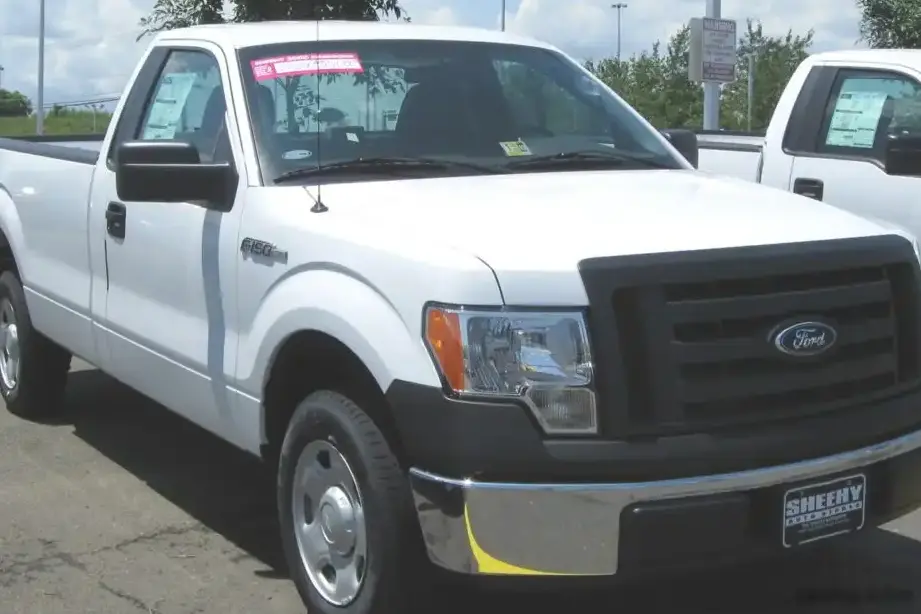
The Ford F-Series F-150 XII Regular Cab, equipped with the 4.6-liter V8 engine and a four-speed automatic transmission, represents a significant iteration in Ford’s long-running and immensely popular F-Series line of pickup trucks. Produced from 2008 through 2010, this configuration occupied a middle ground within the F-150 lineup, offering a balance between capability, affordability, and everyday usability. It was part of the twelfth generation (2009-2014) of the F-Series, internally designated as the F-150 XII, and built on a fully boxed frame designed to improve strength and durability. This particular model catered to buyers needing a robust work truck or a capable hauler without the expense of higher trim levels or more powerful engine options.
Technical Specifications
| Brand | Ford |
| Model | F-Series F-100/F-150 |
| Generation | F-Series F-150 XII Regular Cab |
| Type (Engine) | 4.6 V8 (248 Hp) 4×4 Automatic |
| Start of production | October, 2008 |
| End of production | 2010 |
| Powertrain Architecture | Internal Combustion engine |
| Body type | Pick-up |
| Seats | 3 |
| Doors | 2 |
| Fuel consumption (urban) | 16.8 l/100 km (14 US mpg, 16.8 UK mpg) |
| Fuel consumption (extra urban) | 13.1 l/100 km (18 US mpg, 21.6 UK mpg) |
| Fuel Type | Petrol (Gasoline) |
| Power | 248 Hp @ 4750 rpm |
| Power per litre | 53.8 Hp/l |
| Torque | 399 Nm @ 4000 rpm (294.29 lb.-ft. @ 4000 rpm) |
| Engine layout | Front, Longitudinal |
| Engine displacement | 4606 cm3 (281.08 cu. in.) |
| Number of cylinders | 8 |
| Engine configuration | V-engine |
| Cylinder Bore | 90.17 mm (3.55 in.) |
| Piston Stroke | 89.92 mm (3.54 in.) |
| Compression ratio | 9.4:1 |
| Number of valves per cylinder | 2 |
| Fuel injection system | Multi-port manifold injection |
| Engine aspiration | Naturally aspirated engine |
| Valvetrain | SOHC |
| Engine oil capacity | 5.7 l (6.02 US qt | 5.02 UK qt) |
| Coolant | 15.5 l (16.38 US qt | 13.64 UK qt) |
| Max. weight | 3152 kg (6948.97 lbs.) |
| Trunk (boot) space – minimum | 1685 l (59.51 cu. ft.) |
| Trunk (boot) space – maximum | 2299 l (81.19 cu. ft.) |
| Fuel tank capacity | 98 l (25.89 US gal | 21.56 UK gal) |
| Permitted trailer load with brakes (12%) | 2631 kg (5800.36 lbs.) |
| Length | 5413-5885 mm (213.11 – 231.69 in.) |
| Width | 2004 mm (78.9 in.) |
| Width with mirrors folded | 2123 mm (83.58 in.) |
| Width including mirrors | 2464 mm (97.01 in.) |
| Height | 1925-1930 mm (75.79 – 75.98 in.) |
| Wheelbase | 3200-3670 mm (125.98 – 144.49 in.) |
| Ride height (ground clearance) | 224 mm (8.82 in.) |
| Minimum turning circle | 12.7-14.3 m (41.67 – 46.92 ft.) |
| Approach angle | 23.4-24.3° |
| Departure angle | 21-21.6° |
| Ramp-over angle | 18.3-19.9° |
| Drivetrain Architecture | ICE drives rear wheels, front wheels engaged via clutch |
| Drive wheel | All wheel drive (4×4) |
| Number of gears | 4 |
| Gearbox type | Automatic transmission |
| Front suspension | Double wishbone |
| Rear suspension | Leaf spring |
| Front brakes | Ventilated discs, 330 mm |
| Rear brakes | Ventilated discs, 348 mm |
| Assisting systems | ABS (Anti-lock braking system) |
| Steering type | Steering rack and pinion |
| Power steering | Electric |
| Tires size | 255/70 R17; 275/65 R18 |
| Wheel rims size | 17; 18 |
Powertrain & Engine Architecture
The heart of this F-150 variant is the 4.6-liter Modular V8 engine, specifically the version designated as the 2V. This engine, part of Ford’s long-running Modular engine family, features a single overhead camshaft (SOHC) design with two valves per cylinder. The 4.6L engine utilized a multi-port fuel injection system, delivering fuel directly into the intake ports. The engine’s architecture prioritized durability and low-end torque, making it well-suited for truck applications. The four-speed 4R75E automatic transmission was the standard pairing. This transmission, known for its robustness, featured electronic control for smoother shifting and improved fuel efficiency compared to earlier designs. While not offering the most advanced gear ratios, it provided adequate performance for typical F-150 duties.
Driving Characteristics
The 4.6-liter V8 with the four-speed automatic delivered a comfortable, if not exhilarating, driving experience. Acceleration was adequate for everyday driving and moderate towing, but noticeably slower than the available 5.4-liter V8 or the diesel options. The automatic transmission’s gear ratios were geared towards maximizing fuel economy and providing sufficient torque for hauling. The 4×4 system provided enhanced traction in inclement weather or off-road conditions, making it a versatile choice for a wide range of users. Compared to the manual transmission versions, the automatic offered greater convenience, particularly in stop-and-go traffic, but at the expense of some driver control and fuel efficiency.
Equipment & Trim Levels
The 4.6-liter V8/automatic combination was typically found in the XL and XLT trim levels. The XL was the base model, offering essential features like air conditioning, a basic audio system, and vinyl upholstery. The XLT added features such as cloth upholstery, power windows and locks, and upgraded interior trim. Optional extras included a towing package, upgraded audio systems, and various convenience features. The Regular Cab configuration meant a bench seat for three passengers, prioritizing functionality over luxury.
Chassis & Braking
The F-150 XII utilized a robust body-on-frame construction. The front suspension featured an independent double wishbone setup, while the rear suspension employed a traditional leaf spring design. This configuration provided a good balance between ride comfort and load-carrying capacity. Braking duties were handled by ventilated disc brakes on all four wheels, with ABS as standard equipment. The braking system was adequately sized for the truck’s weight and intended use, providing reliable stopping power in most conditions.
Market Reception & Comparison
The 4.6-liter F-150 was generally well-received as a practical and affordable work truck. Critics noted its adequate power and capability, but also pointed out that it lacked the refinement and performance of the higher-trim models. Fuel economy was average for a full-size pickup truck of its era. Compared to the 5.4-liter V8, the 4.6-liter offered lower initial cost and slightly better fuel economy, but significantly less power. The diesel options provided superior towing capacity and fuel efficiency, but at a higher price point.
Legacy
The 4.6-liter Modular V8 proved to be a durable and reliable engine, and many examples are still on the road today. While not known for exceptional fuel economy, it offered a good balance of power and dependability. The 4R75E automatic transmission also demonstrated good longevity. In the used car market, these F-150s are often sought after as affordable and capable work trucks. Maintenance is relatively straightforward, and parts availability remains good. However, potential buyers should be aware of common issues such as spark plug issues and potential for timing chain wear as these engines age.