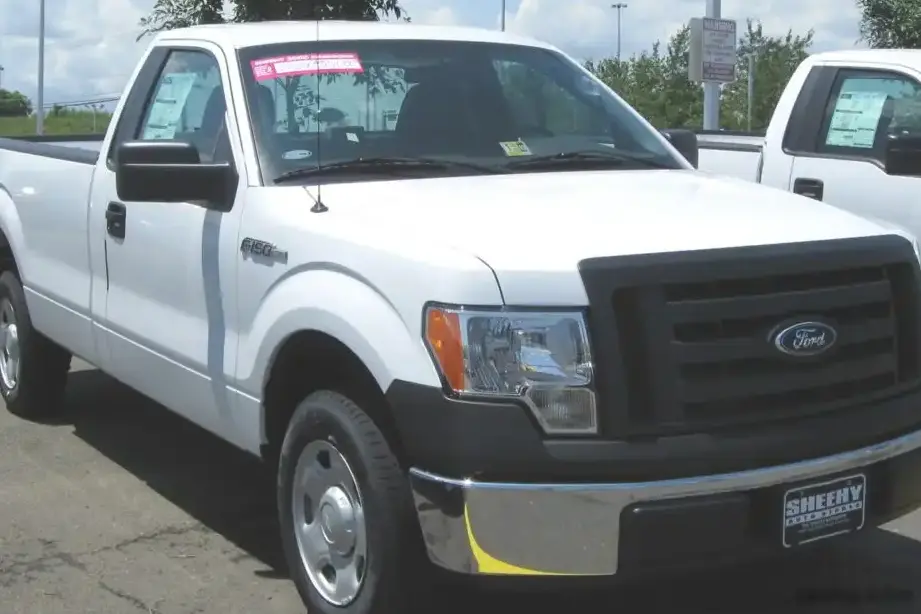
The Ford F-Series F-150 XII Regular Cab, equipped with the 4.6-liter V8 engine and automatic transmission, represents a significant iteration in Ford’s long-running and immensely popular F-Series line of pickup trucks. Produced from 2008 through 2010, this configuration occupied a middle ground within the F-150 lineup, offering a balance between capability, affordability, and ease of use. It was part of the twelfth generation (2009-2014) of the F-Series, internally designated as the F-150 XII, and built on a fully boxed frame designed to improve strength and durability. This particular variant catered to buyers who needed the utility of a full-size pickup but didn’t require the higher performance or premium features of the larger engine options or higher trim levels.
Technical Specifications
| Brand | Ford |
| Model | F-Series F-100/F-150 |
| Generation | F-Series F-150 XII Regular Cab |
| Type (Engine) | 4.6 V8 (248 Hp) Automatic |
| Start of production | October, 2008 |
| End of production | 2010 |
| Powertrain Architecture | Internal Combustion engine |
| Body type | Pick-up |
| Seats | 3 |
| Doors | 2 |
| Fuel consumption (urban) | 16.8 l/100 km (14 US mpg, 16.8 UK mpg) |
| Fuel consumption (extra urban) | 12.4 l/100 km (19 US mpg, 22.8 UK mpg) |
| Fuel Type | Petrol (Gasoline) |
| Power | 248 Hp @ 4750 rpm |
| Power per litre | 53.8 Hp/l |
| Torque | 399 Nm @ 4000 rpm (294.29 lb.-ft. @ 4000 rpm) |
| Engine layout | Front, Longitudinal |
| Engine displacement | 4606 cm3 (281.08 cu. in.) |
| Number of cylinders | 8 |
| Engine configuration | V-engine |
| Cylinder Bore | 90.17 mm (3.55 in.) |
| Piston Stroke | 89.92 mm (3.54 in.) |
| Compression ratio | 9.4:1 |
| Number of valves per cylinder | 2 |
| Fuel injection system | Multi-port manifold injection |
| Engine aspiration | Naturally aspirated engine |
| Valvetrain | SOHC |
| Engine oil capacity | 5.7 l (6.02 US qt | 5.02 UK qt) |
| Coolant | 15.5 l (16.38 US qt | 13.64 UK qt) |
| Max. weight | 3062 kg (6750.55 lbs.) |
| Trunk (boot) space – minimum | 1685 l (59.51 cu. ft.) |
| Trunk (boot) space – maximum | 2299 l (81.19 cu. ft.) |
| Fuel tank capacity | 98 l (25.89 US gal | 21.56 UK gal) |
| Permitted trailer load with brakes (12%) | 2722 kg (6000.98 lbs.) |
| Length | 5413-5885 mm (213.11 – 231.69 in.) |
| Width | 2004 mm (78.9 in.) |
| Width with mirrors folded | 2123 mm (83.58 in.) |
| Width including mirrors | 2464 mm (97.01 in.) |
| Height | 1895-1935 mm (74.61 – 76.18 in.) |
| Wheelbase | 3200-3670 mm (125.98 – 144.49 in.) |
| Ride height (ground clearance) | 218-251 mm (8.58 – 9.88 in.) |
| Minimum turning circle (turning diameter) | 12.7-14.3 m (41.67 – 46.92 ft.) |
| Approach angle | 22.2-24.2° |
| Departure angle | 18.8-21.9° |
| Ramp-over (brakeover) angle | 17.7-19.3° |
| Drivetrain Architecture | The Internal combustion engine (ICE) drives the rear wheels of the vehicle. |
| Drive wheel | Rear wheel drive |
| Number of gears and type of gearbox | 4 gears, automatic transmission |
| Front suspension | Double wishbone |
| Rear suspension | Leaf spring |
| Front brakes | Ventilated discs, 330 mm |
| Rear brakes | Ventilated discs, 348 mm |
| Assisting systems | ABS (Anti-lock braking system) |
| Steering type | Steering rack and pinion |
| Power steering | Electric Steering |
| Tires size | 255/65 R17; 265/60 R18 |
| Wheel rims size | 17; 18 |
Powertrain & Engine Architecture
The heart of this F-150 variant is the 4.6-liter Modular V8 engine, specifically the version designated as the 2V. This engine, part of Ford’s long-running Modular engine family, features a single overhead camshaft (SOHC) design with two valves per cylinder. The 4.6L engine utilized a multi-port fuel injection system, delivering fuel directly into the intake ports. This configuration, while not as technologically advanced as some contemporary engines, proved to be reliable and relatively easy to maintain. The engine’s 9.4:1 compression ratio was a compromise between performance and the ability to run on readily available gasoline. Paired with this engine was a four-speed automatic transmission, a common choice for trucks prioritizing ease of use and towing capability. This transmission, while not offering the fuel efficiency of more modern gearboxes, provided smooth shifts and adequate power delivery for most everyday tasks.
Driving Characteristics
The 4.6-liter V8 with the four-speed automatic delivered adequate, though not exhilarating, performance. Acceleration was sufficient for typical driving scenarios, but it lacked the punch of the 5.4-liter V8 or the turbocharged EcoBoost engines that would arrive in later F-150 generations. The automatic transmission’s gear ratios were tuned for towing and hauling, resulting in a relatively conservative feel. Compared to the manual transmission options, the automatic traded some responsiveness for convenience. The 4.6L engine’s torque curve was relatively flat, providing usable power across a wide RPM range, which was beneficial for towing and hauling loads. However, it required the transmission to downshift more frequently when encountering hills or needing to accelerate quickly.
Equipment & Trim Levels
The F-150 XL, XLT, and Lariat trim levels were available with the 4.6L engine and automatic transmission. The base XL trim was typically spartan, offering essential features like air conditioning, a basic audio system, and vinyl upholstery. The mid-range XLT added features such as power windows and locks, keyless entry, and upgraded interior trim. The Lariat trim offered premium features like leather upholstery, heated seats, and a more sophisticated audio system. Optional extras included a towing package, upgraded wheels, and a navigation system. The Regular Cab configuration featured a bench seat, accommodating up to three passengers, and a simple, functional interior layout.
Chassis & Braking
The F-150 XII utilized a robust body-on-frame construction, providing a solid foundation for hauling and towing. The front suspension featured an independent double wishbone design, while the rear suspension employed a traditional leaf spring setup. This combination offered a good balance between ride comfort and load-carrying capacity. Braking duties were handled by ventilated disc brakes on all four wheels, with ABS (Anti-lock Braking System) standard. The braking system was adequately sized for the truck’s weight and intended use. Steering was rack-and-pinion with power assist, providing responsive and predictable handling.
Market Reception & Comparison
The 4.6-liter F-150 was generally well-received by consumers seeking a capable and affordable full-size pickup. Critics noted its adequate power and comfortable ride, but also pointed out its relatively low fuel economy compared to smaller trucks. Compared to the 5.4-liter V8, the 4.6L offered lower performance but better fuel efficiency and a lower purchase price. The 4.6L was also a more economical choice than the later EcoBoost engines, which offered significantly more power and efficiency but came at a higher cost. Reliability was generally good, with the 4.6L engine proving to be a durable and long-lasting powerplant.
Legacy
The 4.6-liter V8-powered F-150 remains a common sight on used car lots today. Its relatively simple design and proven reliability make it a popular choice for buyers seeking an affordable and dependable truck. While not the most powerful or fuel-efficient option, it offers a good balance of capability and value. The engine is known for its longevity, and with proper maintenance, can easily exceed 200,000 miles. Parts availability is excellent, and repair costs are generally reasonable. The F-150 XII with the 4.6L engine represents a solid and dependable workhorse, continuing to serve owners many years after its production ended.