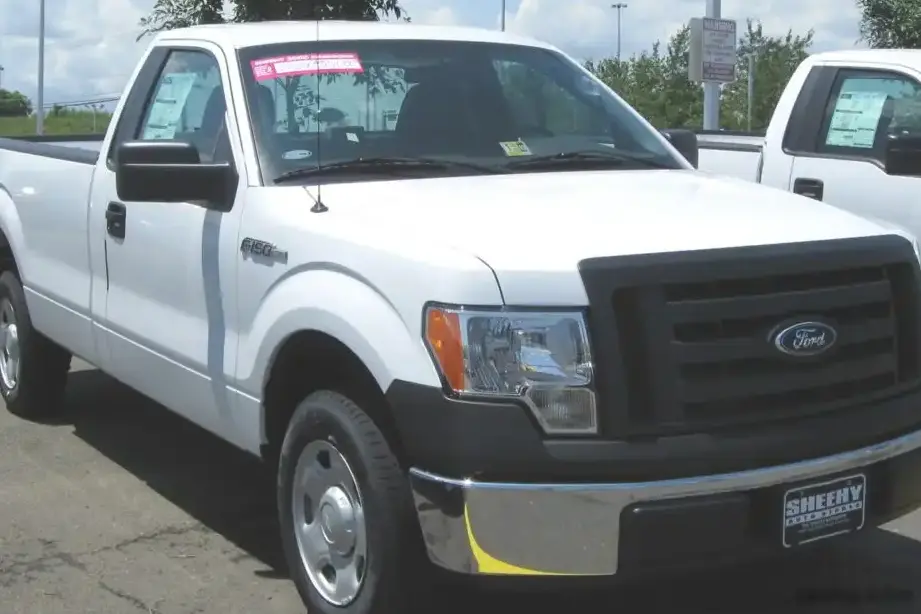
The Ford F-Series F-150, specifically the twelfth generation produced between 2011 and 2014, represented a significant evolution in the full-size pickup truck segment. Within this generation, the Regular Cab configuration powered by the 5.0-liter V8 engine paired with a six-speed automatic transmission occupied a compelling position, offering a balance of capability, performance, and value. This variant aimed to provide buyers with a robust work truck option without sacrificing the refinement and power expected from a modern F-150. It served as a step up from the base V6 models, appealing to those needing more towing capacity and horsepower.
Technical Specifications
| Brand | Ford |
| Model | F-Series F-100/F-150 |
| Generation | F-Series F-150 XII Regular Cab |
| Type (Engine) | 5.0 V8 (360 Hp) Automatic |
| Start of production | 2011 year |
| End of production | 2014 year |
| Powertrain Architecture | Internal Combustion engine |
| Body type | Pick-up |
| Seats | 3 |
| Doors | 2 |
| Fuel consumption (economy) – urban | 15.7 l/100 km (15 US mpg, 18 UK mpg, 6.4 km/l) |
| Fuel consumption (economy) – extra urban | 11.2 l/100 km (21 US mpg, 25.2 UK mpg, 8.9 km/l) |
| Fuel consumption (economy) – combined | 13.8 l/100 km (17 US mpg, 20.5 UK mpg, 7.2 km/l) |
| Fuel Type | Petrol (Gasoline) |
| Weight-to-power ratio | 6 kg/Hp, 165.7 Hp/tonne |
| Weight-to-torque ratio | 4.2 kg/Nm, 237 Nm/tonne |
| Power | 360 Hp @ 5500 rpm |
| Power per litre | 72.7 Hp/l |
| Torque | 515 Nm @ 4250 rpm (379.84 lb.-ft. @ 4250 rpm) |
| Engine layout | Front, Longitudinal |
| Engine displacement | 4949 cm3 (302.01 cu. in.) |
| Number of cylinders | 8 |
| Engine configuration | V-engine |
| Cylinder Bore | 92.2 mm (3.63 in.) |
| Piston Stroke | 92.71 mm (3.65 in.) |
| Compression ratio | 10.5:1 |
| Number of valves per cylinder | 4 |
| Fuel injection system | Multi-port manifold injection |
| Engine aspiration | Naturally aspirated engine |
| Valvetrain | DOHC, Ti-VCT |
| Engine oil capacity | 7.3 l (7.71 US qt | 6.42 UK qt) |
| Coolant | 16.1 l (17.01 US qt | 14.17 UK qt) |
| Kerb Weight | 2173-2306 kg (4790.64 – 5083.86 lbs.) |
| Max. weight | 3719 kg (8198.99 lbs.) |
| Max load | 1413-1546 kg (3115.13 – 3408.35 lbs.) |
| Fuel tank capacity | 98 l (25.89 US gal | 21.56 UK gal) |
| Permitted trailer load with brakes (12%) | 4536 kg (10000.17 lbs.) |
| Length | 5415-5890 mm (213.19 – 231.89 in.) |
| Width | 2012 mm (79.21 in.) |
| Width including mirrors | 2464 mm (97.01 in.) |
| Height | 1900-1905 mm (74.8 – 75 in.) |
| Wheelbase | 3198-3670 mm (125.91 – 144.49 in.) |
| Front track | 1702 mm (67.01 in.) |
| Rear (Back) track | 1702 mm (67.01 in.) |
| Minimum turning circle (turning diameter) | 12.7-14.3 m (41.67 – 46.92 ft.) |
| Drivetrain Architecture | The Internal combustion engine (ICE) drives the rear wheels of the vehicle. |
| Drive wheel | Rear wheel drive |
| Number of gears and type of gearbox | 6 gears, automatic transmission |
| Front suspension | Double wishbone |
| Rear suspension | Leaf spring |
| Front brakes | Ventilated discs, 351×34 mm |
| Rear brakes | Ventilated discs, 348×25 mm |
| Assisting systems | ABS (Anti-lock braking system) |
| Steering type | Steering rack and pinion |
| Power steering | Electric Steering |
| Tires size | 255/70 R17; 265/60 R18; 275/55 R20 |
| Wheel rims size | 7.5J x 17; 7.5J x 18; 8.5J x 20 |
Powertrain & Engine Architecture
At the heart of this F-150 variant lies the 5.0-liter “Coyote” V8 engine. This engine, internally designated as the 3V, is a naturally aspirated powerplant featuring a 90-degree V-configuration. It utilizes a double overhead camshaft (DOHC) valvetrain with variable valve timing (Ti-VCT) on both intake and exhaust valves, contributing to its broad torque curve and respectable horsepower output. The engine employs multi-port fuel injection, delivering fuel directly into the intake ports. The 6R80E six-speed automatic transmission was the standard pairing. This transmission is known for its durability and smooth shifting characteristics, offering a balance between fuel efficiency and performance. The transmission’s gear ratios were tuned to maximize the engine’s torque for towing and hauling, while still providing adequate acceleration for everyday driving.
Driving Characteristics
The 5.0L V8 and 6R80E combination delivered a noticeably more spirited driving experience compared to the base V6 models. While not as quick as the higher-output EcoBoost variants, the 360 horsepower and 380 lb-ft of torque provided ample power for merging onto highways, passing other vehicles, and tackling moderate towing duties. The automatic transmission shifted smoothly and predictably, although it wasn’t as responsive as some of the more modern transmissions available in later F-150 generations. The Regular Cab configuration, combined with the rear-wheel-drive layout, resulted in a relatively nimble feel for a full-size pickup, especially when compared to the heavier 4×4 models. However, the leaf spring rear suspension, while capable of handling significant loads, could result in a somewhat firm ride when unladen.
Equipment & Trim Levels
The 5.0L V8 engine was typically offered on mid-range trim levels like the XLT and Lariat. Standard equipment on these trims included air conditioning, power windows and locks, a basic audio system, and vinyl upholstery. The Lariat trim added features such as alloy wheels, chrome exterior trim, and upgraded interior materials. Optional extras included a trailer towing package, a navigation system, leather upholstery, and a premium sound system. The Regular Cab configuration generally prioritized functionality over luxury, offering a no-frills interior focused on durability and ease of cleaning.
Chassis & Braking
The twelfth-generation F-150 utilized a fully boxed frame construction, providing a solid foundation for the truck’s robust capabilities. The front suspension featured an independent double wishbone design, while the rear suspension employed a traditional leaf spring setup. Braking duties were handled by ventilated disc brakes on all four wheels, with ABS (Anti-lock Braking System) standard. The rear brakes were slightly smaller in diameter than the front brakes. Steering was rack-and-pinion with electric power assist, providing a comfortable and responsive steering feel.
Market Reception & Comparison
The 5.0L V8 F-150 was generally well-received by critics and consumers alike. It offered a compelling alternative to the V6 models for those needing more power and towing capacity, without the higher price tag of the EcoBoost variants. Fuel economy was a common criticism, with the 5.0L V8 returning lower MPG figures than the EcoBoost engines. However, the V8’s simpler design and proven reliability were often cited as advantages. Compared to the 3.7L V6, the 5.0L offered a significant boost in both horsepower and torque. Compared to the 3.5L EcoBoost, it lacked the EcoBoost’s impressive low-end torque and fuel efficiency, but it was often considered more reliable in the long run.
Legacy
The 5.0L Coyote V8 engine has proven to be a remarkably durable and reliable powerplant. The 6R80E transmission, while not without its occasional issues, is also generally considered a robust unit. Today, well-maintained examples of the 2011-2014 F-150 with the 5.0L V8 and automatic transmission command reasonable prices on the used car market. They remain a popular choice for those seeking a capable and affordable full-size pickup truck. The engine’s continued use in subsequent Mustang generations is a testament to its enduring design and performance.