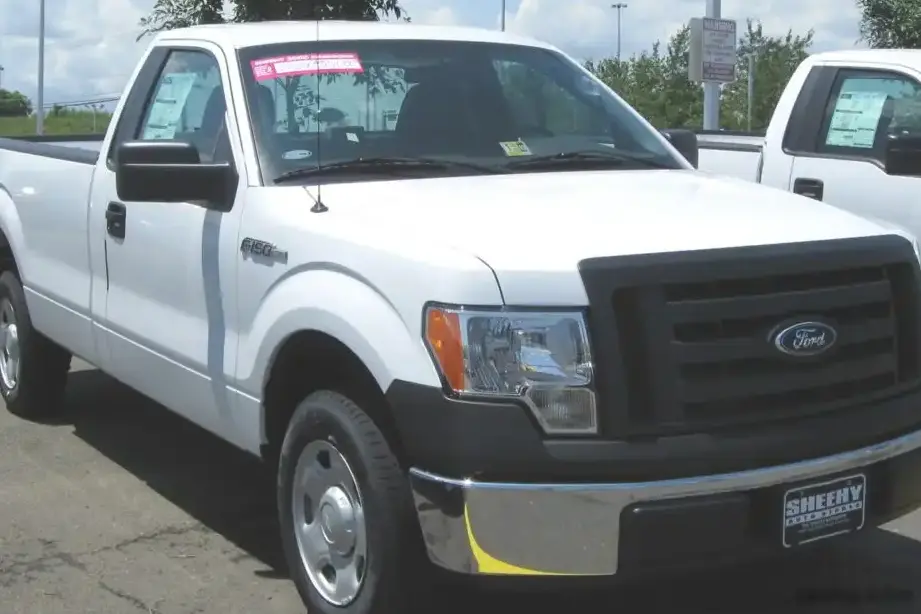
The Ford F-Series F-150 XII Regular Cab, equipped with the 5.4-liter V8 engine and automatic transmission, represents a significant iteration in Ford’s long-running and immensely popular F-Series line of pickup trucks. Produced from 2008 through 2010, this configuration occupied a middle ground within the F-150 lineup, offering a balance between capability, comfort, and affordability. It was part of the twelfth generation (2009-2014) of the F-Series, internally designated as the F-150 XII, and built on a fully boxed frame for improved strength and durability. This particular variant catered to buyers needing substantial towing and hauling capacity without the premium price tag of higher trim levels or the fuel economy concerns associated with the smaller engine options.
Technical Specifications
| Brand | Ford |
| Model | F-Series F-100/F-150 |
| Generation | F-Series F-150 XII Regular Cab |
| Type (Engine) | 5.4 V8 (320 Hp) Automatic |
| Start of production | October, 2008 |
| End of production | 2010 |
| Powertrain Architecture | Internal Combustion engine |
| Body type | Pick-up |
| Seats | 3 |
| Doors | 2 |
| Fuel consumption (urban) | 23.5 l/100 km (10 US mpg, 12 UK mpg, 4.3 km/l) |
| Fuel consumption (extra urban) | 16.8 l/100 km (14 US mpg, 16.8 UK mpg, 6 km/l) |
| Fuel Type | Petrol (Gasoline) |
| Power | 320 Hp @ 5200 rpm |
| Power per litre | 59.2 Hp/l |
| Torque | 529 Nm @ 3500 rpm (390.17 lb.-ft. @ 3500 rpm) |
| Engine layout | Front, Longitudinal |
| Engine displacement | 5408 cm3 (330.02 cu. in.) |
| Number of cylinders | 8 |
| Engine configuration | V-engine |
| Cylinder Bore | 90.17 mm (3.55 in.) |
| Piston Stroke | 105.66 mm (4.16 in.) |
| Compression ratio | 9.8:1 |
| Number of valves per cylinder | 3 |
| Fuel injection system | Multi-port manifold injection |
| Engine aspiration | Naturally aspirated engine |
| Valvetrain | SOHC, VCT |
| Engine oil capacity | 6.6 l (6.97 US qt | 5.81 UK qt) |
| Coolant | 19.6 l (20.71 US qt | 17.25 UK qt) |
| Max. weight | 3719 kg (8198.99 lbs.) |
| Trunk (boot) space – maximum | 2299 l (81.19 cu. ft.) |
| Fuel tank capacity | 98 l (25.89 US gal | 21.56 UK gal) |
| Permitted trailer load with brakes (12%) | 5126 kg (11300.9 lbs.) |
| Length | 5885 mm (231.69 in.) |
| Width | 2004 mm (78.9 in.) |
| Width with mirrors folded | 2123 mm (83.58 in.) |
| Width including mirrors | 2464 mm (97.01 in.) |
| Height | 1935 mm (76.18 in.) |
| Wheelbase | 3670 mm (144.49 in.) |
| Ride height (ground clearance) | 251 mm (9.88 in.) |
| Minimum turning circle (turning diameter) | 14.3 m (46.92 ft.) |
| Approach angle | 24.2° |
| Departure angle | 21.9° |
| Ramp-over (brakeover) angle | 19.3° |
| Drivetrain Architecture | The Internal combustion engine (ICE) drives the rear wheels of the vehicle. |
| Drive wheel | Rear wheel drive |
| Number of gears and type of gearbox | 6 gears, automatic transmission |
| Front suspension | Double wishbone |
| Rear suspension | Leaf spring |
| Front brakes | Ventilated discs, 330 mm |
| Rear brakes | Ventilated discs, 348 mm |
| Assisting systems | ABS (Anti-lock braking system) |
| Steering type | Steering rack and pinion |
| Power steering | Electric Steering |
| Tires size | 255/65 R17; 265/60 R18; 275/55 R20 |
| Wheel rims size | 17; 18; 20 |
Powertrain & Engine Architecture
The heart of this F-150 variant is the 5.4-liter Triton V8 engine. This engine, part of Ford’s Triton family, is a three-valve-per-cylinder design featuring a single overhead camshaft (SOHC) and variable valve timing (VCT). The engine utilizes multi-port fuel injection to deliver fuel to the cylinders. The 5.4L engine was known for its robust construction and relatively smooth power delivery. The automatic transmission paired with this engine is a six-speed unit, offering improved fuel efficiency and smoother shifts compared to earlier four-speed automatics. This transmission was designed to handle the engine’s substantial torque output and provide adequate gear ratios for both towing and everyday driving. The engine’s longitudinal mounting and rear-wheel-drive configuration are standard for full-size American pickup trucks.
Driving Characteristics
The 5.4-liter V8, producing 320 horsepower and 390 lb-ft of torque, provided ample power for most tasks. While not as quick as the higher-output engines available in the F-150 lineup (like the 6.2L), it offered a noticeable step up in performance compared to the base V6. The six-speed automatic transmission helped to keep the engine in its optimal power band, providing reasonable acceleration. However, the sheer weight of the F-150, especially in its regular cab configuration, meant that it wasn’t a particularly nimble vehicle. The automatic transmission, while convenient, did result in some power loss compared to the available manual transmission. Towing and hauling were where this configuration truly shined, offering a comfortable and capable experience for those needing to move substantial loads.
Equipment & Trim Levels
The F-150 XII Regular Cab with the 5.4L V8 and automatic transmission typically fell into the mid-range of available trim levels, often designated as the XLT or FX4. Standard features generally included air conditioning, power windows and locks, a basic audio system, and vinyl upholstery. The FX4 trim added off-road-oriented features like skid plates and a locking rear differential. Optional extras included upgraded audio systems, leather upholstery, power seats, a navigation system, and various towing packages. The interior design was functional and durable, prioritizing practicality over luxury. The regular cab configuration offered seating for three passengers, making it suitable for individual workers or small crews.
Chassis & Braking
The F-150 XII utilized a robust fully boxed frame construction, providing a solid foundation for the vehicle. The front suspension featured an independent double wishbone design, while the rear suspension employed a traditional leaf spring setup. This combination offered a good balance between ride comfort and load-carrying capacity. Braking duties were handled by ventilated disc brakes on all four wheels, with ABS (Anti-lock Braking System) as standard equipment. The braking system was adequately sized for the vehicle’s weight and provided reliable stopping power. Steering was rack-and-pinion with electric power assist, offering a reasonable level of responsiveness.
Market Reception & Comparison
The 5.4-liter V8 and automatic transmission combination was a popular choice for F-150 buyers who prioritized capability and convenience. Critics generally praised the engine’s power and torque, but noted that fuel economy was not a strong point. Compared to the smaller V6 engine, the 5.4L offered significantly more power, making it a better choice for towing and hauling. However, it also consumed more fuel. Compared to the higher-output 6.2L V8, the 5.4L offered a more affordable price point, but lacked the same level of performance. Reliability was generally good, although some owners reported issues with spark plug breakage, a common problem with the Triton V8 engine family.
Legacy
The 5.4-liter Triton V8 engine, while eventually superseded by newer engine designs, remains a relatively common sight on the road today. Its robust construction and readily available parts contribute to its longevity. While not known for exceptional fuel economy, the engine is generally considered reliable when properly maintained. In the used car market, F-150s equipped with this powertrain offer a good value proposition for buyers seeking a capable and affordable pickup truck. The 2008-2010 F-150 XII Regular Cab 5.4L V8 Automatic continues to be a workhorse for many owners, demonstrating the enduring appeal of Ford’s F-Series trucks.