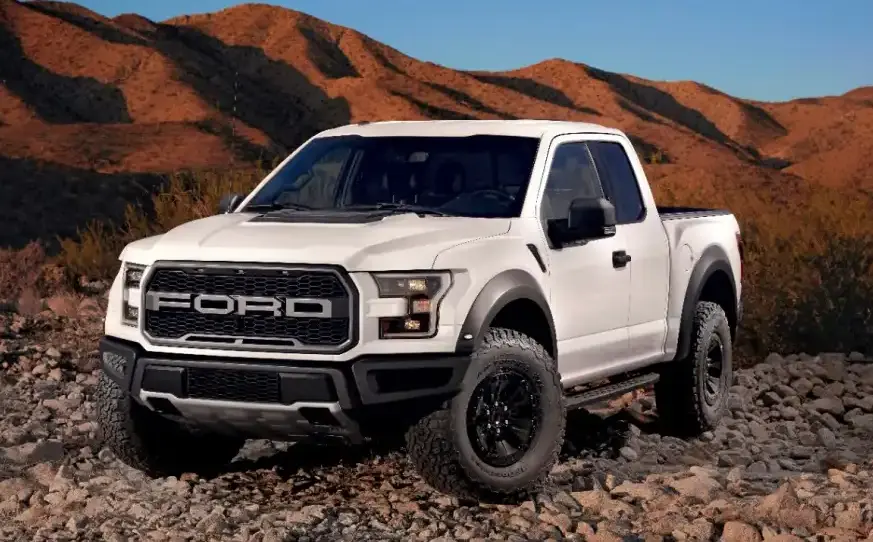
The Ford F-150, consistently a best-selling vehicle in the United States, entered its thirteenth generation with the 2015 model year. This generation marked a significant shift in construction, utilizing a high-strength, military-grade aluminum alloy body on a fully-boxed steel frame – a first for a full-size pickup truck. The 2015-2017 F-150 SuperCab configuration with the 5.0-liter V8 engine and four-wheel drive represented a strong mid-range offering, balancing capability with a more accessible price point than the higher-trim level options. This particular variant aimed to provide a robust work truck experience with enhanced comfort and technology features compared to base models.
Technical Specifications
| Brand | Ford |
| Model | F-Series F-150 |
| Generation | F-Series F-150 XIII SuperCab |
| Type (Engine) | 5.0 V8 (385 Hp) 4×4 Automatic |
| Start of production | 2015 |
| End of production | 2017 |
| Powertrain Architecture | Internal Combustion engine |
| Body type | Pick-up |
| Seats | 5-6 |
| Doors | 2 |
| Fuel consumption (economy) – urban (NEDC) | 15.7 l/100 km (15 US mpg, 18 UK mpg, 6.4 km/l) |
| Fuel consumption (economy) – extra urban (NEDC) | 11.2 l/100 km (21 US mpg, 25.2 UK mpg, 8.9 km/l) |
| Fuel consumption (economy) – combined (NEDC) | 13.8 l/100 km (17 US mpg, 20.5 UK mpg, 7.2 km/l) |
| Fuel Type | Petrol (Gasoline) |
| Weight-to-power ratio | 5.7 kg/Hp, 176.8 Hp/tonne |
| Weight-to-torque ratio | 4.1 kg/Nm, 241 Nm/tonne |
| Power | 385 Hp @ 5750 rpm |
| Power per litre | 77.8 Hp/l |
| Torque | 525 Nm @ 3850 rpm (387.22 lb.-ft. @ 3850 rpm) |
| Engine layout | Front, Longitudinal |
| Engine displacement | 4949 cm3 (302.01 cu. in.) |
| Number of cylinders | 8 |
| Engine configuration | V-engine |
| Cylinder Bore | 92.2 mm (3.63 in.) |
| Piston Stroke | 92.7 mm (3.65 in.) |
| Compression ratio | 10.5:1 |
| Number of valves per cylinder | 2 |
| Fuel injection system | Multi-port manifold injection |
| Engine aspiration | Naturally aspirated engine |
| Engine oil capacity | 7.3 l (7.71 US qt | 6.42 UK qt) |
| Coolant | 15 l (15.85 US qt | 13.2 UK qt) |
| Kerb Weight | 2178-2237 kg (4801.67 – 4931.74 lbs.) |
| Trunk (boot) space – minimum | 1495 l (52.8 cu. ft.) |
| Trunk (boot) space – maximum | 2200 l (77.69 cu. ft.) |
| Fuel tank capacity | 87 l (22.98 US gal | 19.14 UK gal) |
| Length | 5890-6363 mm (231.89 – 250.51 in.) |
| Width | 2029 mm (79.88 in.) |
| Width with mirrors folded | 2121 mm (83.5 in.) |
| Width including mirrors | 2459 mm (96.81 in.) |
| Height | 1956-1961 mm (77.01 – 77.2 in.) |
| Wheelbase | 3683-4158 mm (145 – 163.7 in.) |
| Front track | 1717 mm (67.6 in.) |
| Rear (Back) track | 1717 mm (67.6 in.) |
| Front overhang | 960 mm (37.8 in.) |
| Rear overhang | 1247 mm (49.09 in.) |
| Ride height (ground clearance) | 236-239 mm (9.29 – 9.41 in.) |
| Approach angle | 25.8-26.1° |
| Departure angle | 26.0-26.1° |
| Ramp-over (brakeover) angle | 19.0-21.1° |
| Drive wheel | All wheel drive (4×4) |
| Number of gears and type of gearbox | 6 gears, automatic transmission |
| Front suspension | Double wishbone |
| Rear suspension | Leaf spring |
| Front brakes | Ventilated discs |
| Rear brakes | Ventilated discs |
| Assisting systems | ABS (Anti-lock braking system) |
| Steering type | Steering rack and pinion |
| Power steering | Electric Steering |
| Tires size | 265/70 R17 |
| Wheel rims size | 17 |
Powertrain & Engine Architecture
The heart of this F-150 variant is the 5.0-liter “Coyote” V8 engine. This engine, part of Ford’s Modular engine family, is a naturally aspirated powerplant known for its robust construction and relatively simple design. It features a 92.2mm bore and 92.7mm stroke, resulting in a displacement of 4949cc (302.01 cubic inches). The engine utilizes a cast iron block with aluminum cylinder heads, incorporating dual overhead camshafts (DOHC) with four valves per cylinder. Fuel delivery is managed by a multi-port fuel injection system. The Coyote V8 is known for its responsive throttle and characteristic V8 rumble. Paired with this engine is a six-speed automatic transmission (6R80), chosen for its durability and ability to handle the engine’s torque output. This transmission features a wide gear ratio spread, optimizing both towing capacity and fuel efficiency.
Driving Characteristics
The 5.0L V8 and 6-speed automatic combination in the F-150 SuperCab delivers a noticeable step up in performance compared to the base 3.5L EcoBoost or V6 options. With 385 horsepower and 387 lb-ft of torque, the truck offers ample power for daily driving, towing, and hauling. The automatic transmission provides smooth shifts, although it isn’t as quick or sporty as some newer transmissions. The gear ratios are tuned for practicality, prioritizing low-end torque for work applications. While not a performance-oriented setup, the 5.0L provides confident acceleration and the ability to maintain highway speeds with ease, even when loaded. Compared to the EcoBoost engines, the V8 offers a more traditional driving experience with a linear power delivery, while the EcoBoosts deliver more torque at lower RPMs.
Equipment & Trim Levels
The 2015-2017 F-150 SuperCab 5.0L 4×4 typically fell into the mid-range of the F-150 lineup. Standard equipment generally included air conditioning, power windows and locks, a basic infotainment system with a display screen, and a rearview camera. The SuperCab configuration offered a second row of seating, though legroom was somewhat limited. Popular optional extras included the SYNC 3 infotainment system with Apple CarPlay and Android Auto compatibility, a navigation system, leather upholstery, heated and ventilated front seats, a power moonroof, and a trailer tow package. Trim levels like XLT and Lariat were commonly paired with this powertrain, offering progressively more luxury and convenience features.
Chassis & Braking
The F-150’s chassis features a fully-boxed steel frame designed for strength and rigidity. The front suspension utilizes an independent double-wishbone setup, while the rear suspension employs a traditional leaf spring configuration. This combination provides a comfortable ride quality while maintaining a substantial payload capacity. Braking duties are handled by ventilated discs at all four corners, coupled with an Anti-lock Braking System (ABS). The 4×4 system provides enhanced traction in various off-road conditions. The SuperCab configuration, being slightly shorter than the SuperCrew, offered a bit more maneuverability in tight spaces.
Market Reception & Comparison
The 5.0L V8-equipped F-150 was generally well-received by critics and consumers. It was praised for its strong performance, smooth ride, and overall refinement. Fuel economy, however, was a common criticism, with the combined fuel consumption of 17 mpg being lower than the EcoBoost alternatives. Compared to the 3.5L EcoBoost, the V8 offered a more traditional engine sound and feel, appealing to buyers who preferred a naturally aspirated engine. Reliability was generally good, although some owners reported minor issues with the fuel injection system. The V8 was often seen as a good compromise between power, capability, and cost.
Legacy
The 5.0L Coyote V8 in the 2015-2017 F-150 has proven to be a durable and reliable powertrain. These trucks continue to be popular on the used car market, offering a compelling combination of capability, comfort, and value. The engine’s relatively simple design and robust construction contribute to its longevity. While newer F-150 models have introduced more advanced technologies, the 2015-2017 generation remains a solid choice for buyers seeking a capable and dependable full-size pickup truck. The aluminum body, while initially met with some skepticism, has proven to be durable and has contributed to the truck’s overall weight reduction, improving fuel efficiency and performance.