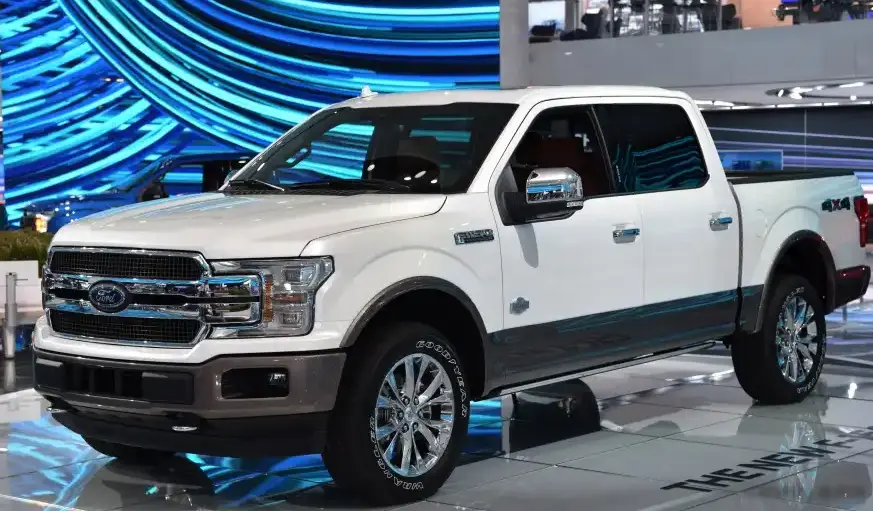
The Ford F-150 is a full-size pickup truck manufactured by Ford Motor Company, and has been the best-selling vehicle in the United States for over four decades. The thirteenth generation, introduced in 2015, received a significant facelift in 2018, bringing updated styling, technology, and powertrain options. This article focuses on the 2018-2020 facelifted F-150 SuperCrew configuration equipped with the 2.7-liter EcoBoost V6 engine producing 325 horsepower, paired with a ten-speed automatic transmission and a four-wheel-drive system. This variant occupied a middle ground in the F-150 lineup, offering a balance of capability, fuel efficiency, and price, appealing to a broad range of truck buyers.
Technical Specifications
| Brand | Ford |
| Model | F-Series F-150 |
| Generation | F-Series F-150 XIII SuperCrew (facelift 2018) |
| Type (Engine) | 2.7 V6 (325 Hp) 4×4 Automatic |
| Start of production | 2018 |
| End of production | October, 2020 |
| Powertrain Architecture | Internal Combustion engine |
| Body type | Pick-up |
| Seats | 5-6 |
| Doors | 4 |
| Fuel consumption (urban) | 12.4 l/100 km (19 US mpg) |
| Fuel consumption (extra urban) | 9.8 l/100 km (24 US mpg) |
| Fuel consumption (combined) | 11.2 l/100 km (21 US mpg) |
| Fuel Type | Petrol (Gasoline) |
| Power | 325 Hp @ 5000 rpm |
| Torque | 542 Nm @ 2750 rpm (399.76 lb.-ft. @ 2750 rpm) |
| Engine layout | Front, Longitudinal |
| Engine displacement | 2689 cm3 (164.09 cu. in.) |
| Number of cylinders | 6 |
| Engine configuration | V-engine |
| Number of valves per cylinder | 4 |
| Fuel injection system | Direct injection |
| Engine aspiration | Twin-Turbo, Intercooler |
| Engine oil capacity | 5.7 l (6.02 US qt | 5.02 UK qt) |
| Coolant capacity | 14.3 l (15.11 US qt | 12.58 UK qt) |
| Trunk (boot) space (minimum) | 2192 l (77.41 cu. ft.) |
| Fuel tank capacity | 87 l (22.98 US gal | 19.14 UK gal) |
| Length | 5890-6190 mm (231.89 – 243.7 in.) |
| Width | 2029 mm (79.88 in.) |
| Width with mirrors folded | 2121 mm (83.5 in.) |
| Width including mirrors | 2459 mm (96.81 in.) |
| Height | 1961-1963 mm (77.2 – 77.28 in.) |
| Wheelbase | 3683-3983 mm (145 – 156.81 in.) |
| Ride height (ground clearance) | 236-239 mm (9.29 – 9.41 in.) |
| Drive wheel | All wheel drive (4×4) |
| Number of gears and type of gearbox | 10 gears, automatic transmission |
| Front suspension | Independent coil spring |
| Rear suspension | Leaf spring |
| Front brakes | Ventilated discs |
| Rear brakes | Ventilated discs |
| Assisting systems | ABS (Anti-lock braking system) |
| Steering type | Steering rack and pinion |
| Power steering | Electric Steering |
| Tires size | 265/70 R17; 275/65 R18 |
| Wheel rims size | 17; 18 |
INTRODUCTION
The 2018-2020 Ford F-150 SuperCrew 2.7L EcoBoost 4×4 represented a sweet spot in Ford’s popular truck lineup. Following the introduction of the aluminum-bodied thirteenth generation in 2015, the 2018 facelift brought a revised grille, headlamps, and updated interior materials. The 2.7-liter EcoBoost V6, part of Ford’s EcoBoost family of turbocharged engines, was positioned as a more fuel-efficient alternative to the larger 3.5L and 5.0L engines, while still providing ample power and towing capacity for many users. The SuperCrew configuration offered a spacious cabin with seating for up to six passengers, making it a practical choice for families and work crews alike. This particular configuration was built on the P2 platform (also known as the 1HX0 platform), shared with other Ford and Lincoln vehicles.
Powertrain & Engine Architecture
The heart of this F-150 variant is the 2.7-liter EcoBoost V6, designated with engine code 3.5EB. This engine utilizes a compact graphite iron cylinder block with aluminum cylinder heads. It features direct fuel injection and twin turbochargers, providing a broad torque curve and responsive acceleration. The twin-turbo setup minimizes turbo lag, delivering power quickly when needed. The engine produces 325 horsepower at 5000 rpm and 400 lb-ft of torque at 3000 rpm. The 2.7L EcoBoost engine is known for its relatively smooth operation and refined sound compared to some other turbocharged engines. Paired with this engine is Ford’s 10-speed automatic transmission (10R80). This transmission offers a wide gear ratio spread, optimizing both fuel economy and performance. The transmission’s sophisticated control logic allows for smooth and precise shifts, enhancing the driving experience. The 4×4 system employs an electronic shift-on-the-fly transfer case, allowing the driver to easily switch between two-wheel drive and four-wheel drive modes.
Driving Characteristics
The 2.7L EcoBoost-equipped F-150 SuperCrew delivers a surprisingly capable and comfortable driving experience. While not as overtly powerful as the larger engine options, the 2.7L provides ample torque for everyday driving and towing. The ten-speed automatic transmission keeps the engine in its optimal power band, resulting in brisk acceleration. The gear ratios are well-matched, providing strong off-the-line performance and confident passing power. Compared to the 3.5L EcoBoost or 5.0L V8, the 2.7L feels less urgent in its acceleration, but the difference is often negligible for typical use cases. The ride quality is generally comfortable, thanks to the independent front suspension and well-tuned leaf spring rear suspension. The steering is precise and responsive, providing good feedback to the driver. The 4×4 system provides excellent traction in various conditions, making it suitable for both on-road and off-road driving.
Equipment & Trim Levels
The 2.7L EcoBoost 4×4 SuperCrew was available in a variety of trim levels, including XL, XLT, Lariat, and King Ranch. The base XL trim offered essential features such as air conditioning, a basic infotainment system, and steel wheels. The popular XLT trim added features like alloy wheels, a more advanced infotainment system with Apple CarPlay and Android Auto compatibility, and power windows and locks. The Lariat trim further enhanced the interior with leather upholstery, heated and ventilated front seats, and a premium sound system. The top-of-the-line King Ranch trim offered even more luxurious features, including unique exterior styling, premium leather upholstery with distinctive stitching, and advanced safety technologies. Standard safety features across most trims included ABS, stability control, and multiple airbags. Optional extras included a trailer tow package, a 360-degree camera system, and adaptive cruise control.
Chassis & Braking
The F-150’s chassis utilizes a high-strength steel frame with an aluminum alloy body, contributing to its impressive strength and reduced weight. The front suspension features independent coil springs, providing a comfortable ride and good handling. The rear suspension utilizes leaf springs, which are well-suited for carrying heavy loads. Braking duties are handled by ventilated discs on all four wheels, providing ample stopping power. The ABS system prevents wheel lockup during hard braking, enhancing stability and control. The 2.7L EcoBoost models typically came equipped with 17 or 18-inch wheels, depending on the trim level. Tire sizes varied, with common options including 265/70R17 and 275/65R18.
Market Reception & Comparison
The 2.7L EcoBoost F-150 received generally positive reviews from automotive critics. It was praised for its blend of power, fuel efficiency, and refinement. Compared to the larger engine options, the 2.7L offered comparable performance for most everyday driving scenarios, while delivering better fuel economy. The 2.7L typically achieved around 19-21 mpg in combined driving, making it a more economical choice for those who didn’t require the maximum towing capacity of the larger engines. Compared to the 3.5L EcoBoost, the 2.7L was often seen as a more sensible option for buyers who didn’t need the extra power. Compared to the 5.0L V8, the 2.7L offered similar fuel economy but less overall power. Reliability has been generally good, although some owners have reported issues with the turbochargers and fuel injectors.
Legacy
The 2.7L EcoBoost engine has proven to be a reliable and durable powertrain in the F-150. The 2018-2020 facelifted models, in particular, are well-regarded for their improved styling and technology. On the used car market, these F-150s hold their value relatively well, reflecting their popularity and reputation for quality. The 2.7L EcoBoost continues to be offered in the current generation F-150, demonstrating its ongoing relevance and appeal to truck buyers. The combination of a turbocharged engine, a ten-speed automatic transmission, and a spacious SuperCrew cabin makes this variant a compelling choice for those seeking a versatile and capable full-size pickup truck.