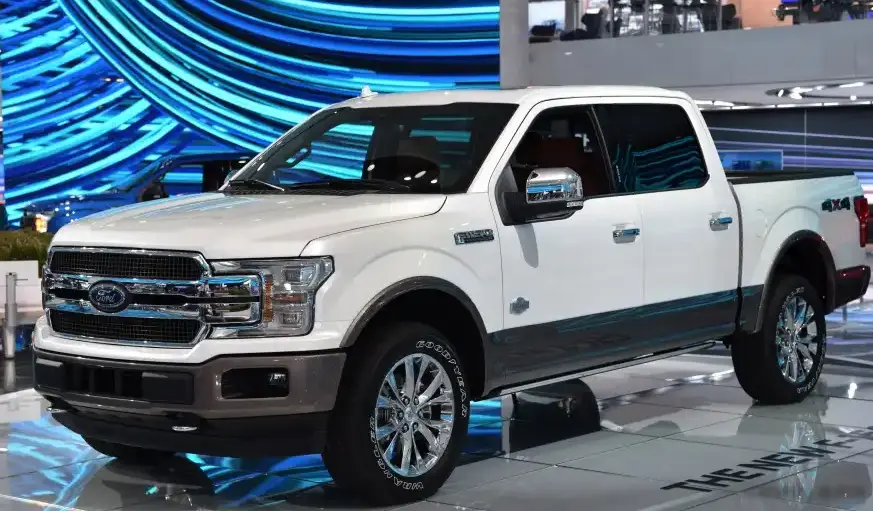
The Ford F-150, consistently the best-selling full-size pickup truck in the United States, entered its thirteenth generation (often referred to as the F-150 XIII) with the 2015 model year. A significant facelift was introduced for the 2018 model year, bringing updated styling, technology, and powertrain options. This article focuses on the 2018-2020 F-150 SuperCrew configuration equipped with the 3.3-liter V6 engine producing 290 horsepower, paired with a six-speed automatic transmission and a four-wheel-drive system. This combination represented a key entry point into the F-150 lineup, balancing affordability with capability for a broad range of buyers.
Technical Specifications
| Brand | Ford |
| Model | F-Series F-150 |
| Generation | F-Series F-150 XIII SuperCrew (facelift 2018) |
| Type (Engine) | 3.3 V6 (290 Hp) 4×4 Automatic |
| Start of production | 2018 |
| End of production | October, 2020 |
| Powertrain Architecture | Internal Combustion engine |
| Body type | Pick-up |
| Seats | 5-6 |
| Doors | 4 |
| Fuel consumption (urban) | 13.1 l/100 km (18 US mpg, 21.6 UK mpg, 7.6 km/l) |
| Fuel consumption (extra urban) | 10.2 l/100 km (23.1 US mpg, 27.7 UK mpg, 9.8 km/l) |
| Fuel consumption (combined) | 11.8 l/100 km (19.9 US mpg, 23.9 UK mpg, 8.5 km/l) |
| Fuel Type | Petrol (Gasoline) |
| Power | 290 Hp @ 6500 rpm |
| Power per litre | 87.9 Hp/l |
| Torque | 359 Nm @ 4000 rpm (264.78 lb.-ft. @ 4000 rpm) |
| Engine layout | Front, Longitudinal |
| Engine displacement | 3300 cm3 (201.38 cu. in.) |
| Number of cylinders | 6 |
| Engine configuration | V-engine |
| Number of valves per cylinder | 4 |
| Fuel injection system | Direct injection |
| Engine oil capacity | 5.7 l (6.02 US qt | 5.02 UK qt) |
| Coolant capacity | 12.86 l (13.59 US qt | 11.32 UK qt) |
| Trunk (boot) space (minimum) | 2192 l (77.41 cu. ft.) |
| Fuel tank capacity | 87 l (22.98 US gal | 19.14 UK gal) |
| Length | 5890-6190 mm (231.89 – 243.7 in.) |
| Width | 2029 mm (79.88 in.) |
| Width with mirrors folded | 2121 mm (83.5 in.) |
| Width including mirrors | 2459 mm (96.81 in.) |
| Height | 1961-1963 mm (77.2 – 77.28 in.) |
| Wheelbase | 3683-3983 mm (145 – 156.81 in.) |
| Ride height (ground clearance) | 236-239 mm (9.29 – 9.41 in.) |
| Drive wheel | All wheel drive (4×4) |
| Number of gears and type of gearbox | 6 gears, automatic transmission |
| Front suspension | Independent coil spring |
| Rear suspension | Leaf spring |
| Front brakes | Ventilated discs |
| Rear brakes | Ventilated discs |
| Assisting systems | ABS (Anti-lock braking system) |
| Steering type | Steering rack and pinion |
| Power steering | Electric Steering |
| Tires size | 265/70 R17 |
| Wheel rims size | 17 |
Introduction
The 2018 facelift of the F-150 represented a mid-cycle refresh for the thirteenth generation. Built on the robust fully-boxed steel frame, the SuperCrew body style offered a spacious cabin with four full-size doors and seating for up to six passengers. The 3.3-liter V6 engine and six-speed automatic transmission combination was positioned as the base engine option for buyers prioritizing value and everyday usability over outright performance. It served as a more affordable alternative to the turbocharged EcoBoost engines and the powerful 5.0-liter V8.
Powertrain & Engine Architecture
The 3.3-liter Ti-VCT V6 engine (engine code: often referred to as the Cyclone engine family) is a naturally aspirated powerplant featuring direct fuel injection. This engine utilizes a dual overhead camshaft (DOHC) design with four valves per cylinder, contributing to its relatively efficient operation. The six-speed automatic transmission (6R80) was a workhorse unit used across various Ford vehicles. It’s known for its durability and smooth shifting characteristics, though it lacks the advanced gear counts found in newer transmissions. The 4×4 system employed an electronic shift-on-the-fly transfer case, allowing the driver to seamlessly switch between two-wheel drive and four-wheel drive modes depending on road conditions.
Driving Characteristics
The 290 horsepower and 264 lb-ft of torque provided by the 3.3L V6 and 6-speed automatic resulted in adequate, but not exhilarating, performance. Acceleration was sufficient for daily driving and moderate towing, but it lagged behind the EcoBoost variants. The automatic transmission was tuned for smooth operation and fuel efficiency, prioritizing comfort over aggressive shifting. The gear ratios were optimized for highway cruising, but could feel somewhat sluggish during quick acceleration maneuvers. Compared to the more powerful engines, this configuration offered a more relaxed driving experience, focusing on usability and fuel economy rather than outright speed.
Equipment & Trim Levels
The 3.3L V6 engine was typically offered in the base XL, mid-range XLT, and sometimes lower trims of the Lariat. Standard features on the XL trim included air conditioning, a basic infotainment system, and steel wheels. The XLT trim added features like alloy wheels, a more advanced infotainment system with a larger touchscreen, and power windows/locks. Optional extras included the FX4 Off-Road Package, which added skid plates, hill descent control, and an electronic locking rear differential. Interior upholstery typically consisted of cloth seating, with higher trims offering leather options. Dashboard configurations varied depending on the trim level, with higher trims featuring more premium materials and technology.
Chassis & Braking
The F-150’s chassis featured a fully-boxed steel frame designed for strength and durability. The front suspension utilized an independent coil-spring setup, providing a comfortable ride. The rear suspension employed a traditional leaf-spring design, optimized for load-carrying capacity. Braking duties were handled by ventilated discs on all four wheels, providing adequate stopping power for the truck’s weight. ABS (Anti-lock Braking System) was standard equipment. The 3.3L V6 models generally featured slightly smaller brake rotors compared to the higher-performance trims.
Market Reception & Comparison
Critics generally viewed the 3.3-liter V6 F-150 as a competent and affordable option, particularly for buyers who didn’t require the extra power of the EcoBoost engines or the V8. Fuel economy was a strong point, offering a noticeable improvement over the larger engines. However, some reviewers noted that the engine could feel strained when towing heavy loads or driving uphill. Compared to the 2.7-liter EcoBoost, the 3.3L offered less torque but a simpler, potentially more reliable powertrain. Against the 5.0-liter V8, the 3.3L lacked the raw power and performance but offered a lower price point.
Legacy
The 3.3-liter V6 F-150 has proven to be a relatively reliable powertrain. While not as sought-after as the EcoBoost models, it remains a popular choice in the used car market for buyers seeking a dependable and affordable full-size pickup. The 6R80 transmission is known for its durability, and the naturally aspirated engine avoids the potential complexities of turbocharging. These trucks represent a good value proposition for those needing a capable work truck or a comfortable daily driver without the premium price tag of the more powerful F-150 variants. Maintenance is generally straightforward and parts availability is excellent, contributing to its long-term appeal.