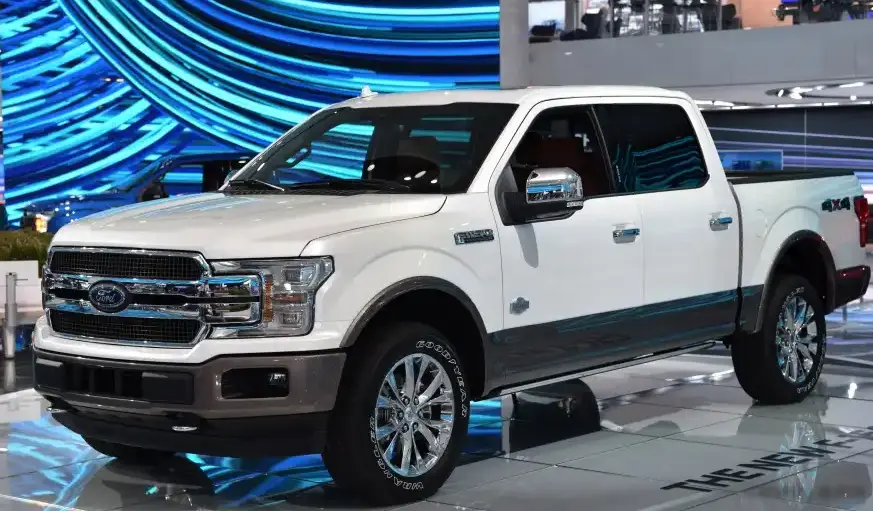
The Ford F-150 is a full-size pickup truck manufactured by Ford Motor Company, and has been the best-selling vehicle in the United States for over four decades. The thirteenth generation, produced from 2015 to 2020, received a significant facelift in 2018, introducing updated styling, technology, and powertrain options. This article focuses on the 2018-2020 F-150 SuperCrew configuration equipped with the 3.5-liter V6 engine producing 375 horsepower, paired with a 10-speed automatic transmission. This combination represented a mid-to-upper tier offering within the extensive F-150 lineup, balancing performance, capability, and fuel efficiency.
Technical Specifications
| Brand | Ford |
| Model | F-Series F-150 |
| Generation | F-Series F-150 XIII SuperCrew (facelift 2018) |
| Type (Engine) | 3.5 V6 (375 Hp) Automatic |
| Start of production | 2018 |
| End of production | October, 2020 |
| Powertrain Architecture | Internal Combustion engine |
| Body type | Pick-up |
| Seats | 5-6 |
| Doors | 4 |
| Fuel consumption (urban) | 13.1 l/100 km (18 US mpg, 21.6 UK mpg, 7.6 km/l) |
| Fuel consumption (extra urban) | 9.4 l/100 km (25 US mpg, 30.1 UK mpg, 10.6 km/l) |
| Fuel consumption (combined) | 11.2 l/100 km (21 US mpg, 25.2 UK mpg, 8.9 km/l) |
| Fuel Type | Petrol (Gasoline) |
| Power | 375 Hp @ 5000 rpm |
| Power per litre | 107.4 Hp/l |
| Torque | 637 Nm @ 3500 rpm (469.83 lb.-ft. @ 3500 rpm) |
| Engine layout | Front, Longitudinal |
| Engine displacement | 3490 cm3 (212.97 cu. in.) |
| Number of cylinders | 6 |
| Engine configuration | V-engine |
| Number of valves per cylinder | 4 |
| Fuel injection system | Direct injection |
| Engine aspiration | Twin-Turbo, Intercooler |
| Engine oil capacity | 5.7 l (6.02 US qt | 5.02 UK qt) |
| Coolant capacity | 14.35 l (15.16 US qt | 12.63 UK qt) |
| Trunk (boot) space (minimum) | 2192 l (77.41 cu. ft.) |
| Fuel tank capacity | 87 l (22.98 US gal | 19.14 UK gal) |
| Length | 5890-6190 mm (231.89 – 243.7 in.) |
| Width | 2029 mm (79.88 in.) |
| Width with mirrors folded | 2121 mm (83.5 in.) |
| Width including mirrors | 2459 mm (96.81 in.) |
| Height | 1920-1923 mm (75.59 – 75.71 in.) |
| Wheelbase | 3683-3983 mm (145 – 156.81 in.) |
| Ride height (ground clearance) | 213-216 mm (8.39 – 8.5 in.) |
| Drivetrain Architecture | Rear wheel drive, Internal Combustion engine |
| Number of gears and type of gearbox | 10 gears, automatic transmission |
| Front suspension | Independent coil spring |
| Rear suspension | Leaf spring |
| Front brakes | Ventilated discs |
| Rear brakes | Ventilated discs |
| Assisting systems | ABS (Anti-lock braking system) |
| Steering type | Steering rack and pinion |
| Power steering | Electric Steering |
| Tires size | 275/45 R22 |
| Wheel rims size | 22 |
INTRODUCTION
The 2018 facelift of the F-150 marked a significant evolution for Ford’s best-selling truck. Built on the 1HX0 platform (shared with the Lincoln Navigator), the updated F-150 featured a bolder exterior design, a more refined interior, and a suite of new technologies. The 3.5-liter EcoBoost V6 with 375 horsepower and a 10-speed automatic transmission was positioned as a strong contender for buyers seeking a balance between towing capacity, payload, and everyday drivability. The SuperCrew configuration offered a spacious cabin, making it a popular choice for families and those needing ample passenger space alongside truck functionality. This particular engine and transmission pairing was a step up from the base 3.3L V6, but offered a more accessible price point than the high-output 3.5L EcoBoost or the 5.0L V8.
Powertrain & Engine Architecture
The heart of this F-150 variant is the 3.5-liter EcoBoost V6, designated with engine code ‘GB’. This engine utilizes a twin-turbocharged configuration, employing two Mitsubishi TD03L turbochargers to deliver increased power and torque. Direct fuel injection is used to precisely meter fuel into the combustion chambers, maximizing efficiency and reducing emissions. The engine features a 9.5:1 compression ratio and a cast aluminum engine block with cast iron cylinder liners. The 10-speed automatic transmission, co-developed with General Motors, is a key component of this powertrain. Its wide gear ratio spread allows for both strong acceleration and efficient highway cruising. The transmission features a sophisticated control system that adapts to driving conditions and driver input, selecting the optimal gear for any given situation.
Driving Characteristics
The 375-horsepower 3.5L EcoBoost F-150 SuperCrew delivers a noticeably more responsive driving experience compared to the base engine. The twin turbos provide ample low-end torque, making it capable of hauling heavy loads and tackling challenging terrain. The 10-speed automatic transmission contributes to smooth and quick shifts, enhancing both acceleration and fuel economy. While not as overtly powerful as the higher-output 3.5L EcoBoost or the 5.0L V8, this configuration provides more than enough power for the vast majority of truck owners. The gear ratios are well-suited for towing, providing strong pulling power in lower gears, while the higher gears allow for relaxed highway cruising. Compared to manual transmission equipped F-150s, the automatic offers greater convenience, particularly in stop-and-go traffic.
Equipment & Trim Levels
The 3.5L EcoBoost engine was available on several F-150 trim levels, including XLT, Lariat, and King Ranch. Standard equipment on the XLT trim typically included features like air conditioning, a basic infotainment system with a touchscreen display, and power windows and locks. Lariat trims added leather upholstery, heated and ventilated front seats, a more advanced infotainment system with navigation, and a premium sound system. King Ranch models further enhanced the luxury with unique exterior and interior styling cues, as well as additional comfort and convenience features. Optional extras included a panoramic sunroof, a 360-degree camera system, and various driver-assistance technologies such as adaptive cruise control and lane-keeping assist.
Chassis & Braking
The F-150’s chassis is built with a high-strength steel frame, designed to provide a solid foundation for hauling and towing. The front suspension utilizes an independent coil-spring design, offering a comfortable ride and good handling characteristics. The rear suspension employs a leaf-spring setup, which is well-suited for supporting heavy loads. Braking duties are handled by ventilated discs on all four wheels, providing ample stopping power. An Anti-lock Braking System (ABS) is standard, enhancing safety and control during emergency braking situations. The specific brake rotor size and stabilizer bar thickness varied depending on the trim level and optional equipment packages.
Market Reception & Comparison
The 2018-2020 F-150 with the 3.5L EcoBoost V6 and 10-speed automatic received generally positive reviews from automotive critics. It was praised for its strong performance, comfortable ride, and advanced technology. Fuel economy was considered competitive for a full-size pickup truck, although it still lagged behind smaller, more fuel-efficient vehicles. Compared to the 3.3L V6, the 3.5L EcoBoost offered a significant increase in power and towing capacity. Compared to the higher-output 3.5L EcoBoost and the 5.0L V8, it provided a more affordable option with a good balance of performance and efficiency. Reliability reports have been generally favorable, although some owners have reported minor issues with the turbochargers and the 10-speed automatic transmission.
Legacy
The 3.5L EcoBoost V6 with the 10-speed automatic transmission has proven to be a durable and reliable powertrain in the F-150. These engines continue to be highly sought after in the used car market, offering a compelling combination of performance, capability, and fuel efficiency. The widespread adoption of the 10-speed automatic transmission has also influenced other manufacturers, leading to its use in a variety of vehicles. The 2018-2020 F-150 represents a significant milestone in the evolution of the F-Series, solidifying its position as the best-selling pickup truck in the United States and a benchmark for the industry.