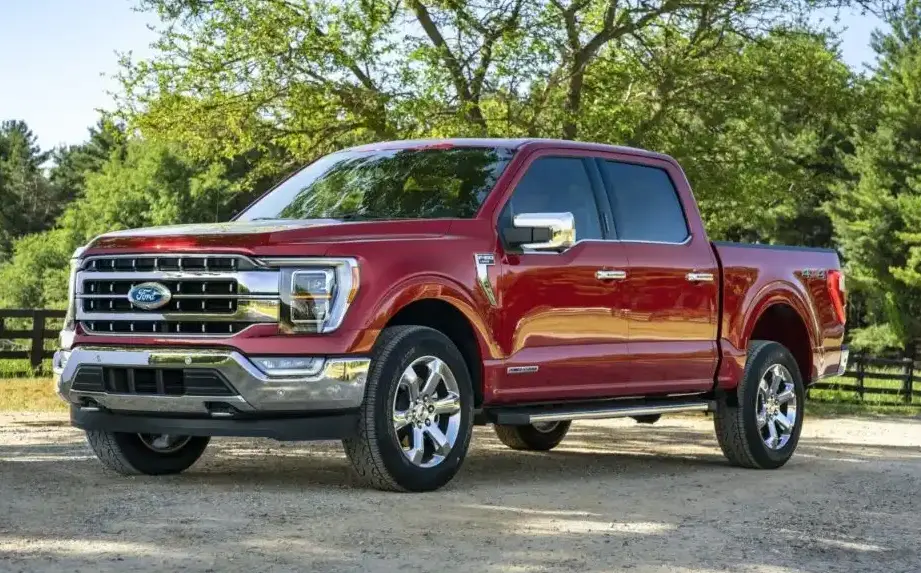
The Ford F-150 XIV SuperCrew, equipped with the 3.3 Ti-VCT V6 engine and a 10-speed automatic transmission with four-wheel drive, represents a significant offering in the full-size pickup truck segment. Introduced for the 2021 model year as part of the fourteenth generation F-Series (2021-2023), this configuration aimed to provide a balance of capability, fuel efficiency, and affordability within the expansive F-150 lineup. It served as a key entry point into the SuperCrew body style, appealing to buyers prioritizing passenger space and everyday usability alongside traditional truck functionality. This variant was offered throughout the 2021, 2022, and 2023 model years.
Technical Specifications
| Brand | Ford |
| Model | F-Series F-150 |
| Generation | F-Series F-150 XIV SuperCrew |
| Type (Engine) | 3.3 Ti-VCT V6 (290 Hp) FFV 4×4 Automatic |
| Start of production | October, 2020 |
| End of production | 2023 |
| Powertrain Architecture | Internal Combustion engine |
| Body type | Pick-up |
| Seats | 5-6 |
| Doors | 4 |
| Fuel consumption (urban) | 12.4 l/100 km (19 US mpg, 22.8 UK mpg, 8.1 km/l) |
| Fuel consumption (extra urban) | 10.7 l/100 km (22 US mpg, 26.4 UK mpg, 9.3 km/l) |
| Fuel consumption (combined) | 11.8 l/100 km (19.9 US mpg, 23.9 UK mpg, 8.5 km/l) |
| Fuel Type | Petrol / Ethanol – E85 |
| Weight-to-power ratio | 7.4 kg/Hp, 135.9 Hp/tonne |
| Weight-to-torque ratio | 5.9 kg/Nm, 168.2 Nm/tonne |
| Power | 290 Hp @ 6500 rpm |
| Power per litre | 86.8 Hp/l |
| Torque | 359 Nm @ 4000 rpm (264.78 lb.-ft. @ 4000 rpm) |
| Engine layout | Front, Longitudinal |
| Engine displacement | 3340 cm3 (203.82 cu. in.) |
| Number of cylinders | 6 |
| Engine configuration | V-engine |
| Cylinder Bore | 90.42 mm (3.56 in.) |
| Piston Stroke | 86.61 mm (3.41 in.) |
| Compression ratio | 12:1 |
| Fuel injection system | Direct injection and Multi-port manifold injection |
| Engine oil capacity | 5.7 l (6.02 US qt | 5.02 UK qt) |
| Coolant | 12 l (12.68 US qt | 10.56 UK qt) |
| Kerb Weight | 2134 kg (4704.66 lbs.) |
| Max. weight | 2935 kg (6470.57 lbs.) |
| Max load | 801 kg (1765.9 lbs.) |
| Trunk (boot) space – minimum | 1495 l (52.8 cu. ft.) |
| Fuel tank capacity | 87-136 l (22.98 – 35.93 US gal | 19.14 – 29.92 UK gal) |
| Permitted trailer load with brakes (12%) | 3719 kg (8198.99 lbs.) |
| Length | 5885 mm (231.69 in.) |
| Width | 2029 mm (79.88 in.) |
| Width with mirrors folded | 2123 mm (83.58 in.) |
| Width including mirrors | 2431 mm (95.71 in.) |
| Height | 1961 mm (77.2 in.) |
| Wheelbase | 3693 mm (145.39 in.) |
| Front track | 1725 mm (67.91 in.) |
| Rear (Back) track | 1735 mm (68.31 in.) |
| Front overhang | 955 mm (37.6 in.) |
| Rear overhang | 1234 mm (48.58 in.) |
| Ride height (ground clearance) | 239 mm (9.41 in.) |
| Minimum turning circle (turning diameter) | 14.6 m (47.9 ft.) |
| Approach angle | 24.3° |
| Departure angle | 25.3° |
| Ramp-over (brakeover) angle | 20° |
| Drivetrain Architecture | The Internal combustion engine (ICE) drives the rear wheels permanently, and the front wheels are driven through an electrically or mechanically operated clutch if necessary. |
| Drive wheel | All wheel drive (4×4) |
| Number of gears and type of gearbox | 10 gears, automatic transmission SelectShift |
| Front suspension | Double wishbone |
| Rear suspension | Leaf spring |
| Front brakes | Ventilated discs, 350×34 mm |
| Rear brakes | Ventilated discs, 336×20 mm |
| Assisting systems | ABS (Anti-lock braking system) |
| Steering type | Steering rack and pinion |
| Power steering | Electric Steering |
| Tires size | 245/70 R17 110T; 265/70 R17 115T; 265/60 R18 110T; 275/65 R18 116T |
| Wheel rims size | 7.5J x 17; 7.5J x 18 |
Powertrain & Engine Architecture
The heart of this F-150 variant is the 3.3-liter Ti-VCT V6 engine. “Ti-VCT” stands for Twin Independent Variable Camshaft Timing, a technology that optimizes engine breathing for improved performance and efficiency. The engine utilizes both direct fuel injection and multi-port fuel injection, combining the benefits of both systems for enhanced combustion control. The engine code is generally identified as the third-generation 3.3L V6. This engine produces 290 horsepower at 6500 rpm and 264 lb-ft of torque at 4000 rpm. It’s a naturally aspirated engine, meaning it doesn’t employ turbocharging or supercharging. The engine is longitudinally mounted in the chassis. Paired with this engine is Ford’s 10-speed SelectShift automatic transmission. This transmission offers a wide gear ratio spread, contributing to both fuel economy and towing capability. The transmission is electronically controlled and features selectable drive modes.
Driving Characteristics
The 3.3L V6 and 10-speed automatic combination delivers a smooth and predictable driving experience. While not as powerful as the higher-trim engines (like the 3.5L EcoBoost or the 5.0L V8), it provides adequate power for everyday driving and light to moderate towing. The 10-speed transmission helps keep the engine in its optimal power band, minimizing the sensation of being underpowered. Acceleration is reasonable, but not brisk. The automatic transmission is well-tuned for smooth shifts, and the wide gear ratio spread aids in maintaining efficient cruising speeds on the highway. Compared to manual transmission equipped F-150s, this variant prioritizes ease of use over outright performance. The automatic transmission is particularly well-suited for drivers who frequently encounter stop-and-go traffic or who prefer a more relaxed driving experience.
Equipment & Trim Levels
The 3.3L V6 engine was typically offered on the base XL, XLT, and Lariat trim levels of the F-150 SuperCrew. Standard features on the XL trim included basic amenities like air conditioning, a rearview camera, and a basic infotainment system. The XLT trim added features such as alloy wheels, power windows and locks, and an upgraded infotainment system. The Lariat trim offered more luxurious appointments, including leather upholstery, heated and ventilated front seats, and a premium sound system. Optional extras available across these trims included a tow package, a panoramic sunroof, and advanced safety features like adaptive cruise control and lane-keeping assist.
Chassis & Braking
The F-150 XIV SuperCrew utilizes a fully boxed frame constructed from high-strength steel. The front suspension features an independent double-wishbone design, while the rear suspension employs a leaf spring setup. This configuration provides a good balance of ride comfort and load-carrying capacity. Braking duties are handled by ventilated disc brakes on all four wheels. ABS (Anti-lock Braking System) is standard. The rear brakes are slightly smaller in diameter than the front brakes. The 4×4 system utilizes an electronically controlled transfer case, allowing the driver to seamlessly switch between two-wheel drive and four-wheel drive modes.
Market Reception & Comparison
The 3.3L V6 F-150 was generally well-received as a value-oriented option in the full-size truck market. Critics praised its fuel efficiency and smooth ride, but noted that it lacked the power and towing capacity of the more expensive engine options. Compared to the 2.7L EcoBoost V6, the 3.3L offered slightly lower fuel economy but a simpler, more traditional powertrain. Compared to the 5.0L V8, the 3.3L provided significantly less power and towing capacity, but at a lower price point. The 3.3L V6 was often seen as a good choice for buyers who primarily used their trucks for commuting and light-duty tasks.
Legacy
The 3.3L Ti-VCT V6 engine has proven to be a relatively reliable powertrain. While not known for exceptional longevity like some older Ford engines, it has generally demonstrated good durability with proper maintenance. On the used car market, F-150s equipped with this engine tend to be more affordable than those with the EcoBoost or V8 engines. This makes them an attractive option for budget-conscious buyers looking for a capable and reliable full-size pickup truck. The 10-speed automatic transmission has also proven to be a durable and efficient unit, contributing to the overall reliability of this powertrain combination.