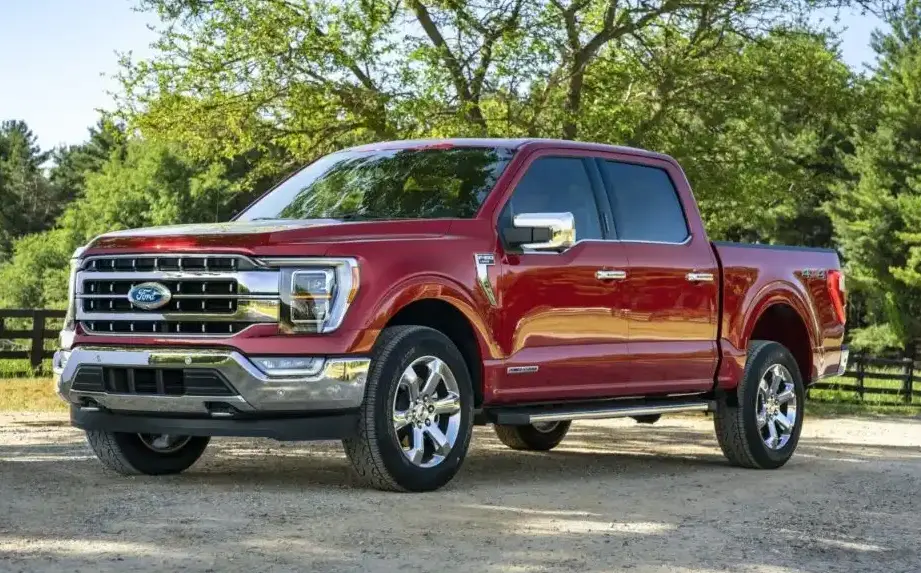
The Ford F-150 XIV SuperCrew, equipped with the 3.5 EcoBoost V6 engine producing 400 horsepower and paired with a 10-speed automatic transmission and four-wheel drive, represents a significant iteration of Ford’s best-selling full-size pickup truck. Production spanned from October 2020 through 2023, falling within the fourteenth generation (F-150 XIV) of the F-Series. This particular configuration aimed to balance robust performance with everyday usability, targeting buyers who needed substantial towing and hauling capacity without sacrificing comfort or modern technology. It occupied a mid-to-upper trim level within the extensive F-150 lineup, offering a step up from the base engine options while remaining below the high-performance Raptor models.
Technical Specifications
| Brand | Ford |
| Model | F-Series F-100/F-150 |
| Generation | F-Series F-150 XIV SuperCrew |
| Type (Engine) | 3.5 EcoBoost V6 (400 Hp) 4×4 Automatic |
| Start of production | October, 2020 |
| End of production | 2023 |
| Powertrain Architecture | Internal Combustion engine |
| Body type | Pick-up |
| Seats | 5-6 |
| Doors | 4 |
| Fuel consumption (urban) | 13.1 l/100 km (18 US mpg, 21.6 UK mpg, 7.6 km/l) |
| Fuel consumption (extra urban) | 10.2 l/100 km (23.1 US mpg, 27.7 UK mpg, 9.8 km/l) |
| Fuel consumption (combined) | 11.8 l/100 km (19.9 US mpg, 23.9 UK mpg, 8.5 km/l) |
| Fuel Type | Petrol (Gasoline) |
| Weight-to-power ratio | 5.6 kg/Hp, 178.3 Hp/tonne |
| Weight-to-torque ratio | 3.3 kg/Nm, 302.1 Nm/tonne |
| Power | 400 Hp @ 6000 rpm |
| Power per litre | 114.4 Hp/l |
| Torque | 678 Nm @ 3100 rpm (500.07 lb.-ft. @ 3100 rpm) |
| Engine layout | Front, Longitudinal |
| Engine displacement | 3497 cm3 (213.4 cu. in.) |
| Number of cylinders | 6 |
| Engine configuration | V-engine |
| Cylinder Bore | 92.46 mm (3.64 in.) |
| Piston Stroke | 86.61 mm (3.41 in.) |
| Compression ratio | 10.5:1 |
| Fuel injection system | Direct injection and Multi-port manifold injection |
| Engine aspiration | Twin-Turbo, Intercooler |
| Engine oil capacity | 5.7 l (6.02 US qt | 5.02 UK qt) |
| Coolant | 13.5 l (14.27 US qt | 11.88 UK qt) |
| Kerb Weight | 2244-2266 kg (4947.17 – 4995.67 lbs.) |
| Max. weight | 3561 kg (7850.66 lbs.) |
| Max load | 1295-1317 kg (2854.99 – 2903.49 lbs.) |
| Trunk (boot) space – minimum | 1495-1764 l (52.8 – 62.3 cu. ft.) |
| Fuel tank capacity | 87-136 l (22.98 – 35.93 US gal | 19.14 – 29.92 UK gal) |
| Permitted trailer load with brakes (12%) | 6305 kg (13900.15 lbs.) |
| Length | 5885-6185 mm (231.69 – 243.5 in.) |
| Width | 2029 mm (79.88 in.) |
| Width with mirrors folded | 2123 mm (83.58 in.) |
| Width including mirrors | 2431 mm (95.71 in.) |
| Height | 1961-1971 mm (77.2 – 77.6 in.) |
| Wheelbase | 3693-3993 mm (145.39 – 157.2 in.) |
| Front track | 1725 mm (67.91 in.) |
| Rear (Back) track | 1735 mm (68.31 in.) |
| Front overhang | 955 mm (37.6 in.) |
| Rear overhang | 1234 mm (48.58 in.) |
| Ride height (ground clearance) | 224-239 mm (8.82 – 9.41 in.) |
| Minimum turning circle (turning diameter) | 14.6-15.6 m (47.9 – 51.18 ft.) |
| Approach angle | 24-24.3° |
| Departure angle | 25.3-26.3° |
| Ramp-over (brakeover) angle | 19-20° |
| Drivetrain Architecture | The Internal combustion engine (ICE) drives the rear wheels permanently, and the front wheels are driven through an electrically or mechanically operated clutch if necessary. |
| Drive wheel | All wheel drive (4×4) |
| Number of gears and type of gearbox | 10 gears, automatic transmission SelectShift |
| Front suspension | Double wishbone |
| Rear suspension | Leaf spring |
| Front brakes | Ventilated discs, 350×34 mm |
| Rear brakes | Ventilated discs, 336×20 mm |
| Assisting systems | ABS (Anti-lock braking system) |
| Steering type | Steering rack and pinion |
| Power steering | Electric Steering |
| Tires size | 245/70 R17 110T; 265/70 R17 115T; 265/60 R18 110T; 275/65 R18 116T; 275/60 R20 115T; 275/50 R22 115T |
| Wheel rims size | 7.5J x 17; 7.5J x 18; 8.5J x 20; 9J x 22 |
Powertrain & Engine Architecture
The heart of this F-150 variant is the 3.5-liter EcoBoost V6 engine, internally designated as part of the third generation of the EcoBoost family. This engine utilizes a 60-degree V-configuration with aluminum alloy cylinder heads and a cast iron block. A key feature is its twin-turbocharger setup, employing electronically controlled wastegates for precise boost control. The engine incorporates both direct fuel injection and multi-port fuel injection, optimizing combustion efficiency and power delivery. The 10-speed automatic transmission, known as SelectShift, is a crucial component, offering a wide gear ratio spread for improved acceleration, towing capability, and fuel economy. This transmission features a sophisticated control system that adapts to driving conditions and driver input.
Driving Characteristics
The 400 horsepower and 500 lb-ft of torque delivered by the 3.5 EcoBoost V6 in the F-150 SuperCrew provides a noticeable step up in performance compared to the base engine options. Acceleration is brisk, and the truck feels confident when merging onto highways or passing other vehicles. The 10-speed automatic transmission contributes to smooth and responsive shifts. While not as overtly sporty as some lower-weight vehicles, the F-150 offers ample power for everyday driving and demanding tasks. The 4×4 system provides enhanced traction in various conditions, making it suitable for both on-road and off-road use. The gear ratios are tuned to prioritize towing and hauling, meaning that while acceleration is good, it’s not optimized for maximizing fuel efficiency at higher speeds.
Equipment & Trim Levels
The F-150 XIV SuperCrew 3.5 EcoBoost typically came standard with features such as a rearview camera, Ford’s SYNC infotainment system, automatic emergency braking, and a suite of driver-assistance technologies. Higher trim levels, such as Lariat, King Ranch, and Platinum, added features like leather upholstery, heated and ventilated seats, a premium sound system, and advanced safety features. Optional extras included a panoramic sunroof, a 360-degree camera system, and various towing packages. Interior materials and finishes varied depending on the trim level, with higher trims offering more luxurious appointments.
Chassis & Braking
The F-150’s chassis is built around a high-strength steel frame, designed to provide a solid foundation for towing and hauling. The front suspension utilizes an independent double-wishbone design, while the rear suspension employs a leaf spring setup. Braking duties are handled by ventilated discs on all four wheels, with larger rotors typically found on higher trim levels. The anti-lock braking system (ABS) is standard, along with electronic stability control. The SuperCrew configuration offers a spacious cabin and a comfortable ride, although the leaf spring rear suspension can sometimes result in a slightly firmer ride when the truck is unloaded.
Market Reception & Comparison
The 3.5 EcoBoost V6 quickly became a popular choice among F-150 buyers, praised for its combination of power, fuel efficiency, and towing capability. Critics generally lauded the engine’s performance and the smooth operation of the 10-speed automatic transmission. Compared to the naturally aspirated V8 options, the EcoBoost offered comparable or better performance with improved fuel economy. Compared to the 2.7-liter EcoBoost, the 3.5-liter provided significantly more power and torque, making it a better choice for those who frequently tow or haul heavy loads. Reliability was generally good, although some early models experienced issues with the turbochargers and fuel injectors, which were addressed through recalls and updates.
Legacy
The 3.5 EcoBoost V6 has become a cornerstone of the F-150 lineup, and the powertrain found in the 2020-2023 models continues to be well-regarded in the used car market. Its combination of power, efficiency, and technology has set a high standard for full-size pickup trucks. While maintenance costs can be slightly higher than those of older, simpler engines, the 3.5 EcoBoost generally proves to be a durable and reliable powertrain when properly maintained. The availability of parts and service is excellent, ensuring that these trucks remain viable transportation options for years to come.