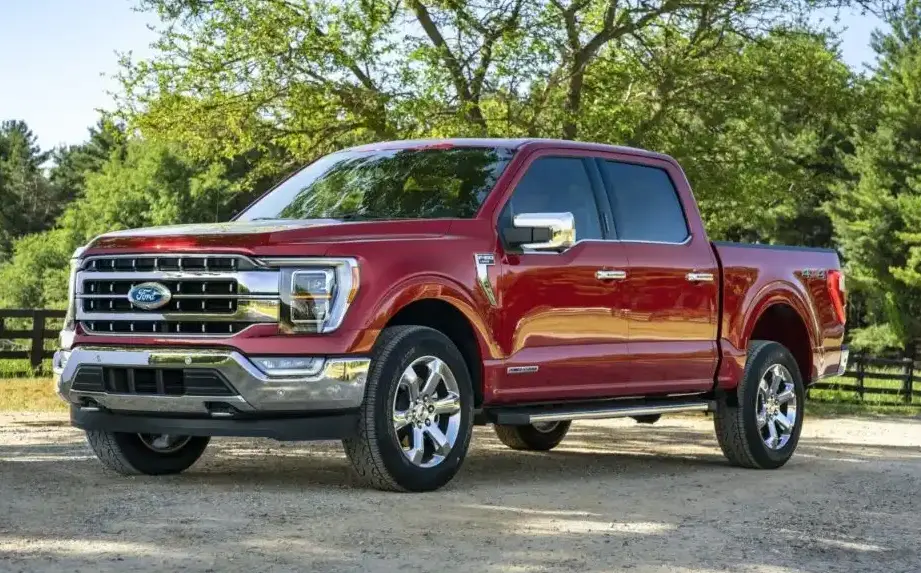
The Ford F-150 XIV SuperCrew 3.5 PowerBoost V6 is a full-size, light-duty pickup truck produced by Ford from October 2020 through 2023. Representing the fourteenth generation of the F-Series, this variant introduced Ford’s first full hybrid powertrain option to the highly competitive pickup truck market. Positioned as a premium offering within the F-150 lineup, the PowerBoost aimed to deliver both substantial power and improved fuel efficiency, appealing to buyers seeking capability without compromising on economy. It quickly became a popular choice, particularly in regions where fuel costs are a significant concern and environmental awareness is growing.
Technical Specifications
| Brand | Ford |
| Model | F-Series F-100/F-150 |
| Generation | F-Series F-150 XIV SuperCrew |
| Type (Engine) | 3.5 PowerBoost V6 (430 Hp) FHEV Automatic |
| Start of production | October, 2020 |
| End of production | 2023 |
| Powertrain Architecture | FHEV (Full Hybrid Electric Vehicle) |
| Body type | Pick-up |
| Seats | 5-6 |
| Doors | 4 |
| Fuel consumption (economy) – urban | 9.4 l/100 km (25 US mpg, 30.1 UK mpg, 10.6 km/l) |
| Fuel consumption (economy) – extra urban | 9 l/100 km (26.1 US mpg, 31.4 UK mpg, 11.1 km/l) |
| Fuel consumption (economy) – combined | 9.4 l/100 km (25 US mpg, 30.1 UK mpg, 10.6 km/l) |
| Fuel Type | Petrol (Gasoline) |
| Weight-to-power ratio | 5.5 kg/Hp, 181.4 Hp/tonne |
| Weight-to-torque ratio | 3.1 kg/Nm, 326 Nm/tonne |
| Gross battery capacity | 1.5 kWh |
| Battery technology | Lithium-ion (Li-Ion) |
| Battery location | Below the floor, Under the trunk |
| Electric motor power | 48 Hp |
| Electric motor location | Between the combustion engine and the transmission |
| System power | 430 Hp @ 6000 rpm |
| System torque | 773 Nm @ 3000 rpm (570.14 lb.-ft. @ 3000 rpm) |
| Engine layout | Front, Longitudinal |
| Engine displacement | 3497 cm3 (213.4 cu. in.) |
| Number of cylinders | 6 |
| Engine configuration | V-engine |
| Cylinder Bore | 92.46 mm (3.64 in.) |
| Piston Stroke | 86.61 mm (3.41 in.) |
| Compression ratio | 10.5:1 |
| Fuel injection system | Direct injection and Multi-port manifold injection |
| Engine aspiration | Twin-Turbo, Intercooler |
| Engine oil capacity | 5.7 l (6.02 US qt | 5.02 UK qt) |
| Coolant | 14.5 l (15.32 US qt | 12.76 UK qt) |
| Kerb Weight | 2371-2386 kg (5227.16 – 5260.23 lbs.) |
| Max. weight | 3334 kg (7350.21 lbs.) |
| Max load | 948-963 kg (2089.98 – 2123.05 lbs.) |
| Trunk (boot) space – minimum | 1495-1764 l (52.8 – 62.3 cu. ft.) |
| Fuel tank capacity | 116 l (30.64 US gal | 25.52 UK gal) |
| Permitted trailer load with brakes (12%) | 5761 kg (12700.83 lbs.) |
| Length | 5885-6185 mm (231.69 – 243.5 in.) |
| Width | 2029 mm (79.88 in.) |
| Width with mirrors folded | 2123 mm (83.58 in.) |
| Width including mirrors | 2431 mm (95.71 in.) |
| Height | 1920-1925 mm (75.59 – 75.79 in.) |
| Wheelbase | 3693-3993 mm (145.39 – 157.2 in.) |
| Front track | 1725 mm (67.91 in.) |
| Rear (Back) track | 1735 mm (68.31 in.) |
| Front overhang | 955 mm (37.6 in.) |
| Rear overhang | 1234 mm (48.58 in.) |
| Ride height (ground clearance) | 208-216 mm (8.19 – 8.5 in.) |
| Minimum turning circle (turning diameter) | 14.6-15.6 m (47.9 – 51.18 ft.) |
| Approach angle | 21-21.8° |
| Departure angle | 22.9-23.9° |
| Ramp-over (brakeover) angle | 16.6-17.6° |
| Drivetrain Architecture | The Internal combustion engine (ICE) and electric motor drive the rear wheels of the car with the ability to work in full electric or mixed mode. |
| Drive wheel | Rear wheel drive |
| Number of gears and type of gearbox | 10 gears, automatic transmission |
| Front suspension | Double wishbone |
| Rear suspension | Rigid axle suspension, Leaf spring |
| Front brakes | Ventilated discs, 350×34 mm |
| Rear brakes | Ventilated discs, 336×20 mm |
| Assisting systems | ABS (Anti-lock braking system) |
| Steering type | Steering rack and pinion |
| Power steering | Electric Steering |
| Tires size | 245/70 R17 110T; 265/70 R17 115T; 265/60 R18 110T; 275/65 R18 116T; 275/60 R20 115T; 275/50 R22 115T |
| Wheel rims size | 7.5J x 17; 7.5J x 18; 8.5J x 20; 9J x 22 |
INTRODUCTION
The Ford F-150 XIV SuperCrew 3.5 PowerBoost V6, launched in late 2020, marked a significant step in Ford’s electrification strategy. Built on the F-150 platform (1HX0/A3), this variant combined a 3.5-liter EcoBoost V6 engine with an electric motor and a small battery pack to deliver a hybrid powertrain. The SuperCrew configuration offered a spacious, four-door cabin, making it a popular choice for families and those needing passenger space alongside truck functionality. The PowerBoost was positioned above the standard EcoBoost models but below the high-performance Raptor, offering a balance of power, efficiency, and features.
Powertrain & Engine Architecture
At the heart of the PowerBoost is Ford’s 3.5-liter EcoBoost V6 engine, designated as the third generation of the EcoBoost family. This engine utilizes a twin-turbocharged configuration with direct fuel injection and multi-port fuel injection, optimizing both power and fuel efficiency. The engine produces 430 horsepower at 6000 rpm and 570 lb-ft of torque at 3000 rpm when combined with the electric motor. The electric motor, rated at 48 horsepower, is integrated between the engine and the 10-speed automatic transmission. A 1.5 kWh lithium-ion battery pack, located under the floor and trunk, provides the energy storage for the electric motor. The transmission itself is a sophisticated 10-speed automatic, specifically tuned to work seamlessly with the hybrid powertrain, providing smooth shifts and optimized gear ratios for both performance and fuel economy. The engine management system intelligently switches between electric-only, gasoline-only, and combined operation modes, maximizing efficiency based on driving conditions.
Driving Characteristics
The 3.5 PowerBoost V6 delivers a unique driving experience. The instant torque from the electric motor provides brisk acceleration, particularly from a standstill. The 10-speed automatic transmission is well-matched to the engine’s powerband, offering quick and smooth gear changes. While not as overtly sporty as some of the higher-performance F-150 trims, the PowerBoost offers ample power for towing, hauling, and everyday driving. The hybrid system allows for limited all-electric driving at lower speeds, contributing to improved fuel economy in urban environments. Compared to the standard 3.5L EcoBoost, the PowerBoost feels more responsive due to the electric motor assist. Compared to the 5.0L V8, the PowerBoost offers comparable power but with significantly better fuel economy. The weight of the hybrid components does slightly impact handling, but the overall driving experience remains comfortable and capable.
Equipment & Trim Levels
The PowerBoost was typically offered in higher trim levels, such as XLT, Lariat, King Ranch, Platinum, and Limited. Standard features included Ford’s SYNC 4 infotainment system with a large touchscreen display, Apple CarPlay and Android Auto compatibility, and a suite of driver-assistance technologies like automatic emergency braking and lane-keeping assist. Higher trims added features like leather upholstery, heated and ventilated seats, a premium sound system, and advanced towing technologies. The Pro Power Onboard feature, which allows the truck to function as a mobile generator, was a standout feature of the PowerBoost, providing up to 7.2 kW of power through available outlets in the bed and cabin. Optional extras included a panoramic sunroof, adaptive cruise control, and a 360-degree camera system.
Chassis & Braking
The F-150 XIV SuperCrew utilizes a fully boxed frame constructed from high-strength steel, providing a robust and durable foundation. The front suspension features independent double wishbones, while the rear suspension employs a solid axle with leaf springs. Braking duties are handled by ventilated discs on all four wheels, with larger rotors and calipers on higher trim levels. ABS (Anti-lock Braking System) is standard. The PowerBoost models generally featured heavier-duty suspension components to accommodate the added weight of the hybrid system and the increased payload capacity. Stabilizer bars were standard front and rear, contributing to improved handling and stability.
Market Reception & Comparison
The F-150 PowerBoost was generally well-received by critics and consumers alike. Reviewers praised its combination of power, fuel efficiency, and innovative features like Pro Power Onboard. Fuel economy figures of 25 mpg combined were a significant improvement over traditional gasoline-powered F-150s. Compared to the 3.5L EcoBoost, the PowerBoost commanded a higher price but offered the benefit of improved fuel economy and the added functionality of the electric motor. Reliability reports have been generally positive, although some early owners reported minor software glitches with the hybrid system, which were addressed through software updates. The PowerBoost quickly became a popular choice for buyers seeking a versatile and efficient full-size pickup truck.
Legacy
The Ford F-150 PowerBoost represents a pivotal moment in the evolution of the pickup truck. It demonstrated that hybrid technology could be successfully integrated into a full-size truck without sacrificing capability or performance. The powertrain has proven to be relatively reliable, with the 10-speed automatic transmission holding up well under demanding conditions. On the used car market, PowerBoost models tend to command a premium due to their fuel efficiency and unique features. As Ford continues to expand its electric vehicle offerings, the PowerBoost serves as a stepping stone towards a fully electrified future for the F-Series.