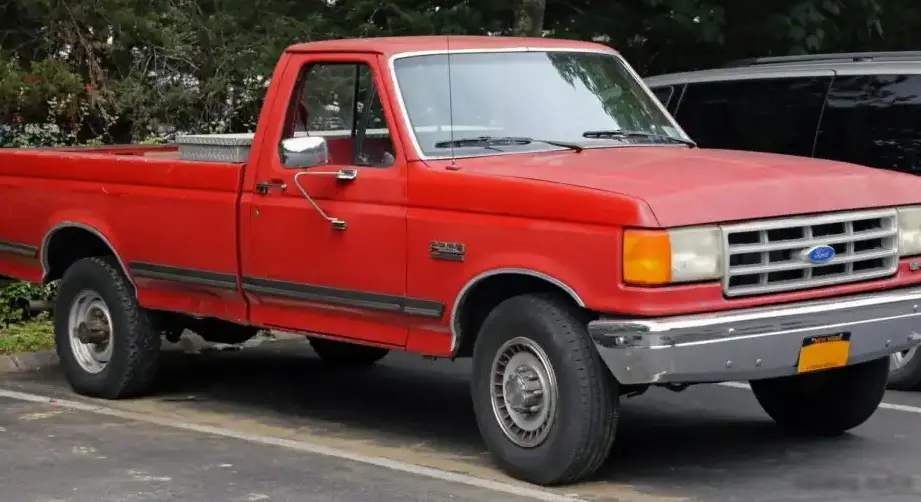
The Ford F-Series F-250 VIII Regular Cab, equipped with the 5.8-liter V8 Windsor engine producing 210 horsepower and a four-wheel-drive (4×4) system, was a mainstay of Ford’s heavy-duty truck lineup from 1986 to 1988. This generation, part of the broader eighth generation of the F-Series (1987-1991), represented a significant evolution in truck design, offering increased capability and comfort compared to its predecessors. The F-250, positioned above the F-150 and below the F-350, catered to buyers needing a robust work truck capable of handling substantial payloads and towing demands. This particular configuration – the 5.8L V8 with a manual transmission and 4×4 – represented a balance between affordability and capability, appealing to a wide range of users from farmers and ranchers to construction workers and tradespeople.
Technical Specifications
| Brand | Ford |
| Model | F-Series F-250 |
| Generation | F-Series F-250 VIII Regular Cab |
| Type (Engine) | 5.8 V8 Windsor (210 Hp) 4×4 |
| Start of production | 1986 |
| End of production | 1988 |
| Powertrain Architecture | Internal Combustion engine |
| Body type | Pick-up |
| Seats | 3 |
| Doors | 2 |
| Fuel Type | Petrol (Gasoline) |
| Power | 210 Hp |
| Power per litre | 36.5 Hp/l |
| Torque | 414 Nm / 305.35 lb.-ft. |
| Engine layout | Front, Longitudinal |
| Engine displacement | 5752 cm3 / 351.01 cu. in. |
| Number of cylinders | 8 |
| Engine configuration | V-engine |
| Fuel injection system | Carburettor |
| Engine aspiration | Naturally aspirated engine |
| Max. weight | 2994 kg / 6600.64 lbs. |
| Fuel tank capacity | 72 l / 19.02 US gal | 15.84 UK gal |
| Length | 5339 mm / 210.2 in. |
| Width | 1778 mm / 70 in. |
| Height | 1923 mm / 75.71 in. |
| Wheelbase | 3378 mm / 132.99 in. |
| Wading depth | 869 mm / 34.21 in. |
| Drivetrain Architecture | The Internal combustion engine (ICE) drives the rear wheels permanently, and the front wheels are driven through an electrically or mechanically operated clutch if necessary. |
| Drive wheel | All wheel drive (4×4) |
| Number of gears and type of gearbox | 4 gears, manual transmission |
| Front suspension | Leaf spring |
| Rear suspension | Leaf spring |
| Front brakes | Disc |
| Rear brakes | Drum |
| Power steering | Electric Steering |
| Tires size | 215/85 R16 |
| Wheel rims size | 6J x 16 |
Powertrain & Engine Architecture
The heart of this F-250 was the 5.8-liter (351 cubic inch) Windsor V8 engine. This engine, a Ford mainstay for decades, was known for its durability and relatively simple design. It utilized a cast iron block and cylinder heads, and was equipped with a two-barrel carburetor for fuel delivery. The engine featured a traditional pushrod valvetrain with two valves per cylinder. While not the most technologically advanced engine of its time, the Windsor V8 was a proven performer, providing ample torque for heavy-duty tasks. The four-speed manual transmission was a rugged unit designed to handle the engine’s output and the demands of 4×4 operation. The transfer case allowed the driver to switch between two-wheel drive, four-wheel drive high range, and four-wheel drive low range, providing enhanced traction in challenging conditions.
Driving Characteristics
The 1986-1988 F-250 with the 5.8L V8 and manual transmission offered a decidedly truck-like driving experience. The engine delivered a respectable 210 horsepower, but its strength lay in its 305 lb-ft of torque. This torque allowed for confident towing and hauling, even when fully loaded. The manual transmission provided direct control over gear selection, allowing the driver to optimize power delivery for various situations. Compared to the available diesel engines (typically the 6.9L or 7.3L IDI), the 5.8L V8 was quieter and offered quicker acceleration, but lacked the diesel’s superior fuel economy and low-end grunt. Compared to the smaller 302 cubic inch V8, the 5.8L provided a noticeable increase in power and towing capacity. The leaf spring suspension, while robust, resulted in a firm ride, especially when unladen. Steering was accomplished through a power steering system, but still required considerable effort, particularly at low speeds.
Equipment & Trim Levels
The F-250 VIII Regular Cab, in this configuration, was typically a fairly basic work truck. Standard equipment included a vinyl bench seat, a basic AM radio, and manual windows and locks. The interior was functional and durable, designed to withstand the rigors of daily use. Optional extras included air conditioning, a more powerful radio, upgraded interior trim, and a sliding rear window. The exterior typically featured minimal chrome trim, with a focus on practicality rather than luxury. The bed was usually equipped with a basic drop-in bedliner, and a trailer hitch was a common option for those needing to tow.
Chassis & Braking
The F-250’s chassis was a traditional body-on-frame construction, providing a solid and durable foundation. The front suspension utilized leaf springs, while the rear suspension also employed leaf springs, designed to handle heavy loads. Braking duties were handled by disc brakes at the front and drum brakes at the rear. Power steering was standard, but the steering geometry resulted in a relatively wide turning radius. The 4×4 system employed a part-time transfer case, allowing the driver to engage four-wheel drive when needed. Tire size was typically 215/85R16, providing a good balance of on-road comfort and off-road traction.
Market Reception & Comparison
The 1986-1988 Ford F-250 with the 5.8L V8 and manual transmission was well-received by buyers seeking a capable and affordable heavy-duty truck. Critics praised its durability and towing capacity, but noted its relatively basic interior and firm ride. Compared to the diesel-powered F-250s, the 5.8L V8 offered a lower initial cost but suffered from poorer fuel economy. Compared to the F-150, the F-250 provided a significant increase in payload and towing capacity, making it the preferred choice for those needing a more robust truck. The manual transmission was favored by those who preferred direct control over gear selection, while an automatic transmission was also available for those seeking greater convenience.
Legacy
The 5.8L Windsor V8-powered F-250 from this era has proven to be a remarkably durable vehicle. Many examples are still in service today, a testament to the engine’s reliability and the truck’s robust construction. While fuel economy is not a strong point by modern standards, the engine is relatively easy to maintain and repair. In the used car market, these trucks are often sought after by enthusiasts and those needing a dependable work truck. Parts availability is generally good, although some trim-specific components may be difficult to find. The 1986-1988 F-250 represents a classic era of American truck design, offering a blend of capability, durability, and simplicity that continues to appeal to buyers today. The combination of the 5.8L V8 and manual transmission is particularly appreciated by those who value a traditional, driver-focused experience.