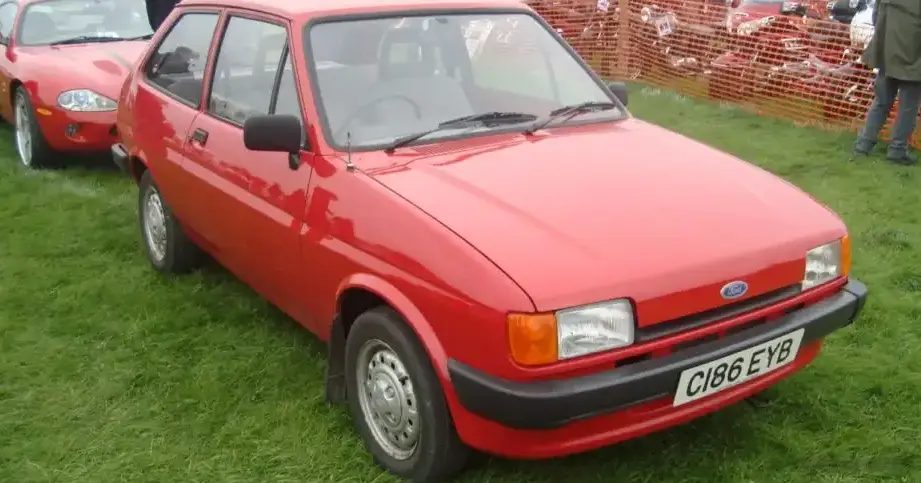
The Ford Fiesta Mk2 1.1, powered by the FBD engine producing 49 horsepower, represented the entry point into the second generation Fiesta range, produced between 1986 and 1989. Positioned as an affordable and economical city car, it played a crucial role in Ford of Europe’s strategy to offer a compact, fuel-efficient vehicle to a broad customer base. The Mk2 Fiesta, built upon the original Mk1’s successful foundation, aimed to modernize the design and improve overall refinement while retaining the core values of practicality and affordability. This 1.1-liter variant was particularly significant in markets where smaller engine capacities were favored due to taxation and fuel economy concerns.
Technical Specifications
| Brand | Ford |
| Model | Fiesta |
| Generation | Fiesta II (Mk2) |
| Type (Engine) | 1.1 (FBD) (49 Hp) |
| Start of production | 1986 |
| End of production | 1989 |
| Powertrain Architecture | Internal Combustion engine |
| Body type | Hatchback |
| Fuel Type | Petrol (Gasoline) |
| Power | 49 Hp |
| Engine Model/Code | FBD |
| Engine aspiration | Naturally aspirated engine |
| Engine oil capacity | 3.25 l (3.43 US qt | 2.86 UK qt) |
| Coolant capacity | 5.3 l (5.6 US qt | 4.66 UK qt) |
Powertrain & Engine Architecture
The heart of the Fiesta Mk2 1.1 was the Ford FBD engine, a 1.1-liter inline-four cylinder petrol engine. This engine, part of Ford’s ‘Valencia’ engine family, was a simple, robust design intended for reliability and fuel efficiency rather than outright performance. It featured a single overhead camshaft (SOHC) operating two valves per cylinder. Fuel delivery was managed by a single-barrel carburetor, a common feature for engines of this era and capacity, prioritizing simplicity and cost-effectiveness. The FBD engine produced 49 horsepower at 6000 rpm and approximately 68 lb-ft of torque at 3600 rpm. The engine block was constructed from cast iron, contributing to its durability, while the cylinder head was made of aluminum alloy to reduce weight. The transmission offered was typically a four-speed manual, although a three-speed automatic was available as an option, albeit less common. The automatic transmission was a Ford-designed unit, known for its smooth operation but relatively slow shift times compared to contemporary automatic gearboxes.
Driving Characteristics
The Fiesta Mk2 1.1, particularly in its base specification, offered a driving experience focused on practicality and ease of use. Acceleration was modest, with a 0-60 mph time of around 16-18 seconds. The engine’s limited power meant that spirited driving required frequent gear changes, especially when tackling hills or overtaking. The four-speed manual gearbox, while not particularly sporty, was light and easy to operate. The automatic transmission, while providing convenience, further reduced acceleration performance and increased fuel consumption. The car’s relatively light weight (around 1,600 lbs) helped to mitigate the effects of the low power output, making it feel reasonably nimble in urban environments. Suspension consisted of MacPherson struts at the front and a twist-beam rear axle, providing a comfortable, if somewhat basic, ride quality. Steering was light and responsive, making it easy to maneuver in tight spaces.
Equipment & Trim Levels
The Fiesta Mk2 1.1 typically came with a fairly basic level of equipment, reflecting its position as the entry-level model. Standard features generally included cloth upholstery, a basic instrument cluster with speedometer and fuel gauge, and manually operated windows and door locks. Central locking and electric windows were not typically offered on this trim level. Interior trim was functional and durable, prioritizing practicality over luxury. Optional extras included a radio cassette player, heated windscreen, and upgraded interior trim materials. The Fiesta Mk2 range offered several trim levels above the 1.1, including the 1.3, 1.4, and 1.6 models, which featured more powerful engines, improved interior appointments, and additional equipment. The 1.1 was often identified by its steel wheels with hubcaps and relatively simple exterior trim.
Chassis & Braking
The Fiesta Mk2 utilized a monocoque chassis construction, providing a good balance of strength and weight. Front suspension employed MacPherson struts with an anti-roll bar, while the rear suspension featured a twist-beam axle. Braking on the base 1.1 model typically consisted of disc brakes at the front and drum brakes at the rear. The braking system was adequate for the car’s performance and weight, but lacked the stopping power of the larger-engined models which often featured all-round disc brakes. Steering was rack and pinion, providing precise and responsive handling. The car’s relatively small size and light weight contributed to its agility and ease of handling.
Market Reception & Comparison
The Fiesta Mk2 1.1 was generally well-received as an affordable and economical city car. Critics praised its fuel efficiency, ease of driving, and practicality. However, the engine’s limited power was often cited as a drawback, particularly for those who frequently drove on motorways or carried passengers and luggage. Compared to the higher-specification Fiesta models, the 1.1 offered significantly less performance and refinement. The 1.3 and 1.6 models provided a more enjoyable driving experience, but at a higher price point. The 1.1 also faced competition from other small hatchbacks of the era, such as the Vauxhall Nova and the Austin Metro, all vying for a share of the budget-conscious buyer market. Fuel economy was a key selling point, with the 1.1 achieving around 45-50 mpg in typical driving conditions.
Legacy
The Ford Fiesta Mk2 1.1, while not a performance icon, remains a popular choice among classic car enthusiasts and those seeking an affordable and reliable vintage vehicle. The FBD engine, despite its simplicity, proved to be remarkably durable, and many examples are still on the road today. Parts availability is generally good, and maintenance is relatively straightforward. The car’s simple construction and robust mechanicals make it a relatively easy vehicle to work on for amateur mechanics. In the used car market, the Fiesta Mk2 1.1 typically commands modest prices, making it an accessible entry point into classic car ownership. Its enduring appeal lies in its practicality, affordability, and nostalgic charm, representing a bygone era of simple, honest motoring.