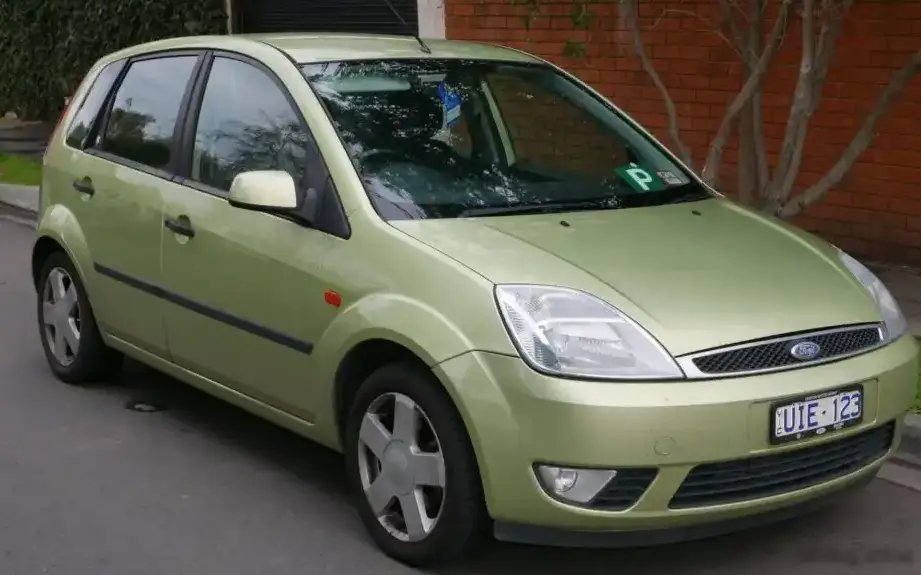
The Ford Fiesta Mk6, produced from 2001 to 2005, represented a significant step forward for Ford’s supermini. The 1.4 Duratec variant, producing 80 horsepower, was a mainstay of the lineup, particularly in the five-door body style. This model occupied the entry-level to mid-range position within the Mk6 Fiesta range, appealing to buyers seeking affordable, practical, and reliable transportation. It was a key offering in the European market, where the Fiesta consistently ranked among the best-selling vehicles in its class, competing directly with rivals like the Volkswagen Polo, Renault Clio, and Opel Corsa.
Technical Specifications
| Brand | Ford |
| Model | Fiesta |
| Generation | Fiesta VI (Mk6) 5 door |
| Type (Engine) | 1.4 Duratec (80 Hp) |
| Start of production | 2001 |
| End of production | 2005 |
| Powertrain Architecture | Internal Combustion engine |
| Body type | Hatchback |
| Seats | 5 |
| Doors | 5 |
| Fuel consumption (urban) | 8.6 l/100 km (27.4 US mpg, 32.8 UK mpg, 11.6 km/l) |
| Fuel consumption (extra urban) | 5.2 l/100 km (45.2 US mpg, 54.3 UK mpg, 19.2 km/l) |
| Fuel consumption (combined) | 6.1 l/100 km (38.6 US mpg, 46.3 UK mpg, 16.4 km/l) |
| Fuel Type | Petrol (Gasoline) |
| Acceleration 0 – 100 km/h | 13.2 sec |
| Acceleration 0 – 62 mph | 13.2 sec |
| Acceleration 0 – 60 mph | 12.5 sec |
| Maximum speed | 166 km/h (103.15 mph) |
| Weight-to-power ratio | 12.9 kg/Hp, 77.7 Hp/tonne |
| Weight-to-torque ratio | 8.3 kg/Nm, 120.4 Nm/tonne |
| Power | 80 Hp @ 5000 rpm |
| Power per litre | 57.6 Hp/l |
| Torque | 124 Nm @ 3500 rpm (91.46 lb.-ft. @ 3500 rpm) |
| Engine layout | Front, Transverse |
| Engine Model/Code | FXJA |
| Engine displacement | 1388 cm3 (84.7 cu. in.) |
| Number of cylinders | 4 |
| Engine configuration | Inline |
| Cylinder Bore | 76 mm (2.99 in.) |
| Piston Stroke | 76.5 mm (3.01 in.) |
| Compression ratio | 11:1 |
| Number of valves per cylinder | 4 |
| Fuel injection system | Multi-port manifold injection |
| Engine aspiration | Naturally aspirated engine |
| Valvetrain | DOHC |
| Engine oil capacity | 3.8 l (4.02 US qt | 3.34 UK qt) |
| Coolant capacity | 5 l (5.28 US qt | 4.4 UK qt) |
| Kerb Weight | 1030 kg (2270.76 lbs.) |
| Max. weight | 1530 kg (3373.07 lbs.) |
| Max load | 500 kg (1102.31 lbs.) |
| Trunk (boot) space – minimum | 284 l (10.03 cu. ft.) |
| Trunk (boot) space – maximum | 947 l (33.44 cu. ft.) |
| Fuel tank capacity | 45 l (11.89 US gal | 9.9 UK gal) |
| Length | 3917 mm (154.21 in.) |
| Width | 1683 mm (66.26 in.) |
| Height | 1417 mm (55.79 in.) |
| Wheelbase | 2487 mm (97.91 in.) |
| Front track | 1477 mm (58.15 in.) |
| Rear track | 1444 mm (56.85 in.) |
| Drivetrain Architecture | Front wheel drive |
| Number of gears | 5 |
| Gearbox type | Manual transmission |
| Front suspension | Independent type McPherson |
| Rear suspension | Torsion |
| Front brakes | Ventilated discs |
| Rear brakes | Drum |
| Assisting systems | ABS (Anti-lock braking system) |
| Steering type | Steering rack and pinion |
| Power steering | Hydraulic Steering |
| Tires size | 175/65 R14 |
| Wheel rims size | 14 |
Powertrain & Engine Architecture
The heart of the Fiesta 1.4 was the FXJA engine, a 1.4-liter inline-four cylinder Duratec engine. This engine was part of Ford’s Duratec family, known for its relatively simple design and focus on fuel efficiency. It featured a double overhead camshaft (DOHC) valvetrain with four valves per cylinder, contributing to reasonable power output for its displacement. Fuel delivery was handled by a multi-port fuel injection system, providing adequate atomization for efficient combustion. The engine produced 80 horsepower at 5000 rpm and 124 Nm (91.46 lb-ft) of torque at 3500 rpm. The engine’s 11:1 compression ratio was typical for naturally aspirated gasoline engines of the era. The five-speed manual transmission was the standard offering, providing a balance between fuel economy and drivability. The transmission’s gear ratios were tuned for everyday use, prioritizing acceleration in lower gears and comfortable cruising at highway speeds.
Driving Characteristics
The 1.4-liter Fiesta offered a predictable and undemanding driving experience. Acceleration was adequate for urban and suburban driving, but it wasn’t particularly quick. The 0-60 mph time of around 12.5 seconds reflects this. Compared to higher-output versions of the Mk6 Fiesta, such as the 1.6 or the sporty ST models, the 1.4 felt noticeably slower. However, the 1.4’s lighter weight and less stressed engine contributed to better fuel economy. The five-speed manual transmission allowed drivers to keep the engine in its optimal power band, but the relatively narrow torque curve meant frequent shifting was often necessary. The steering was light and precise, making it easy to maneuver in tight spaces. The suspension provided a comfortable ride, absorbing bumps and imperfections in the road surface reasonably well.
Equipment & Trim Levels
The 1.4 Fiesta typically came with a basic level of equipment, reflecting its position as an entry-level model. Standard features generally included power steering, central locking, and an immobilizer. Interior upholstery was typically cloth, and the dashboard featured a simple, functional design. Optional extras included air conditioning, electric front windows, and an upgraded audio system. Higher trim levels, such as the Style or Zetec, added features like alloy wheels, body-colored bumpers, and more luxurious interior trim.
Chassis & Braking
The Mk6 Fiesta utilized a McPherson strut independent suspension at the front and a torsion beam suspension at the rear. This setup provided a good balance between ride comfort and handling. The front brakes were ventilated discs, offering good stopping power, while the rear brakes were drums, a cost-saving measure common in this class of vehicle. Anti-lock Braking System (ABS) was standard, enhancing safety by preventing wheel lockup during hard braking. The steering system employed a rack and pinion setup with hydraulic power assistance, providing light and precise steering feel.
Market Reception & Comparison
The 1.4 Fiesta was generally well-received by critics as a practical and affordable supermini. It was praised for its fuel efficiency, comfortable ride, and ease of driving. However, some reviewers noted its lack of outright performance compared to rivals. Compared to the 1.6-liter Fiesta, the 1.4 offered better fuel economy but less power. The 1.4 also proved to be more reliable than some of the more complex engine options available in the Mk6 range, such as the Duratec-RS. The 1.4’s simplicity translated to lower maintenance costs and fewer potential issues.
Legacy
The 1.4 Duratec engine in the Mk6 Fiesta has proven to be a relatively durable and reliable powertrain. Many examples are still on the road today, testament to its robust design. In the used car market, the 1.4 Fiesta is often sought after by buyers looking for an affordable and dependable vehicle. While it may not offer the performance of higher-spec models, its low running costs and simple mechanics make it an attractive option for first-time drivers or those seeking a practical city car. Parts availability remains good, and maintenance is relatively straightforward, ensuring that these Fiestas can continue to provide reliable transportation for years to come.