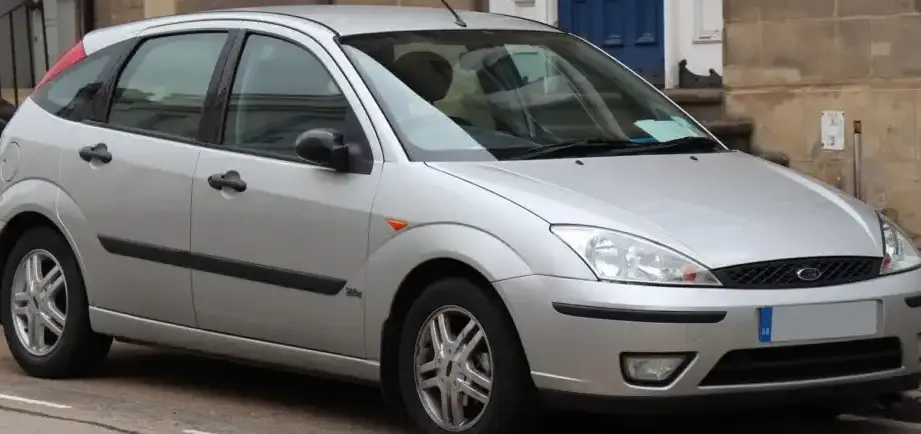
The Ford Focus Hatchback I 1.8 TDCi, produced between 2001 and 2005, represented a significant step forward for Ford in the European small family car segment. This variant, equipped with the 1.8-liter turbodiesel engine producing 115 horsepower, occupied a middle ground in the first-generation Focus lineup, offering a balance between fuel efficiency, reasonable performance, and affordability. It was primarily aimed at drivers seeking a practical and economical hatchback for daily commuting and longer journeys. The Focus I, internally designated the C307, was a crucial model for Ford, replacing the aging Escort and establishing a new benchmark for handling and refinement in its class.
Technical Specifications
| Brand | Ford |
| Model | Focus |
| Generation | Focus Hatchback I |
| Type (Engine) | 1.8 TDCi (115 Hp) |
| Start of production | 2001 |
| End of production | 2005 |
| Powertrain Architecture | Internal Combustion engine |
| Body type | Hatchback |
| Seats | 5 |
| Doors | 3/5 |
| Fuel consumption (urban) | 7.2 l/100 km (32.7 US mpg) |
| Fuel consumption (extra urban) | 4.4 l/100 km (53.5 US mpg) |
| Fuel consumption (combined) | 5.4 l/100 km (43.6 US mpg) |
| Fuel Type | Diesel |
| Acceleration 0 – 100 km/h | 10.8 sec |
| Acceleration 0 – 62 mph | 10.8 sec |
| Acceleration 0 – 60 mph | 10.3 sec |
| Maximum speed | 196 km/h (121.79 mph) |
| Weight-to-power ratio | 11.1 kg/Hp |
| Weight-to-torque ratio | 5.1 kg/Nm |
| Power | 115 Hp @ 3800 rpm |
| Torque | 250 Nm @ 2000 rpm (184.39 lb.-ft. @ 2000 rpm) |
| Engine layout | Front, Transverse |
| Engine Model/Code | F9DA |
| Engine displacement | 1753 cm3 (106.97 cu. in.) |
| Number of cylinders | 4 |
| Engine configuration | Inline |
| Cylinder Bore | 82.5 mm (3.25 in.) |
| Piston Stroke | 82 mm (3.23 in.) |
| Compression ratio | 18.5:1 |
| Number of valves per cylinder | 2 |
| Fuel injection system | Diesel Commonrail |
| Engine aspiration | Turbocharger, Intercooler |
| Valvetrain | OHC |
| Engine oil capacity | 5.6 l (5.92 US qt | 4.93 UK qt) |
| Coolant capacity | 6.5 l (6.87 US qt | 5.72 UK qt) |
| Kerb Weight | 1279 kg (2819.71 lbs.) |
| Max. weight | 1692 kg (3730.22 lbs.) |
| Max load | 413 kg (910.51 lbs.) |
| Trunk (boot) space – minimum | 350 l (12.36 cu. ft.) |
| Trunk (boot) space – maximum | 1205 l (42.55 cu. ft.) |
| Fuel tank capacity | 53 l (14 US gal | 11.66 UK gal) |
| Length | 4178 mm (164.49 in.) |
| Width | 1702 mm (67.01 in.) |
| Height | 1481 mm (58.31 in.) |
| Wheelbase | 2615 mm (102.95 in.) |
| Front track | 1484 mm (58.43 in.) |
| Rear track | 1477 mm (58.15 in.) |
| Drivetrain Architecture | Front wheel drive |
| Number of gears | 5 |
| Gearbox type | Manual transmission |
| Front suspension | Wishbone |
| Rear suspension | Coil spring |
| Front brakes | Ventilated discs |
| Rear brakes | Disc |
| Assisting systems | ABS (Anti-lock braking system) |
| Steering type | Steering rack and pinion |
| Power steering | Hydraulic |
| Tires size | 195/60 R15 |
Introduction
The Ford Focus Hatchback I 1.8 TDCi was introduced as part of the first generation Focus range (1998-2004), a car that marked a turning point for Ford of Europe. Replacing the long-running Escort, the Focus aimed to offer a more modern, refined, and enjoyable driving experience. The 1.8 TDCi variant, launched in 2001, was a key component of this strategy, providing a diesel option that appealed to European buyers prioritizing fuel economy and lower running costs. Available in both 3-door and 5-door configurations, it slotted into the lineup below the more powerful TDCi models and above the petrol-powered variants.
Powertrain & Engine Architecture
At the heart of the 1.8 TDCi was the F9DA engine, a 1753cc inline-four cylinder diesel. This engine utilized a common rail direct injection system, a relatively new technology at the time, which allowed for precise fuel delivery and improved combustion efficiency. The engine featured an overhead camshaft (OHC) valvetrain with two valves per cylinder. A turbocharger with an intercooler was employed to boost power and torque, resulting in a respectable 115 horsepower at 3800 rpm and 250 Nm (184 lb-ft) of torque at 2000 rpm. The engine’s high compression ratio of 18.5:1 was typical for direct injection diesels of the era. The engine was paired with a five-speed manual transmission, which was the most common configuration. While an automatic transmission was offered on some Focus models, it was less frequently paired with the 1.8 TDCi due to concerns about performance and fuel economy.
Driving Characteristics
The 1.8 TDCi Focus offered a comfortable and refined driving experience, particularly for a diesel engine of its time. While not particularly quick – 0-60 mph took around 10.3 seconds – the engine provided ample torque for everyday driving and overtaking maneuvers. The five-speed manual transmission was well-matched to the engine’s characteristics, offering smooth gear changes and a usable spread of ratios. Compared to the higher-output TDCi variants, the 1.8 felt less strained at higher speeds, but lacked the same level of outright acceleration. The Focus’s renowned chassis, with its multi-link rear suspension, contributed to excellent handling and ride quality, making it a genuinely enjoyable car to drive on winding roads.
Equipment & Trim Levels
The 1.8 TDCi typically came equipped with a reasonable level of standard equipment. This included central locking, power steering, electric front windows, and an adjustable steering column. Higher trim levels, such as Zetec and Ghia, added features like alloy wheels, air conditioning, a CD player, and upgraded interior trim. Interior upholstery was typically cloth, with options for more premium materials on higher-spec models. Safety features included ABS brakes and driver and passenger airbags. Optional extras included a sunroof, metallic paint, and parking sensors.
Chassis & Braking
The Focus I utilized a MacPherson strut front suspension and a multi-link rear suspension, a configuration that was praised for its excellent handling and ride comfort. The 1.8 TDCi models typically featured ventilated disc brakes at the front and solid disc brakes at the rear. ABS (Anti-lock Braking System) was standard, providing enhanced braking performance and stability. The steering was a hydraulic power-assisted rack and pinion system, offering precise and responsive steering feel. The suspension setup was tuned to provide a balance between comfort and handling, making the car suitable for a wide range of driving conditions.
Market Reception & Comparison
The Ford Focus 1.8 TDCi was generally well-received by automotive critics. It was praised for its fuel efficiency, comfortable ride, and engaging handling. However, some reviewers noted that the engine could be somewhat noisy compared to petrol alternatives. Compared to the 2.0-liter TDCi models, the 1.8 offered lower running costs but sacrificed some performance. Against competitors like the Volkswagen Golf TDI and Opel/Vauxhall Astra TDI, the Focus 1.8 TDCi offered a compelling package, often at a more competitive price point. Its fuel economy was comparable to its rivals, and its handling was generally considered superior.
Legacy
The Ford Focus 1.8 TDCi has proven to be a relatively reliable and durable powertrain. While diesel engines are inherently more complex than petrol engines, the F9DA engine has a good reputation for longevity, provided it has been properly maintained. Common issues include turbocharger failure and injector problems, but these are not widespread. Today, the Focus 1.8 TDCi remains a popular choice in the used car market, particularly for buyers seeking an economical and practical hatchback. Its combination of fuel efficiency, reliability, and enjoyable driving dynamics continues to make it a worthwhile option, even after two decades on the road.