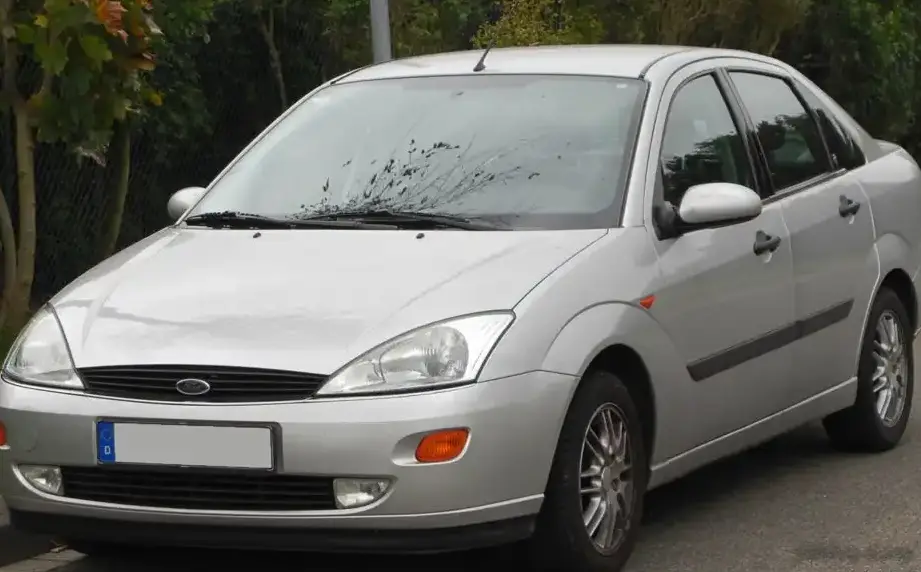
The Ford Focus I Sedan 1.8 TDCi, produced from 2004 to 2005, represented a key offering in Ford’s European and global compact car lineup. This variant, powered by the 1.8-liter turbodiesel engine producing 115 horsepower, was positioned as a fuel-efficient and practical option within the first generation (Mk1) Focus sedan range. It aimed to balance economy with reasonable performance, appealing to drivers prioritizing lower running costs. The Focus Mk1, built on the C170 platform, was a significant departure from its predecessor, the Escort, offering improved handling, safety, and interior space. The sedan body style, while less common in Europe, was specifically tailored for markets like Eastern Europe and parts of Asia where sedan preferences were stronger.
Technical Specifications
| Brand | Ford |
| Model | Focus |
| Generation | Focus I Sedan |
| Type (Engine) | 1.8 TDCi (115 Hp) |
| Start of production | 2004 |
| End of production | 2005 |
| Powertrain Architecture | Internal Combustion engine |
| Body type | Sedan |
| Seats | 5 |
| Doors | 4 |
| Fuel consumption (urban) | 7.2 l/100 km (32.7 US mpg) |
| Fuel consumption (extra urban) | 4.4 l/100 km (53.5 US mpg) |
| Fuel consumption (combined) | 5.4 l/100 km (43.6 US mpg) |
| Fuel Type | Diesel |
| Acceleration 0 – 100 km/h | 10.8 sec |
| Acceleration 0 – 62 mph | 10.8 sec |
| Acceleration 0 – 60 mph | 10.3 sec |
| Maximum speed | 196 km/h (121.79 mph) |
| Weight-to-power ratio | 11.3 kg/Hp |
| Weight-to-torque ratio | 5.2 kg/Nm |
| Power | 115 Hp @ 3800 rpm |
| Torque | 250 Nm @ 2000 rpm (184.39 lb.-ft. @ 2000 rpm) |
| Engine layout | Front, Transverse |
| Engine Model/Code | F9DA |
| Engine displacement | 1753 cm3 (106.97 cu. in.) |
| Number of cylinders | 4 |
| Engine configuration | Inline |
| Cylinder Bore | 82.5 mm (3.25 in.) |
| Piston Stroke | 82 mm (3.23 in.) |
| Compression ratio | 18.5:1 |
| Number of valves per cylinder | 2 |
| Fuel injection system | Diesel Commonrail |
| Engine aspiration | Turbocharger, Intercooler |
| Valvetrain | OHC |
| Engine oil capacity | 5.6 l (5.92 US qt | 4.93 UK qt) |
| Coolant capacity | 6.5 l (6.87 US qt | 5.72 UK qt) |
| Kerb Weight | 1300 kg (2866.01 lbs.) |
| Max. weight | 1725 kg (3802.97 lbs.) |
| Max load | 425 kg (936.96 lbs.) |
| Trunk (boot) space – minimum | 490 l (17.3 cu. ft.) |
| Fuel tank capacity | 53 l (14 US gal | 11.66 UK gal) |
| Length | 4369 mm (172.01 in.) |
| Width | 1702 mm (67.01 in.) |
| Height | 1481 mm (58.31 in.) |
| Wheelbase | 2615 mm (102.95 in.) |
| Front track | 1484 mm (58.43 in.) |
| Rear track | 1477 mm (58.15 in.) |
| Drivetrain Architecture | Front wheel drive |
| Number of gears | 5 |
| Gearbox type | Manual transmission |
| Front suspension | Wishbone |
| Rear suspension | Coil spring |
| Front brakes | Ventilated discs |
| Rear brakes | Disc |
| Assisting systems | ABS (Anti-lock braking system) |
| Steering type | Steering rack and pinion |
| Power steering | Hydraulic |
| Tires size | 195/60 R 15 |
Powertrain & Engine Architecture
The heart of the Focus 1.8 TDCi was the F9DA engine, a 1.8-liter inline-four cylinder diesel. This engine was part of Ford’s Duratorq family, known for its robust construction and relatively simple design. It utilized a common rail direct injection system, delivering fuel at extremely high pressure for improved combustion efficiency and reduced emissions. The engine featured an overhead camshaft (OHC) valvetrain with two valves per cylinder. A turbocharger with an intercooler was employed to boost power output and improve torque across the rev range. The 1.8 TDCi engine produced 115 horsepower at 3800 rpm and 250 Nm (184 lb-ft) of torque at 2000 rpm. This torque figure was a key strength, providing good low-end grunt for everyday driving. The engine was paired with a five-speed manual transmission, which was the most common configuration. While an automatic transmission was offered in some markets, it was less frequently seen with this specific engine.
Driving Characteristics
The 1.8 TDCi with the five-speed manual gearbox offered a practical and economical driving experience. Acceleration to 60 mph took around 10.3 seconds, and top speed was approximately 122 mph. While not a performance-oriented variant, the engine’s torque made it feel responsive in everyday driving situations. The gear ratios were well-matched, providing adequate acceleration in each gear. Compared to the higher-output 1.8 TDCi versions (typically around 125 hp), this 115 hp variant felt less eager to rev, but it offered superior fuel economy. Against petrol-powered Focus models, the 1.8 TDCi provided significantly better fuel efficiency, but lacked the immediate responsiveness of the gasoline engines.
Equipment & Trim Levels
The 1.8 TDCi typically came equipped with a reasonable level of standard features. These included power steering, central locking, electric front windows, and an ABS anti-lock braking system. Interior upholstery was usually cloth, and the dashboard featured a functional, if somewhat basic, design. Optional extras included air conditioning, alloy wheels, a CD player, and upgraded interior trim. Trim levels varied by market, but generally, the 1.8 TDCi sat in the mid-range of the Focus lineup, offering a good balance of features and affordability.
Chassis & Braking
The Focus Mk1 chassis was a significant improvement over the Escort it replaced. It featured independent front suspension with wishbones and a coil spring rear suspension. This setup provided good handling and ride comfort. The 1.8 TDCi models typically used ventilated disc brakes at the front and solid disc brakes at the rear. The braking system was effective, and the ABS system provided added safety. The suspension was tuned to provide a comfortable ride without sacrificing handling, making it a well-rounded performer for everyday driving.
Market Reception & Comparison
The Ford Focus 1.8 TDCi was generally well-received by automotive critics. It was praised for its fuel efficiency, comfortable ride, and good handling. However, some critics noted that the engine could be somewhat noisy and lacked the refinement of some competitors. Compared to other engines in the Focus lineup, the 1.8 TDCi offered the best fuel economy, making it a popular choice for drivers covering long distances. It was often compared to the Volkswagen Golf TDI, which was a benchmark in the compact diesel segment. The Focus generally offered a more engaging driving experience, while the Golf was often praised for its build quality and refinement.
Legacy
The Ford Focus 1.8 TDCi has proven to be a relatively reliable powertrain. The Duratorq engine is known for its durability, and with regular maintenance, it can cover high mileages. However, like all diesel engines, it is susceptible to issues with the fuel injection system and turbocharger. In the used car market, the 1.8 TDCi models are often sought after for their fuel efficiency and affordability. They represent a practical and economical choice for drivers looking for a reliable compact car. While not a collector’s item, the Focus 1.8 TDCi remains a popular and well-regarded vehicle among those seeking a sensible and dependable mode of transportation.