Technical Specifications
| Brand | Ford |
| Model | Focus |
| Generation | Focus II Hatchback |
| Type (Engine) | 1.6 TDCi (90 Hp) |
| Start of production | 2005 |
| End of production | 2010 |
| Powertrain Architecture | Internal Combustion engine |
| Body type | Hatchback |
| Seats | 5 |
| Doors | 3/5 |
| Fuel consumption (urban) | 5.9 l/100 km (39.9 US mpg, 47.9 UK mpg, 16.9 km/l) |
| Fuel consumption (extra urban) | 4 l/100 km (58.8 US mpg, 70.6 UK mpg, 25 km/l) |
| Fuel Type | Diesel |
| Acceleration 0 – 100 km/h | 12.6 sec |
| Acceleration 0 – 62 mph | 12.6 sec |
| Acceleration 0 – 60 mph | 12 sec |
| Maximum speed | 177 km/h (109.98 mph) |
| Weight-to-power ratio | 14.3 kg/Hp, 69.8 Hp/tonne |
| Weight-to-torque ratio | 6 kg/Nm, 166.7 Nm/tonne |
| Power | 90 Hp @ 4000 rpm |
| Power per litre | 57.7 Hp/l |
| Torque | 215 Nm @ 1750 rpm (158.58 lb.-ft. @ 1750 rpm) |
| Engine layout | Front, Transverse |
| Engine Model/Code | HHDA, HHDB, GPDA, GPDC |
| Engine displacement | 1560 cm3 (95.2 cu. in.) |
| Number of cylinders | 4 |
| Engine configuration | Inline |
| Cylinder Bore | 75 mm (2.95 in.) |
| Piston Stroke | 88.3 mm (3.48 in.) |
| Compression ratio | 18.3:1 |
| Number of valves per cylinder | 4 |
| Fuel injection system | Diesel Commonrail |
| Engine aspiration | Turbocharger, Intercooler |
| Engine oil capacity | 3.8 l (4.02 US qt | 3.34 UK qt) |
| Coolant | 7.3 l (7.71 US qt | 6.42 UK qt) |
| Kerb Weight | 1290 kg (2843.96 lbs.) |
| Max. weight | 1790 kg (3946.27 lbs.) |
| Max load | 500 kg (1102.31 lbs.) |
| Trunk (boot) space – minimum | 385 l (13.6 cu. ft.) |
| Trunk (boot) space – maximum | 1247 l (44.04 cu. ft.) |
| Fuel tank capacity | 53 l (14 US gal | 11.66 UK gal) |
| Length | 4342 mm (170.94 in.) |
| Width | 1840 mm (72.44 in.) |
| Height | 1497 mm (58.94 in.) |
| Wheelbase | 2640 mm (103.94 in.) |
| Front track | 1535 mm (60.43 in.) |
| Rear (Back) track | 1531 mm (60.28 in.) |
| Drivetrain Architecture | The Internal combustion engine (ICE) drives the front wheels of the vehicle. |
| Drive wheel | Front wheel drive |
| Number of gears and type of gearbox | 5 gears, manual transmission |
| Front suspension | Spring Strut |
| Rear suspension | Transverse stabilizer |
| Front brakes | Ventilated discs |
| Rear brakes | Drum |
| Steering type | Steering rack and pinion |
| Tires size | 195/65 R15 |
| Wheel rims size | 6J x 15 |
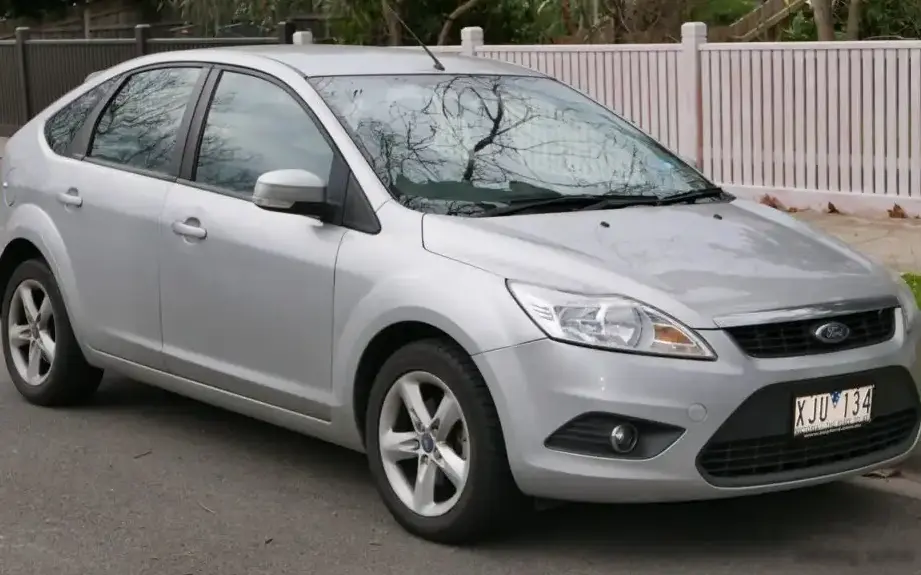
The Ford Focus II Hatchback 1.6 TDCi, producing 90 horsepower, was a significant offering in the European Ford lineup from 2005 to 2010. Positioned as an entry-level diesel variant within the second generation Focus (internally designated as the 1HX0/A3 platform), it aimed to provide fuel efficiency and practicality to a broad customer base. This model was particularly popular in markets where diesel fuel was more affordable and government incentives favored lower-emission vehicles. While not sold in significant numbers in the US market, the Focus II represented Ford’s commitment to a globally competitive small car platform.
Powertrain & Engine Architecture
The heart of the Focus II 1.6 TDCi was the Duratorq engine family, specifically the 1.6-liter inline-four diesel. Engine codes HHDA, HHDB, GPDA, and GPDC were commonly found in this variant, with minor variations depending on the specific market and emissions regulations. This engine utilized a common rail direct injection system, delivering fuel at extremely high pressure for optimized combustion. A turbocharger with an intercooler was employed to boost power output and improve torque across a wider rev range. The engine featured four valves per cylinder and a robust engine block designed for durability. The 90 horsepower output was achieved at 4000 rpm, while peak torque of 215 Nm (158.58 lb-ft) was available from as low as 1750 rpm. The transmission was typically a five-speed manual gearbox, although a four-speed automatic transmission was also offered, albeit less common. The automatic transmission, while providing convenience, generally resulted in slightly reduced fuel economy and acceleration compared to the manual version.
Driving Characteristics
The 1.6 TDCi 90 hp Focus II offered a practical and economical driving experience. Acceleration was adequate for everyday driving, with a 0-60 mph time of around 12 seconds. However, it wasn’t a particularly sporty performer. The engine’s strong low-end torque made it well-suited for navigating city streets and overtaking at moderate speeds. The five-speed manual gearbox provided precise shifts, while the optional automatic transmission offered smooth, if somewhat slower, gear changes. Compared to the higher-output 1.6 TDCi variants (110-115 hp) or the petrol-powered models, the 90 hp version felt noticeably less powerful, especially when fully loaded or tackling steep inclines. The gear ratios were optimized for fuel efficiency rather than outright performance.
Equipment & Trim Levels
The 1.6 TDCi 90 hp typically represented the entry-level diesel offering in the Focus II range. Standard equipment generally included power steering, central locking, electric front windows, and an adjustable steering column. Air conditioning was often an optional extra. Interior upholstery was typically cloth, with a functional, if somewhat basic, dashboard layout. Higher trim levels, such as LX or Ghia, added features like alloy wheels, upgraded audio systems, climate control, and more luxurious interior trim. Safety features included ABS brakes, driver and passenger airbags, and seatbelt pretensioners.
Chassis & Braking
The Focus II utilized a MacPherson strut front suspension and a multi-link rear suspension, providing a good balance between ride comfort and handling. The 1.6 TDCi models typically featured ventilated disc brakes at the front and drum brakes at the rear. Stabilizer bars were fitted to both the front and rear axles to reduce body roll during cornering. The suspension setup was tuned to prioritize comfort and stability, rather than outright sportiness. The steering was precise and responsive, providing good feedback to the driver.
Market Reception & Comparison
The Ford Focus II 1.6 TDCi 90 hp was generally well-received by automotive critics as a practical and fuel-efficient small car. It was praised for its comfortable ride, good handling, and economical engine. However, some critics noted that the engine lacked outright power, particularly when compared to higher-output alternatives. In terms of fuel economy, the 1.6 TDCi consistently outperformed the petrol-powered models, making it an attractive option for drivers covering long distances. Reliability was generally good, although some owners reported issues with the diesel particulate filter (DPF) and the common rail injection system. Compared to rivals like the Volkswagen Golf and Opel/Vauxhall Astra, the Focus II offered a competitive package in terms of price, features, and fuel efficiency.
Legacy
The Ford Focus II 1.6 TDCi 90 hp remains a relatively common sight on European roads today. The Duratorq engine, while not without its potential issues, proved to be reasonably durable and reliable when properly maintained. The availability of spare parts is generally good, and the car’s relatively simple mechanical design makes it relatively easy to repair. In the used car market, these models are typically affordable and represent a good value for money, particularly for buyers seeking a fuel-efficient and practical hatchback. However, potential buyers should be aware of the potential for DPF issues and ensure that the car has been regularly serviced.