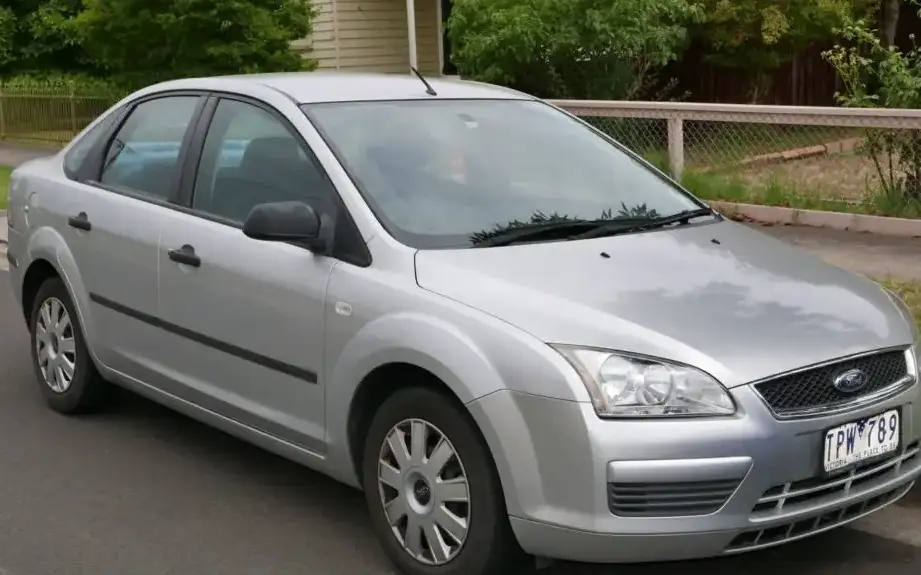
The Ford Focus II Sedan 1.6 Duratec Ti-VCT 16V (115 hp) was a popular variant of the second-generation Focus, produced between 2005 and 2010. Positioned as a mainstream offering within the Focus lineup, it aimed to provide a balance of fuel efficiency, affordability, and practicality for the average driver. This model was primarily sold in Europe and other international markets, where the sedan body style remained in demand. While the Focus was a significant success in North America, the second generation was only offered as a hatchback and wagon, making the sedan version a distinctly global offering.
Technical Specifications
| Brand | Ford |
| Model | Focus |
| Generation | Focus II Sedan |
| Type (Engine) | 1.6 Duratec Ti-VCT 16V (115 Hp) |
| Start of production | 2005 |
| End of production | 2010 |
| Powertrain Architecture | Internal Combustion engine |
| Body type | Sedan |
| Seats | 5 |
| Doors | 4 |
| Fuel consumption (urban) | 8.7 l/100 km (27 US mpg, 32.5 UK mpg, 11.5 km/l) |
| Fuel consumption (extra urban) | 5.1 l/100 km (46.1 US mpg, 55.4 UK mpg, 19.6 km/l) |
| Fuel Type | Petrol (Gasoline) |
| Acceleration 0 – 100 km/h | 10.9 sec |
| Acceleration 0 – 62 mph | 10.9 sec |
| Acceleration 0 – 60 mph | 10.4 sec |
| Maximum speed | 193 km/h (119.92 mph) |
| Weight-to-power ratio | 11.1 kg/Hp, 89.9 Hp/tonne |
| Weight-to-torque ratio | 8.3 kg/Nm, 121.2 Nm/tonne |
| Power | 115 Hp @ 6000 rpm |
| Power per litre | 72.1 Hp/l |
| Torque | 155 Nm @ 4150 rpm (114.32 lb.-ft. @ 4150 rpm) |
| Engine layout | Front, Transverse |
| Engine Model/Code | HXDA, HXDB |
| Engine displacement | 1596 cm3 (97.39 cu. in.) |
| Number of cylinders | 4 |
| Engine configuration | Inline |
| Cylinder Bore | 79 mm (3.11 in.) |
| Piston Stroke | 81.4 mm (3.2 in.) |
| Compression ratio | 11:1 |
| Number of valves per cylinder | 4 |
| Fuel injection system | Multi-port manifold injection |
| Engine aspiration | Naturally aspirated engine |
| Valvetrain | DOHC |
| Engine oil capacity | 4.1 l (4.33 US qt | 3.61 UK qt) |
| Coolant | 6 l (6.34 US qt | 5.28 UK qt) |
| Kerb Weight | 1279 kg (2819.71 lbs.) |
| Max. weight | 1765 kg (3891.16 lbs.) |
| Max load | 486 kg (1071.45 lbs.) |
| Trunk (boot) space – minimum | 467 l (16.49 cu. ft.) |
| Trunk (boot) space – maximum | 931 l (32.88 cu. ft.) |
| Fuel tank capacity | 55 l (14.53 US gal | 12.1 UK gal) |
| Length | 4488 mm (176.69 in.) |
| Width | 1840 mm (72.44 in.) |
| Height | 1497 mm (58.94 in.) |
| Wheelbase | 2640 mm (103.94 in.) |
| Front track | 1535 mm (60.43 in.) |
| Rear (Back) track | 1531 mm (60.28 in.) |
| Drivetrain Architecture | The Internal combustion engine (ICE) drives the front wheels of the vehicle. |
| Drive wheel | Front wheel drive |
| Number of gears and type of gearbox | 5 gears, manual transmission |
| Front suspension | Spring Strut |
| Rear suspension | Transverse stabilizer |
| Front brakes | Disc |
| Rear brakes | Disc |
| Steering type | Steering rack and pinion |
| Tires size | 205/55 R16 |
Powertrain & Engine Architecture
The heart of this Focus variant was the 1.6-liter Duratec Ti-VCT inline-four engine. The ‘Ti-VCT’ designation stands for Twin Independent Variable Camshaft Timing, a technology that allowed for optimized valve timing for both intake and exhaust valves, improving both performance and fuel efficiency. Engine codes HXDA and HXDB were commonly used, with minor variations depending on specific market requirements. The engine utilized a multi-port fuel injection system, delivering fuel directly into the intake ports. The DOHC (Double Overhead Camshaft) valvetrain further contributed to the engine’s breathing efficiency. The 1.6L engine produced 115 horsepower at 6000 rpm and 155 Nm (114 lb-ft) of torque at 4150 rpm. This power was delivered to the front wheels through a five-speed manual transmission, which was the most common configuration. While an automatic transmission was offered in some markets, it was less prevalent and often resulted in slightly reduced performance and fuel economy.
Driving Characteristics
The 1.6L Duratec Ti-VCT with the five-speed manual transmission provided adequate, though not exhilarating, performance. Acceleration from 0-60 mph took around 10.4 seconds, and the top speed was approximately 119.92 mph. The engine felt relatively responsive in the mid-range, making it suitable for everyday driving. However, it lacked the punch of the higher-output 1.8L or diesel variants. The five-speed gearbox was well-matched to the engine’s characteristics, offering smooth shifts and reasonable gear ratios. Compared to the more powerful versions, this variant prioritized fuel economy and ease of driving over outright performance. The lighter weight of the 1.6L engine also contributed to slightly improved handling compared to the heavier 1.8L models.
Equipment & Trim Levels
The 1.6L Focus Sedan typically came with a reasonable level of standard equipment. This included power steering, air conditioning, electric front windows, and a basic audio system. Higher trim levels, such as the ‘Comfort’ or ‘Trend’ variants, added features like alloy wheels, upgraded upholstery, a multi-function steering wheel, and more advanced audio systems. Optional extras included a sunroof, rear parking sensors, and upgraded safety features. Interior upholstery was typically cloth, with a relatively simple and functional dashboard layout. The overall interior design was geared towards practicality and durability rather than luxury.
Chassis & Braking
The Focus II Sedan utilized a MacPherson strut front suspension and a multi-link rear suspension, providing a good balance of ride comfort and handling. The suspension was tuned for everyday driving, offering a compliant ride on most road surfaces. Front and rear disc brakes provided adequate stopping power, although the rear drums found on some base models offered less performance. The steering was a rack-and-pinion system, providing precise and responsive steering feel. The standard tire size was 205/55 R16, offering a good compromise between grip and comfort.
Market Reception & Comparison
The 1.6L Duratec Ti-VCT Focus Sedan was generally well-received by critics as a practical and affordable family car. It was praised for its fuel efficiency, comfortable ride, and decent handling. However, it was often criticized for its lack of power compared to the higher-output variants. Compared to the 1.8L models, the 1.6L offered better fuel economy but less performance. The diesel variants, such as the 1.6 TDCi, provided even better fuel economy and more torque, but at a higher initial cost. The 1.6L variant appealed to buyers who prioritized economy and practicality over performance, making it a popular choice for families and commuters.
Legacy
The 1.6L Duratec Ti-VCT engine proved to be a relatively reliable powertrain. While not without its quirks, it generally required routine maintenance and was not prone to major mechanical failures. In the used car market, the 1.6L Focus Sedan remains an affordable and practical option. Its fuel efficiency and relatively low running costs make it an attractive choice for budget-conscious buyers. However, potential buyers should be aware of the potential for age-related issues, such as worn suspension components and corrosion. Overall, the 1.6L Duratec Ti-VCT Focus Sedan represents a solid and dependable choice in the used car market, offering a good balance of practicality, affordability, and reliability.