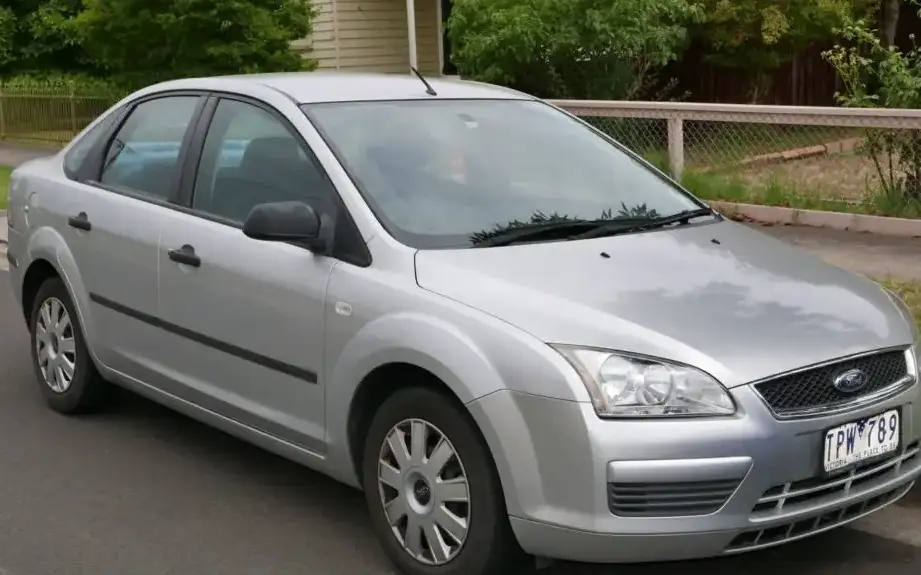
The Ford Focus II Sedan 1.8i 16V, produced between 2006 and 2010, represented a significant step forward for Ford’s compact offerings in the global market. Positioned as a mainstream, family-oriented vehicle, the Focus II aimed to deliver a blend of practicality, affordability, and reasonable performance. This particular 1.8-liter variant, generating 125 horsepower, served as a key entry point into the Focus sedan range, appealing to buyers prioritizing fuel efficiency and a comfortable driving experience over outright speed. It was built on the C170 platform, shared with other Ford and Mazda models, and represented a substantial redesign over the first-generation Focus.
Technical Specifications
| Brand | Ford |
| Model | Focus |
| Generation | Focus II Sedan |
| Type (Engine) | 1.8 i 16V (125 Hp) |
| Start of production | 2006 |
| End of production | 2010 |
| Powertrain Architecture | Internal Combustion engine |
| Body type | Sedan |
| Seats | 5 |
| Doors | 4 |
| Fuel consumption (urban) | 9.6 l/100 km (24.5 US mpg) |
| Fuel consumption (extra urban) | 5.6 l/100 km (42 US mpg) |
| Fuel Type | Petrol (Gasoline) |
| Acceleration 0 – 100 km/h | 10.6 sec |
| Acceleration 0 – 62 mph | 10.6 sec |
| Acceleration 0 – 60 mph | 10.1 sec |
| Maximum speed | 193 km/h (119.92 mph) |
| Weight-to-power ratio | 10.4 kg/Hp |
| Weight-to-torque ratio | 7.8 kg/Nm |
| Power | 125 Hp @ 6000 rpm |
| Torque | 165 Nm @ 4000 rpm (121.7 lb.-ft. @ 4000 rpm) |
| Engine Model/Code | QQDB |
| Engine displacement | 1798 cm3 (109.72 cu. in.) |
| Number of cylinders | 4 |
| Engine configuration | Inline |
| Cylinder Bore | 83 mm (3.27 in.) |
| Piston Stroke | 83.1 mm (3.27 in.) |
| Compression ratio | 10.8:1 |
| Number of valves per cylinder | 4 |
| Fuel injection system | Multi-port manifold injection |
| Engine aspiration | Naturally aspirated |
| Engine oil capacity | 4.3 l (4.54 US qt | 3.78 UK qt) |
| Coolant capacity | 6.5 l (6.87 US qt | 5.72 UK qt) |
| Kerb Weight | 1295 kg (2854.99 lbs.) |
| Max. weight | 1810 kg (3990.37 lbs.) |
| Max load | 515 kg (1135.38 lbs.) |
| Trunk (boot) space – minimum | 467 l (16.49 cu. ft.) |
| Trunk (boot) space – maximum | 872 l (30.79 cu. ft.) |
| Fuel tank capacity | 55 l (14.53 US gal | 12.1 UK gal) |
| Length | 4488 mm (176.69 in.) |
| Width | 1840 mm (72.44 in.) |
| Height | 1497 mm (58.94 in.) |
| Wheelbase | 2640 mm (103.94 in.) |
| Front track | 1535 mm (60.43 in.) |
| Rear track | 1531 mm (60.28 in.) |
| Drivetrain Architecture | Front wheel drive |
| Number of gears | 5 |
| Gearbox type | Manual transmission |
| Front suspension | Independent, McPherson with coil spring and anti-roll bar |
| Rear suspension | Independent multi-link with stabilizer |
| Front brakes | Disc |
| Rear brakes | Drum |
| Steering type | Steering rack and pinion |
| Tires size | 195/65R15 |
Powertrain & Engine Architecture
The heart of the Focus II 1.8i is the QQDB engine, a 1.8-liter inline-four cylinder gasoline engine. This engine belongs to Ford’s Duratec family, known for its relatively simple design and durability. The QQDB features a dual overhead camshaft (DOHC) design with four valves per cylinder, contributing to improved breathing and efficiency. Fuel delivery is managed by a multi-port fuel injection system, providing precise fuel metering for optimal combustion. The engine’s 10.8:1 compression ratio strikes a balance between performance and fuel economy. Paired with this engine was a five-speed manual transmission, offering a traditional driving experience. While an automatic transmission was available, the manual was favored by those seeking better fuel economy and more driver engagement.
Driving Characteristics
The 1.8-liter engine in the Focus II Sedan delivers a respectable, though not exhilarating, driving experience. With 125 horsepower and 165 Nm (121.7 lb-ft) of torque, acceleration from 0 to 60 mph takes around 10.1 seconds. The engine feels most comfortable in the mid-range, providing adequate power for everyday driving situations like highway merging and overtaking. The five-speed manual transmission allows drivers to keep the engine in its optimal power band. Compared to the higher-performance variants, such as those equipped with the 2.0-liter Duratec engine, the 1.8i feels noticeably less powerful. However, it offers a smoother and more refined driving experience, particularly in urban environments. The gear ratios are well-matched for everyday usability, prioritizing fuel efficiency over outright speed.
Equipment & Trim Levels
The 1.8i trim level of the Focus II Sedan typically included standard features such as air conditioning, power windows, power door locks, and a basic audio system. Safety features included dual front airbags, ABS brakes, and electronic brakeforce distribution (EBD). Higher trim levels, such as the Ghia, offered additional features like alloy wheels, upgraded interior trim, and a more sophisticated audio system. Optional extras included a sunroof, rear parking sensors, and a trip computer. The interior upholstery was typically cloth, with a functional and durable design. The dashboard layout was straightforward and user-friendly, prioritizing ease of use.
Chassis & Braking
The Focus II Sedan utilizes an independent front suspension with McPherson struts and a coil spring, coupled with an independent multi-link rear suspension. This suspension setup provides a comfortable ride quality while maintaining good handling characteristics. The front brakes are disc brakes, offering adequate stopping power, while the rear brakes are drum brakes, a cost-saving measure for this trim level. A stabilizer bar is included on both the front and rear axles to reduce body roll during cornering. The steering is rack and pinion, providing precise and responsive steering feel. The 195/65R15 tires offer a good balance between comfort and grip.
Market Reception & Comparison
The Ford Focus II Sedan 1.8i was generally well-received by automotive critics as a practical and affordable family car. It was praised for its comfortable ride, spacious interior, and good fuel economy. However, some critics noted that the 1.8-liter engine lacked the power and refinement of some of its competitors. Compared to other trims in the Focus lineup, the 1.8i offered the best value for money, making it an attractive option for budget-conscious buyers. Its fuel economy was notably better than the higher-output 2.0-liter variants, making it a popular choice for those who prioritized efficiency. Reliability was generally good, with few major issues reported.
Legacy
The Ford Focus II Sedan 1.8i has proven to be a reliable and durable vehicle, with many examples still on the road today. The QQDB engine is known for its longevity, and routine maintenance is relatively straightforward and affordable. In the used car market, the 1.8i represents a good value proposition, offering a practical and dependable mode of transportation at a reasonable price. While it may not be the most exciting car to drive, its blend of affordability, fuel efficiency, and reliability has ensured its continued popularity among budget-minded car buyers. The Focus II generation, as a whole, helped solidify Ford’s reputation for building well-rounded and dependable compact cars.