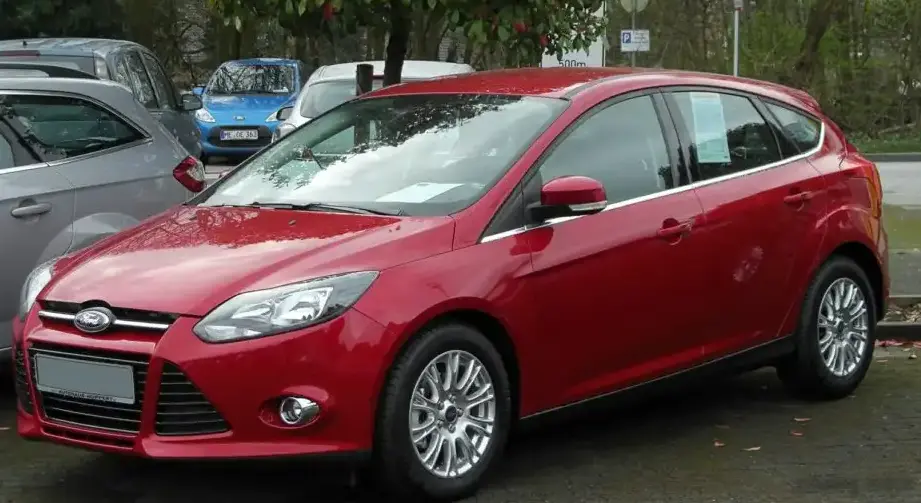
The Ford Focus III Hatchback, produced from 2010 to 2014, represented a significant step forward for Ford’s global compact car. Within the Focus III range, the 1.0 EcoBoost 100 horsepower variant with the Start/Stop system occupied an important position as an entry-level offering focused on fuel efficiency and affordability. This model was primarily aimed at European and Asian markets, where smaller displacement engines were favored due to taxation and fuel costs, but it also saw limited availability in North America. The 1.0 EcoBoost engine was a key component of Ford’s strategy to offer technologically advanced, fuel-efficient options across its lineup.
Technical Specifications
| Brand | Ford |
| Model | Focus |
| Generation | Focus III Hatchback |
| Type (Engine) | 1.0 EcoBoost (100 Hp) start/stop |
| Start of production | 2010 |
| End of production | 2014 |
| Powertrain Architecture | Internal Combustion engine |
| Body type | Hatchback |
| Seats | 5 |
| Doors | 5 |
| Fuel consumption (urban) | 5.8 l/100 km (40.6 US mpg, 48.7 UK mpg, 17.2 km/l) |
| Fuel consumption (extra urban) | 4.1 l/100 km (57.4 US mpg, 68.9 UK mpg, 24.4 km/l) |
| Fuel consumption (combined) | 4.7 l/100 km (50 US mpg, 60.1 UK mpg, 21.3 km/l) |
| Fuel Type | Petrol (Gasoline) |
| Acceleration 0 – 100 km/h | 12.5 sec |
| Acceleration 0 – 62 mph | 12.5 sec |
| Acceleration 0 – 60 mph | 11.9 sec |
| Maximum speed | 185 km/h (114.95 mph) |
| Power | 100 Hp |
| Engine layout | Front, Transverse |
| Engine Model/Code | M2DA |
| Engine configuration | Inline |
| Fuel injection system | Direct injection |
| Engine aspiration | Turbocharger, Intercooler |
| Engine oil capacity | 4.1 l (4.33 US qt, 3.61 UK qt) |
| Coolant capacity | 6.3 l (6.66 US qt, 5.54 UK qt) |
| Engine systems | Start & Stop System |
| Drivetrain Architecture | Front wheel drive, Internal Combustion Engine |
| Number of gears and type of gearbox | 5 gears, manual transmission |
| Assisting systems | ABS (Anti-lock braking system) |
| Steering type | Steering rack and pinion |
Powertrain & Engine Architecture
The heart of this Focus variant is the 1.0-liter EcoBoost inline-three cylinder engine, designated with the engine code M2DA. This engine was a revolutionary design for Ford, combining direct fuel injection, a single scroll turbocharger, and variable valve timing to deliver a surprising amount of power from such a small displacement. The direct injection system allowed for precise fuel delivery, optimizing combustion efficiency and reducing emissions. The turbocharger, coupled with an intercooler, boosted power output by forcing more air into the cylinders. The engine utilized a timing chain, contributing to its longevity and reduced maintenance requirements. The 100 horsepower version of the 1.0 EcoBoost produced approximately 140 Nm (103 lb-ft) of torque. This engine was paired with a five-speed manual transmission, chosen for its simplicity and efficiency. While an automatic transmission was offered in some Focus III models, it wasn’t typically paired with the base 100 hp EcoBoost engine.
Driving Characteristics
The 1.0 EcoBoost 100 hp Focus offered a surprisingly sprightly driving experience, particularly considering its small engine size. While not a performance-oriented model, the turbocharger provided a noticeable boost in power during acceleration. The five-speed manual transmission allowed drivers to keep the engine in its optimal power band. However, the engine did require frequent downshifting, especially when tackling hills or overtaking. Compared to the higher-output 125 hp version of the 1.0 EcoBoost, the 100 hp model felt noticeably less powerful, with a slower 0-60 mph time of around 12.5 seconds. The gear ratios were tuned for fuel economy rather than outright performance. The steering was precise and responsive, typical of the Focus III, providing a confident feel on the road.
Equipment & Trim Levels
The 1.0 EcoBoost 100 hp model typically served as the entry point to the Focus III range. Standard equipment generally included air conditioning, power windows, power door locks, a basic audio system with USB connectivity, and ABS brakes. Interior upholstery was typically cloth, and the dashboard featured a straightforward design. Optional extras included alloy wheels, upgraded audio systems, a trip computer, and parking sensors. Higher trim levels, such as the Titanium, offered more luxurious features like leather upholstery, automatic climate control, and a navigation system. The base trim focused on providing essential features at an affordable price point.
Chassis & Braking
The Focus III utilized a MacPherson strut front suspension and a multi-link rear suspension, providing a good balance between ride comfort and handling. The 1.0 EcoBoost models typically featured smaller wheels and tires compared to higher-performance variants. Braking systems varied depending on the market and trim level. Many models were equipped with front disc brakes and rear drum brakes, while some higher-spec versions received rear disc brakes. The ABS system was standard, providing enhanced braking control in emergency situations. Stabilizer bars were fitted to both the front and rear axles to reduce body roll during cornering.
Market Reception & Comparison
The 1.0 EcoBoost 100 hp Focus was generally well-received by critics for its fuel efficiency and surprisingly capable engine. It was praised for offering a good balance between affordability and practicality. However, some reviewers noted that the engine could feel strained when fully loaded or driving uphill. Compared to the 1.6-liter naturally aspirated engine offered in earlier Focus models, the 1.0 EcoBoost provided better fuel economy and comparable performance. Against the 125 hp version of the same engine, the 100 hp model offered a lower purchase price but sacrificed some performance. The 1.6-liter diesel variants were also popular, offering even better fuel economy but at a higher initial cost.
Legacy
The 1.0 EcoBoost engine proved to be a remarkably reliable powertrain, with many examples still on the road today. The engine’s timing chain design contributed to its longevity, reducing the need for costly timing belt replacements. While some owners have reported issues with the turbocharger or fuel injectors, these are relatively uncommon. The 1.0 EcoBoost 100 hp Focus remains a popular choice in the used car market, particularly for buyers seeking a fuel-efficient and affordable compact hatchback. Its combination of practicality, economy, and surprisingly enjoyable driving dynamics has ensured its continued relevance in the years since its production ended.