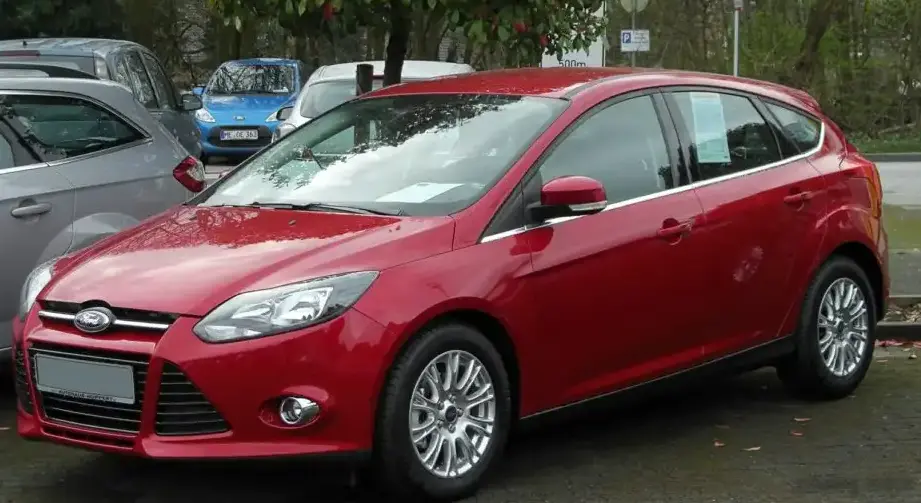
The Ford Focus III Hatchback, produced from 2010 to 2014, represented a significant step forward for Ford’s global compact car. The 1.6 Ti-VCT (125 hp) variant equipped with the Powershift dual-clutch transmission was a key offering in the European market, and later introduced to North America. This model aimed to balance fuel efficiency with acceptable performance, targeting buyers seeking a practical and modern hatchback. It sat within the Focus III range as a mid-range option, positioned above the base 1.0 EcoBoost models and below the higher-performance 1.6 EcoBoost and diesel variants.
Technical Specifications
| Brand | Ford |
| Model | Focus |
| Generation | Focus III Hatchback |
| Type (Engine) | 1.6 Ti-VCT (125 Hp) Powershift |
| Start of production | 2010 |
| End of production | 2014 |
| Powertrain Architecture | Internal Combustion engine |
| Body type | Hatchback |
| Seats | 5 |
| Doors | 5 |
| Fuel consumption (urban) | 8.7 l/100 km (27 US mpg, 32.5 UK mpg, 11.5 km/l) |
| Fuel consumption (extra urban) | 4.9 l/100 km (48 US mpg, 57.6 UK mpg, 20.4 km/l) |
| Fuel consumption (combined) | 6.3 l/100 km (37.3 US mpg, 44.8 UK mpg, 15.9 km/l) |
| Fuel Type | Petrol (Gasoline) |
| Acceleration 0 – 100 km/h | 11.7 sec |
| Acceleration 0 – 62 mph | 11.7 sec |
| Acceleration 0 – 60 mph | 11.1 sec |
| Maximum speed | 193 km/h (119.92 mph) |
| Power | 125 Hp |
| Engine layout | Front, Transverse |
| Engine Model/Code | PNDA |
| Engine configuration | Inline |
| Fuel injection system | Multi-port manifold injection |
| Engine aspiration | Naturally aspirated engine |
| Engine oil capacity | 4.1 l (4.33 US qt, 3.61 UK qt) |
| Coolant capacity | 5.8 l (6.13 US qt, 5.1 UK qt) |
| Drivetrain Architecture | Front wheel drive, Internal Combustion Engine |
| Number of gears | 6 |
| Gearbox type | Automatic transmission (Powershift) |
| Assisting systems | ABS (Anti-lock braking system) |
| Steering type | Steering rack and pinion |
Powertrain & Engine Architecture
The heart of this Focus variant is the PNDA 1.6-liter inline-four cylinder engine. This engine utilizes Ti-VCT (Twin Independent Variable Camshaft Timing) technology, allowing for optimized valve timing on both the intake and exhaust sides. This improves both power delivery and fuel efficiency. The engine employs multi-port fuel injection, a relatively conventional system for its time, delivering fuel directly into the intake ports. The PNDA engine is a naturally aspirated design, meaning it doesn’t rely on turbocharging or supercharging for increased power. The Powershift transmission is a six-speed dual-clutch transmission (DCT), essentially two manual transmissions in one housing, allowing for quick and smooth gear changes. It operates in a fully automatic mode but also offers a manual shift mode via steering wheel-mounted paddles or the gear selector.
Driving Characteristics
The 1.6 Ti-VCT with Powershift offered a comfortable and refined driving experience. While not particularly sporty, the 125 hp output provided adequate power for everyday driving situations. Acceleration from 0-60 mph in around 11.1 seconds was respectable for the class. The Powershift transmission contributed to smooth gear changes, particularly during normal driving. However, some drivers noted occasional hesitation or jerkiness at low speeds, a common characteristic of early dual-clutch transmissions. The gear ratios were tuned for fuel efficiency, with a relatively tall final drive. Compared to the manual transmission version of the 1.6 Ti-VCT, the Powershift offered greater convenience, but slightly reduced fuel economy and a less engaging driving experience. The higher-output 1.6 EcoBoost models provided significantly more performance, while the diesel variants offered superior fuel economy.
Equipment & Trim Levels
The 1.6 Ti-VCT Powershift typically came equipped with a reasonable level of standard features. These included air conditioning, power windows and mirrors, a basic audio system with USB connectivity, and ABS brakes. Higher trim levels, such as the SEL and Limited, added features like alloy wheels, upgraded audio systems, automatic climate control, and a sunroof. Interior upholstery was typically cloth, with options for leather available on higher trims. The dashboard layout was functional and modern, with a focus on ergonomics. Optional extras included navigation systems, parking sensors, and a rearview camera.
Chassis & Braking
The Focus III utilized a MacPherson strut front suspension and a multi-link rear suspension, providing a good balance of ride comfort and handling. The 1.6 Ti-VCT models typically featured smaller diameter alloy wheels and tires compared to the higher-performance variants. Braking systems consisted of disc brakes on the front wheels and drum brakes on the rear wheels for most trims. Anti-lock Braking System (ABS) was standard. Stabilizer bars were fitted to both the front and rear axles to reduce body roll during cornering. The suspension tuning was geared towards comfort, making it a pleasant vehicle for long journeys.
Market Reception & Comparison
The Ford Focus III 1.6 Ti-VCT Powershift received generally positive reviews. Critics praised its comfortable ride, refined interior, and fuel efficiency. However, the Powershift transmission received some criticism for its occasional hesitation and lack of smoothness at low speeds. Compared to the manual transmission version, the Powershift offered greater convenience but slightly lower fuel economy. The 1.6 Ti-VCT was seen as a good all-rounder, suitable for a wide range of drivers. The diesel variants were favored by those prioritizing fuel economy, while the EcoBoost models appealed to drivers seeking more performance.
Legacy
The Ford Focus III 1.6 Ti-VCT Powershift has proven to be a relatively reliable vehicle, although the Powershift transmission has been the source of some issues. Common problems include clutch wear and transmission control module failures. Regular maintenance, including fluid changes, is crucial for ensuring the longevity of the transmission. In the used car market, these Focus models represent a good value proposition, offering a comfortable and well-equipped hatchback at an affordable price. However, potential buyers should be aware of the potential issues with the Powershift transmission and factor in the cost of potential repairs. The Focus III, in general, helped solidify Ford’s reputation for building competent and well-rounded compact cars.