Technical Specifications
| Brand | Ford |
| Model | Focus |
| Generation | Focus III Hatchback |
| Type (Engine) | 2.0 TDCi (115 Hp) PowerShift |
| Start of production | December, 2010 |
| End of production | September, 2014 |
| Powertrain Architecture | Internal Combustion engine |
| Body type | Hatchback |
| Seats | 5 |
| Doors | 5 |
| Fuel consumption (urban) | 6.6-6.8 l/100 km (35.6 – 34.6 US mpg, 42.8 – 41.5 UK mpg, 15.2 – 14.7 km/l) |
| Fuel consumption (extra urban) | 4.3-4.4 l/100 km (54.7 – 53.5 US mpg, 65.7 – 64.2 UK mpg, 23.3 – 22.7 km/l) |
| Fuel consumption (combined) | 5.2-5.3 l/100 km (45.2 – 44.4 US mpg, 54.3 – 53.3 UK mpg, 19.2 – 18.9 km/l) |
| CO2 emissions | 134-139 g/km |
| Fuel Type | Diesel |
| Acceleration 0 – 100 km/h | 10.9 sec |
| Acceleration 0 – 62 mph | 10.9 sec |
| Acceleration 0 – 60 mph | 10.4 sec |
| Maximum speed | 196 km/h (121.79 mph) |
| Emission standard | Euro 5 |
| Weight-to-power ratio | 12.1 kg/Hp, 83 Hp/tonne |
| Weight-to-torque ratio | 4.6 kg/Nm, 216.5 Nm/tonne |
| Power | 115 Hp @ 3750 rpm |
| Power per litre | 57.6 Hp/l |
| Torque | 300 Nm @ 1500-2250 rpm (221.27 lb.-ft. @ 1500-2250 rpm) |
| Engine layout | Front, Transverse |
| Engine Model/Code | TYDA |
| Engine displacement | 1997 cm3 (121.86 cu. in.) |
| Number of cylinders | 4 |
| Engine configuration | Inline |
| Cylinder Bore | 85 mm (3.35 in.) |
| Piston Stroke | 88 mm (3.46 in.) |
| Number of valves per cylinder | 4 |
| Fuel injection system | Diesel Commonrail |
| Engine aspiration | Turbocharger, Intercooler |
| Valvetrain | DOHC |
| Engine oil capacity | 5.7 l (6.02 US qt | 5.02 UK qt) |
| Coolant | 8.5 l (8.98 US qt | 7.48 UK qt) |
| Kerb Weight | 1386 kg (3055.61 lbs.) |
| Max. weight | 2050 kg (4519.48 lbs.) |
| Max load | 664 kg (1463.87 lbs.) |
| Trunk (boot) space – minimum | 316 l (11.16 cu. ft.) |
| Trunk (boot) space – maximum | 1101 l (38.88 cu. ft.) |
| Fuel tank capacity | 60 l (15.85 US gal | 13.2 UK gal) |
| Permitted trailer load with brakes (12%) | 1500 kg (3306.93 lbs.) |
| Permitted trailer load without brakes | 740 kg (1631.42 lbs.) |
| Length | 4358 mm (171.57 in.) |
| Width | 1823 mm (71.77 in.) |
| Width with mirrors folded | 1858 mm (73.15 in.) |
| Width including mirrors | 2010 mm (79.13 in.) |
| Height | 1484 mm (58.43 in.) |
| Wheelbase | 2648 mm (104.25 in.) |
| Front track | 1544-1559 mm (60.79 – 61.38 in.) |
| Rear (Back) track | 1534-1549 mm (60.39 – 60.98 in.) |
| Minimum turning circle | 11 m (36.09 ft.) |
| Drivetrain Architecture | The Internal combustion engine (ICE) drives the front wheels of the vehicle. |
| Drive wheel | Front wheel drive |
| Number of gears and type of gearbox | 6 gears, automatic transmission PowerShift |
| Front suspension | Independent, type McPherson with coil spring and anti-roll bar |
| Rear suspension | Independent multi-link spring suspension with stabilizer |
| Front brakes | Ventilated discs |
| Rear brakes | Drum |
| Assisting systems | ABS (Anti-lock braking system) |
| Steering type | Steering rack and pinion |
| Power steering | Electric Steering |
| Tires size | 215/55 R16; 215/50 R17; 235/40 R18 |
| Wheel rims size | 7J x 16; 7J x 17; 8J x 18 |
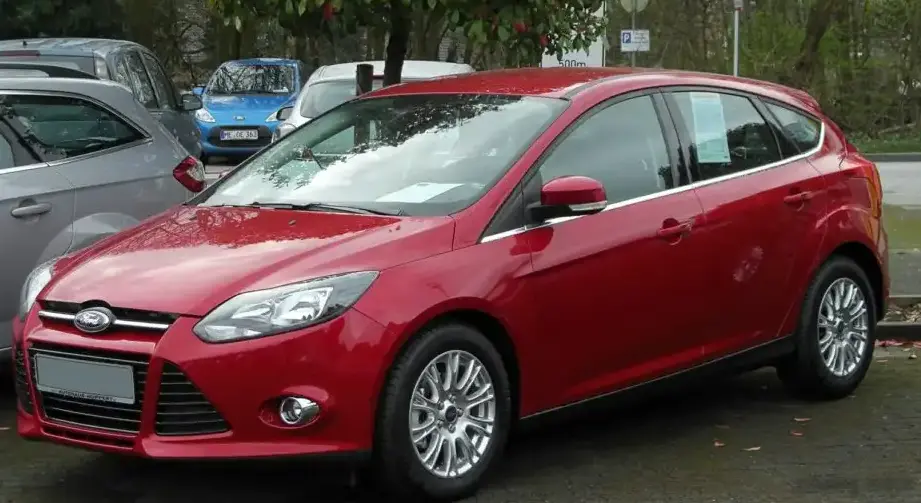
The Ford Focus III Hatchback 2.0 TDCi (115 hp) PowerShift, produced from December 2010 to September 2014, was a significant offering within the third generation of Ford’s globally successful Focus model. Positioned as a mid-range option, this variant aimed to balance fuel efficiency with respectable performance, appealing to buyers seeking a practical and economical family hatchback. It was a key component of Ford of Europe’s strategy to offer a diverse range of powertrains within the C-segment, catering to varying customer needs and preferences. The 2.0 TDCi PowerShift utilized the Ford’s 1HX0/A3 platform, shared with other models like the C-Max and Kuga, providing a solid foundation for its engineering.
Powertrain & Engine Architecture
The heart of this Focus variant is the 2.0-liter TYDA turbodiesel engine. This engine belongs to Ford’s Duratorque family, known for its robust construction and fuel efficiency. The TYDA engine utilizes a common-rail direct injection system, delivering fuel at extremely high pressures for optimized combustion. This system, coupled with a variable geometry turbocharger and intercooler, allows for a broad torque curve, peaking at 300 Nm (221 lb-ft) between 1500 and 2250 rpm. The engine features a double overhead camshaft (DOHC) valvetrain with four valves per cylinder, enhancing breathing and contributing to its power output of 115 hp at 3750 rpm. The PowerShift transmission is a 6-speed dual-clutch transmission (DCT). This transmission offers quicker and smoother gear changes compared to a traditional automatic, contributing to improved fuel economy and a more engaging driving experience. It operates similarly to automated manual transmissions, using two separate clutches for odd and even gears.
Driving Characteristics
The 2.0 TDCi 115 hp PowerShift Focus offers a comfortable and refined driving experience. While not overtly sporty, the engine provides sufficient power for everyday driving and highway cruising. The PowerShift transmission contributes to smooth acceleration, although some drivers have noted occasional hesitation at low speeds. The gear ratios are tuned for fuel efficiency, meaning the engine doesn’t rev as high as in some performance-oriented variants. Compared to the higher-output 2.0 TDCi versions (163 hp), this variant feels noticeably less powerful, particularly during overtaking maneuvers. However, it offers superior fuel economy and a more relaxed driving experience. Against the petrol-powered 1.6 Ti-VCT models, the 2.0 TDCi provides significantly more torque, making it more effortless in everyday situations, despite a slightly slower 0-60 mph time.
Equipment & Trim Levels
The 2.0 TDCi 115 hp PowerShift typically came equipped as a mid-range trim level, often designated as ‘Zetec’ or ‘Titanium’ depending on the market. Standard features generally included air conditioning, electric front windows, a CD/radio system with USB connectivity, alloy wheels, and ABS brakes. Higher trim levels, like the Titanium, added features such as automatic headlights and rain-sensing wipers, rear parking sensors, and upgraded interior trim. Optional extras included a panoramic sunroof, leather upholstery, and a navigation system. Interior upholstery was typically cloth, with higher trims offering partial leather options.
Chassis & Braking
The Focus III utilized a McPherson strut front suspension and a multi-link rear suspension, providing a good balance between ride comfort and handling. The 2.0 TDCi variant, due to its increased weight compared to lower-powered models, often featured slightly stiffer springs and dampers to maintain composure. Front brakes were typically ventilated discs, while rear brakes were drum brakes on lower trims and discs on higher trims. The electric power steering provided a light and precise feel, making it easy to maneuver in urban environments. Stabilizer bars were fitted to both the front and rear axles to reduce body roll during cornering.
Market Reception & Comparison
The 2.0 TDCi 115 hp PowerShift Focus was generally well-received by automotive critics. It was praised for its fuel efficiency, comfortable ride, and refined powertrain. However, some reviewers noted the PowerShift transmission could be occasionally jerky at low speeds. Compared to the 1.6 TDCi variant, the 2.0 TDCi offered more power and torque, making it a more versatile option for those who frequently carry passengers or travel long distances. In terms of reliability, the 2.0 TDCi engine proved to be generally robust, although the PowerShift transmission was known to have some issues in early production years, including clutch wear and software glitches.
Legacy
The Ford Focus III 2.0 TDCi 115 hp PowerShift remains a popular choice in the used car market, particularly for buyers seeking a practical and economical family hatchback. While the PowerShift transmission requires careful inspection due to its potential issues, a well-maintained example can provide years of reliable service. The engine’s durability and fuel efficiency continue to be strong selling points. This variant represents a key step in Ford’s development of efficient and technologically advanced vehicles, paving the way for future generations of the Focus and other models.