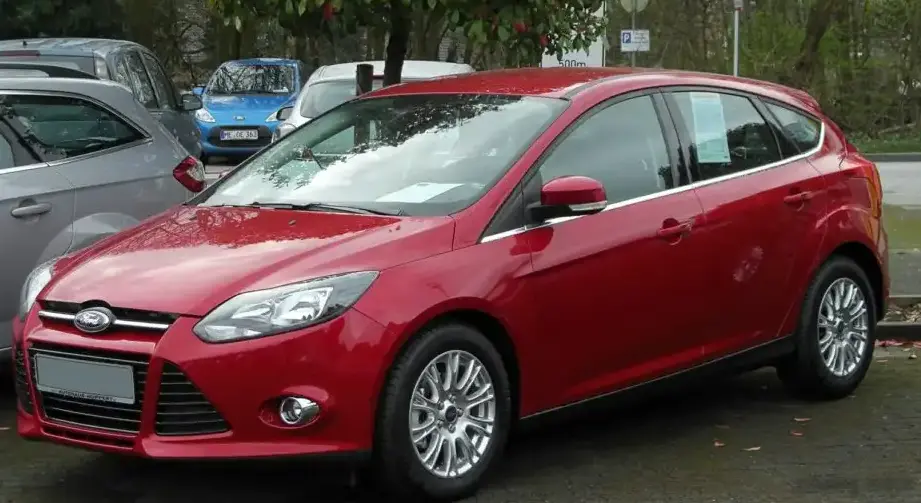
The Ford Focus III Hatchback, produced from 2010 to 2014, represented a significant step forward for Ford’s global compact car. The 2.0 Ti-VCT variant, generating 160 horsepower, occupied a mid-range position within the Focus III lineup, offering a balance between performance and fuel efficiency. This model was primarily aimed at the North American and European markets, where consumers desired a practical yet engaging driving experience. It was built on the C170 platform, shared with other Ford and Mazda vehicles, and represented a move towards more sophisticated engineering and design compared to its predecessors.
Technical Specifications
| Brand | Ford |
| Model | Focus |
| Generation | Focus III Hatchback |
| Type (Engine) | 2.0 Ti-VCT (160 Hp) |
| Start of production | 2010 |
| End of production | 2014 |
| Powertrain Architecture | Internal Combustion engine |
| Body type | Hatchback |
| Seats | 5 |
| Doors | 5 |
| Fuel consumption (urban) | 9 l/100 km (26.1 US mpg) |
| Fuel consumption (extra urban) | 6.5 l/100 km (36.2 US mpg) |
| Fuel consumption (combined) | 7.8 l/100 km (30.2 US mpg) |
| Fuel Type | Petrol (Gasoline) |
| Emission standard | SULEV |
| Weight-to-power ratio | 8.3 kg/Hp |
| Weight-to-torque ratio | 6.7 kg/Nm |
| Power | 160 Hp @ 6500 rpm |
| Power per litre | 80 Hp/l |
| Torque | 198 Nm @ 4450 rpm (146.04 lb.-ft. @ 4450 rpm) |
| Engine layout | Front, Transverse |
| Engine Model/Code | Duratec |
| Engine displacement | 1999 cm3 (121.99 cu. in.) |
| Number of cylinders | 4 |
| Engine configuration | Inline |
| Cylinder Bore | 87.5 mm (3.44 in.) |
| Piston Stroke | 83.1 mm (3.27 in.) |
| Compression ratio | 12:1 |
| Number of valves per cylinder | 4 |
| Fuel injection system | Direct injection |
| Engine aspiration | Naturally aspirated engine |
| Valvetrain | DOHC, Ti-VCT |
| Engine oil capacity | 4.3 l (4.54 US qt | 3.78 UK qt) |
| Coolant capacity | 5 l (5.28 US qt | 4.4 UK qt) |
| Kerb Weight | 1324 kg (2918.92 lbs.) |
| Trunk (boot) space – minimum | 316 l (11.16 cu. ft.) |
| Trunk (boot) space – maximum | 1101 l (38.88 cu. ft.) |
| Fuel tank capacity | 47 l (12.42 US gal | 10.34 UK gal) |
| Length | 4359 mm (171.61 in.) |
| Width | 1824 mm (71.81 in.) |
| Height | 1466 mm (57.72 in.) |
| Wheelbase | 2649 mm (104.29 in.) |
| Front track | 1554 mm (61.18 in.) |
| Rear track | 1534 mm (60.39 in.) |
| Minimum turning circle | 11 m (36.09 ft.) |
| Drivetrain Architecture | Front wheel drive |
| Number of gears | 5 |
| Gearbox type | Manual transmission |
| Front suspension | Independent, McPherson with coil spring and anti-roll bar |
| Rear suspension | Independent multi-link spring suspension with stabilizer |
| Front brakes | Ventilated discs, 278 mm |
| Rear brakes | Drum, 228 mm |
| Assisting systems | ABS (Anti-lock braking system) |
| Steering type | Steering rack and pinion |
| Power steering | Electric Steering |
| Tires size | 195/65 R15; 215/55 R16; 215/50 R17; 235/40 R18 |
| Wheel rims size | 15; 16; 17; 18 |
Powertrain & Engine Architecture
The heart of the 2.0 Ti-VCT Focus was the Duratec 2.0-liter inline-four engine. This engine utilized direct fuel injection and Ford’s Twin Independent Variable Camshaft Timing (Ti-VCT) technology. Ti-VCT allowed for independent control of intake and exhaust valve timing, optimizing engine performance across the rev range and improving fuel efficiency. The engine produced 160 horsepower at 6500 rpm and 198 Nm (146 lb-ft) of torque at 4450 rpm. The 5-speed manual transmission was the standard offering, providing a direct connection to the engine and allowing for driver engagement. The transmission’s gear ratios were tuned to balance acceleration and fuel economy, with a relatively tall fifth gear for highway cruising.
Driving Characteristics
The 2.0 Ti-VCT Focus offered a noticeably more spirited driving experience than the base 1.6-liter engine. While not a performance-oriented model like the Focus ST, the 160 hp engine provided ample power for everyday driving and confident highway merging. The manual transmission allowed drivers to fully utilize the engine’s powerband, although the shift quality was sometimes criticized for being slightly notchy. Compared to the higher-output versions, the 2.0L offered a more balanced feel, prioritizing usability over outright speed. The power delivery was linear, making it easy to modulate throttle inputs and maintain control in various driving conditions.
Equipment & Trim Levels
The 2.0 Ti-VCT trim typically included standard features such as air conditioning, power windows and locks, a basic audio system with auxiliary input, and steel wheels with wheel covers. Higher trim levels, such as the SEL and Limited, added features like alloy wheels, upgraded audio systems, automatic climate control, and a sunroof. Optional extras included a navigation system, leather upholstery, and a rear parking sensor system. Interior upholstery was typically cloth, with higher trims offering leather options. The dashboard layout was functional and straightforward, prioritizing ease of use over stylistic flair.
Chassis & Braking
The Focus III utilized an independent front suspension with McPherson struts and a multi-link independent rear suspension. This setup provided a comfortable ride while maintaining good handling characteristics. The front brakes were ventilated discs, providing adequate stopping power, while the rear brakes were drum brakes on most trims. ABS (Anti-lock Braking System) was standard. The suspension tuning was geared towards comfort and everyday usability, rather than aggressive cornering. Stabilizer bars were included both front and rear to reduce body roll during cornering.
Market Reception & Comparison
The 2.0 Ti-VCT Focus was generally well-received by automotive critics. It was praised for its balanced performance, fuel efficiency, and comfortable ride. However, some reviewers noted that the interior materials felt somewhat cheap compared to competitors. Compared to the base 1.6-liter engine, the 2.0 Ti-VCT offered a significant performance upgrade, making it a more appealing option for drivers who prioritized driving enjoyment. Fuel economy was competitive within its class, averaging around 30.2 US mpg in combined driving. Reliability was generally good, although some owners reported minor issues with the fuel pump and ignition coils.
Legacy
The 2.0 Ti-VCT Focus III remains a popular choice in the used car market due to its affordability, practicality, and relatively good reliability. The Duratec engine is known for its durability, and with proper maintenance, it can provide many years of reliable service. While not a collector’s item, the 2.0 Ti-VCT Focus represents a solid and well-rounded compact car that offers a good balance of performance, fuel efficiency, and features. Parts availability is generally good, making it a relatively easy vehicle to maintain and repair. The model helped solidify the Focus’s reputation as a competent and enjoyable compact car in a competitive segment.