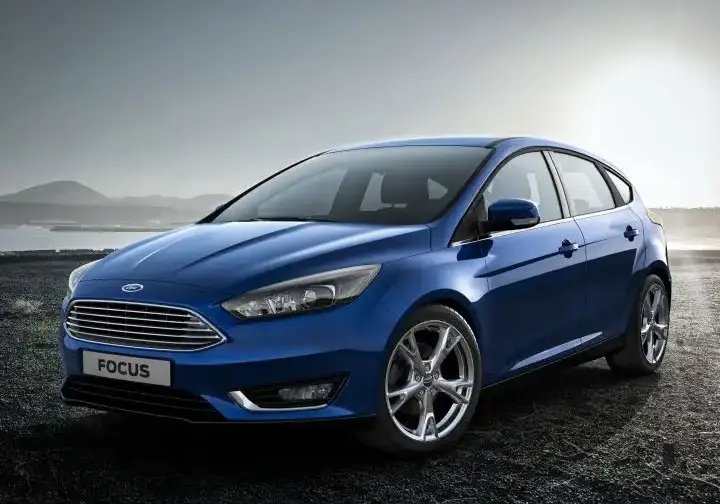
The Ford Focus III, particularly the facelifted version introduced in 2014, represented a significant step forward for Ford’s global compact car. Among the various engine and transmission options offered, the 1.5 TDCi 95 horsepower variant with a manual transmission was a popular choice, especially in European markets. Produced from 2014 through 2018, this version aimed to balance fuel efficiency with everyday usability, positioning itself as an entry-level to mid-range offering within the Focus III lineup. It was designed to appeal to drivers prioritizing economy and practicality over outright performance.
Technical Specifications
| Brand | Ford |
| Model | Focus |
| Generation | Focus III Hatchback (facelift 2014) |
| Type (Engine) | 1.5 TDCi (95 Hp) S&S |
| Start of production | 2014 |
| End of production | 2018 |
| Powertrain Architecture | Internal Combustion engine |
| Body type | Hatchback |
| Seats | 5 |
| Doors | 5 |
| Fuel consumption (urban) | 4.3 l/100 km (54.7 US mpg, 65.7 UK mpg, 23.3 km/l) |
| Fuel consumption (extra urban) | 3.4 l/100 km (69.2 US mpg, 83.1 UK mpg, 29.4 km/l) |
| Fuel consumption (combined) | 3.8 l/100 km (61.9 US mpg, 74.3 UK mpg, 26.3 km/l) |
| CO2 emissions | 98 g/km |
| Fuel Type | Diesel |
| Acceleration 0 – 100 km/h | 12 sec |
| Acceleration 0 – 62 mph | 12 sec |
| Acceleration 0 – 60 mph | 11.4 sec |
| Maximum speed | 182 km/h (113.09 mph) |
| Emission standard | Euro 6 |
| Weight-to-power ratio | 14.1 kg/Hp, 71 Hp/tonne |
| Weight-to-torque ratio | 5 kg/Nm, 201.8 Nm/tonne |
| Power | 95 Hp @ 3600 rpm |
| Power per litre | 63.4 Hp/l |
| Torque | 270 Nm @ 1500-2000 rpm (199.14 lb.-ft. @ 1500-2000 rpm) |
| Engine layout | Front, Transverse |
| Engine Model/Code | XXDA, XXDC |
| Engine displacement | 1499 cm3 (91.47 cu. in.) |
| Number of cylinders | 4 |
| Engine configuration | Inline |
| Cylinder Bore | 73.5 mm (2.89 in.) |
| Piston Stroke | 88.3 mm (3.48 in.) |
| Compression ratio | 16:1 |
| Number of valves per cylinder | 2 |
| Fuel injection system | Diesel Commonrail |
| Engine aspiration | Turbocharger, Intercooler |
| Valvetrain | SOHC |
| Engine oil capacity | 3.85 l (4.07 US qt | 3.39 UK qt) |
| Coolant | 7.3 l (7.71 US qt | 6.42 UK qt) |
| Kerb Weight | 1338 kg (2949.79 lbs.) |
| Max. weight | 1900 kg (4188.78 lbs.) |
| Max load | 562 kg (1239 lbs.) |
| Trunk (boot) space – minimum | 277 l (9.78 cu. ft.) |
| Trunk (boot) space – maximum | 1062 l (37.5 cu. ft.) |
| Fuel tank capacity | 53 l (14 US gal | 11.66 UK gal) |
| Length | 4358 mm (171.57 in.) |
| Width | 1823 mm (71.77 in.) |
| Height | 1484 mm (58.43 in.) |
| Wheelbase | 2648 mm (104.25 in.) |
| Front track | 1544 mm (60.79 in.) |
| Rear (Back) track | 1559 mm (61.38 in.) |
| Minimum turning circle | 11 m (36.09 ft.) |
| Drivetrain Architecture | Front wheel drive |
| Number of gears | 6 gears, manual transmission |
| Front suspension | Independent, type McPherson with coil spring and anti-roll bar |
| Rear suspension | Independent multi-link suspension |
| Front brakes | Disc |
| Rear brakes | Drum |
| Assisting systems | ABS (Anti-lock braking system) |
| Steering type | Steering rack and pinion |
| Tires size | 205/55 R16; 215/50 R17 |
| Wheel rims size | 6.5J x 16; 7.0J x 17 |
Powertrain & Engine Architecture
The heart of this Focus variant is the 1.5-liter TDCi diesel engine, specifically utilizing the XXDA or XXDC engine codes depending on the exact specification and market. This engine is a four-cylinder, inline configuration, employing a turbocharger with intercooling to boost power and efficiency. The engine features a common-rail direct fuel injection system, delivering fuel directly into the cylinders at extremely high pressure for optimized combustion. A single overhead camshaft (SOHC) controls the two valves per cylinder. The 16:1 compression ratio is typical for diesel engines, contributing to their inherent efficiency. The engine’s design prioritizes low-end torque, making it well-suited for everyday driving. The 6-speed manual transmission was the standard offering, providing a good balance between fuel economy and driver control.
Driving Characteristics
The 95 horsepower output and 270 Nm (199 lb-ft) of torque deliver adequate, though not exhilarating, performance. Acceleration from 0-60 mph takes around 11.4 seconds, and top speed is around 113 mph. The engine’s strength lies in its mid-range torque, making it easy to maintain speed on highways and navigate city traffic. The manual transmission allows for precise control, but the gear ratios are tuned for economy rather than sporty driving. Compared to higher-output versions of the Focus III, such as those with the 1.5 EcoBoost petrol engine, this diesel variant feels noticeably slower. However, it offers significantly better fuel economy. Compared to the 1.6 TDCi models it replaced, the 1.5 TDCi offered improved refinement and slightly better fuel efficiency.
Equipment & Trim Levels
The 1.5 TDCi 95 hp model typically came equipped with standard features like air conditioning, power windows, power mirrors, and a basic audio system. Safety features included ABS, electronic stability control, and multiple airbags. Higher trim levels, such as Titanium or Zetec, added features like alloy wheels, upgraded audio systems, climate control, and parking sensors. Optional extras included navigation systems, leather upholstery, and a sunroof. Interior upholstery was generally cloth, with a functional and durable design. The dashboard layout was typical of the Focus III, with a clear and straightforward instrument cluster.
Chassis & Braking
The Focus III utilizes an independent front suspension with McPherson struts and a multi-link independent rear suspension. This setup provides a good balance between ride comfort and handling. The front brakes are discs, while the rear brakes are drums, a cost-saving measure common in entry-level trims. Anti-lock Braking System (ABS) is standard. Stabilizer bars are fitted to both the front and rear axles to reduce body roll during cornering. The suspension tuning is geared towards comfort, but the Focus III still offers a reasonably engaging driving experience.
Market Reception & Comparison
The 1.5 TDCi 95 hp variant was well-received in Europe as a practical and economical choice. Critics praised its fuel efficiency and low running costs, but some noted its lack of outright performance. Compared to the petrol-powered versions, the diesel offered significantly better fuel economy, making it a popular choice for high-mileage drivers. The 1.5 TDCi was also more affordable than the higher-output diesel variants, such as the 1.5 TDCi 120 hp, making it accessible to a wider range of buyers. Reliability was generally good, although, like all modern diesels, it was susceptible to issues with the diesel particulate filter (DPF) if not driven on longer journeys regularly.
Legacy
The 1.5 TDCi engine proved to be a durable and reliable unit when properly maintained. In the used car market, these Focus models are still relatively common and offer good value for money. However, potential buyers should be aware of the potential for DPF issues and the importance of regular servicing. The Focus III, in general, established a reputation for being a well-rounded and practical family car, and the 1.5 TDCi 95 hp variant played a significant role in its success, particularly for those seeking an economical and reliable daily driver.