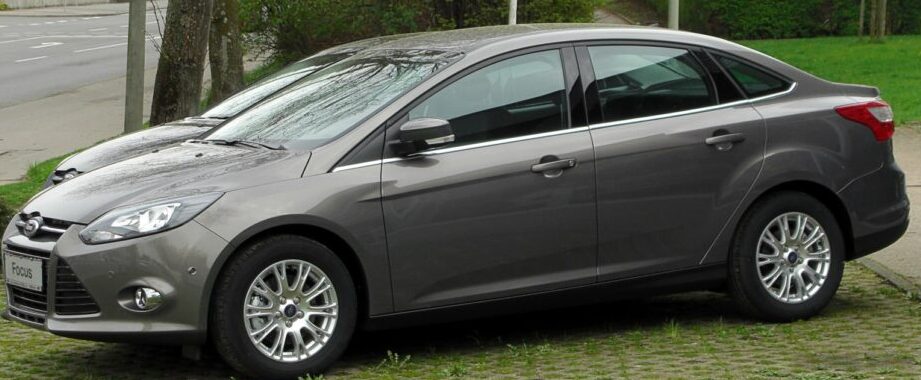
The Ford Focus III Sedan 1.6 Ti-VCT (125 hp) Powershift represents a significant iteration of Ford’s globally successful compact car, produced between 2010 and 2014. This variant was primarily aimed at the North American and European markets, offering a balance between fuel efficiency and acceptable performance within the Focus sedan range. It sat as a mid-range offering, positioned above the base models and below the more powerful, often turbocharged, variants. The Focus III generation, built on the C346 platform, marked a substantial leap forward in terms of interior quality, driving dynamics, and available technology compared to its predecessors.
Technical Specifications
| Brand | Ford |
| Model | Focus |
| Generation | Focus III Sedan |
| Type (Engine) | 1.6 Ti-VCT (125 Hp) Powershift |
| Start of production | 2010 |
| End of production | 2014 |
| Powertrain Architecture | Internal Combustion Engine |
| Body type | Sedan |
| Seats | 5 |
| Doors | 4 |
| Fuel consumption (urban) | 8.7 l/100 km (27 US mpg, 32.5 UK mpg, 11.5 km/l) |
| Fuel consumption (extra urban) | 4.9 l/100 km (48 US mpg, 57.6 UK mpg, 20.4 km/l) |
| Fuel consumption (combined) | 6.3 l/100 km (37.3 US mpg, 44.8 UK mpg, 15.9 km/l) |
| Fuel Type | Petrol (Gasoline) |
| Acceleration 0 – 100 km/h | 11.8 sec |
| Acceleration 0 – 62 mph | 11.8 sec |
| Acceleration 0 – 60 mph | 11.2 sec |
| Maximum speed | 195 km/h (121.17 mph) |
| Power | 125 Hp |
| Engine layout | Front, Transverse |
| Engine Model/Code | PNDA |
| Engine configuration | Inline |
| Fuel injection system | Multi-port manifold injection |
| Engine aspiration | Naturally aspirated |
| Engine oil capacity | 4.1 l (4.33 US qt, 3.61 UK qt) |
| Coolant capacity | 5.8 l (6.13 US qt, 5.1 UK qt) |
| Drivetrain | Front wheel drive |
| Number of gears | 6 |
| Gearbox type | Automatic transmission |
| Assisting systems | ABS (Anti-lock braking system) |
| Steering type | Steering rack and pinion |
Powertrain & Engine Architecture
The heart of this Focus variant is the 1.6-liter Ti-VCT (Twin Independent Variable Camshaft Timing) inline-four cylinder engine, designated with the engine code PNDA. This engine is a naturally aspirated unit, meaning it doesn’t employ forced induction like a turbocharger or supercharger. The Ti-VCT system allows for independent control of both intake and exhaust valve timing, optimizing engine performance and fuel efficiency across a wider range of engine speeds. Fuel delivery is managed by a multi-port fuel injection system, providing precise fuel metering. The engine produces 125 horsepower and a respectable amount of torque for its displacement.
Paired with the 1.6L engine is Ford’s “Powershift” 6-speed dual-clutch transmission (DCT). This transmission, based on the Getrag 6DCT250 unit, offers the efficiency of a manual transmission with the convenience of an automatic. It utilizes two separate clutches – one for odd-numbered gears and one for even-numbered gears – allowing for seamless and rapid gear changes. The Powershift transmission was a key selling point, offering a more engaging driving experience than traditional automatic transmissions.
Driving Characteristics
The 1.6 Ti-VCT with the Powershift transmission delivers a generally smooth and refined driving experience. Acceleration from 0-60 mph takes approximately 11.2 seconds, which is adequate for everyday driving but doesn’t offer particularly sporty performance. The Powershift transmission contributes to a responsive feel, with quick shifts when accelerating. However, some drivers have reported occasional hesitation or jerkiness at low speeds, a common characteristic of early dual-clutch transmissions. The gear ratios are tuned for a balance between fuel economy and usability, providing sufficient power for highway cruising and city driving. Compared to the higher-output 2.0L direct-injection variants, this 1.6L engine feels less powerful, particularly when fully loaded or climbing hills. Manual transmission versions of the 1.6L offered slightly improved fuel economy and a more direct connection to the engine.
Equipment & Trim Levels
The 1.6 Ti-VCT Powershift trim typically included standard features such as air conditioning, power windows and locks, a basic audio system with auxiliary input, and ABS. Higher trim levels, often denoted by “SE” or “SEL” designations, added features like alloy wheels, upgraded audio systems with USB connectivity, cruise control, and a leather-wrapped steering wheel. Optional extras included a sunroof, navigation system, and premium interior upholstery. The interior design of the Focus III was a significant improvement over previous generations, with a more modern and user-friendly layout. The dashboard featured a central information display and well-placed controls.
Chassis & Braking
The Focus III Sedan utilizes a MacPherson strut front suspension and a multi-link rear suspension, providing a comfortable and controlled ride. The suspension tuning is geared towards everyday usability rather than outright sportiness. The braking system typically consists of front disc brakes and rear drum brakes, although some higher trim levels featured rear disc brakes. ABS (Anti-lock Braking System) is standard, enhancing braking performance and stability. The steering is a rack and pinion system, offering precise and responsive steering feel. Stabilizer bars are included on both the front and rear axles to reduce body roll during cornering.
Market Reception & Comparison
The Ford Focus III Sedan 1.6 Ti-VCT Powershift was generally well-received by automotive critics. It was praised for its comfortable ride, refined interior, and fuel efficiency. However, the Powershift transmission received mixed reviews, with some critics noting its occasional hesitation and jerkiness. Compared to the 2.0L direct-injection variants, the 1.6L engine was considered less powerful, but it offered better fuel economy. The 1.6L automatic was often seen as a good choice for drivers prioritizing fuel efficiency and comfort over outright performance. In terms of reliability, the 1.6 Ti-VCT engine itself is generally considered reliable, but the Powershift transmission has been known to experience issues in some cases, including clutch failure and software glitches.
Legacy
The Ford Focus III Sedan 1.6 Ti-VCT Powershift remains a relatively common sight on used car lots today. While the Powershift transmission requires careful inspection due to its potential for issues, the 1.6L engine is generally considered durable and long-lasting. The Focus III generation as a whole established Ford as a serious competitor in the compact car segment, offering a compelling combination of style, comfort, and technology. The 1.6L automatic variant, while not the most exciting version of the Focus, provided a practical and affordable option for buyers seeking a fuel-efficient and comfortable daily driver.