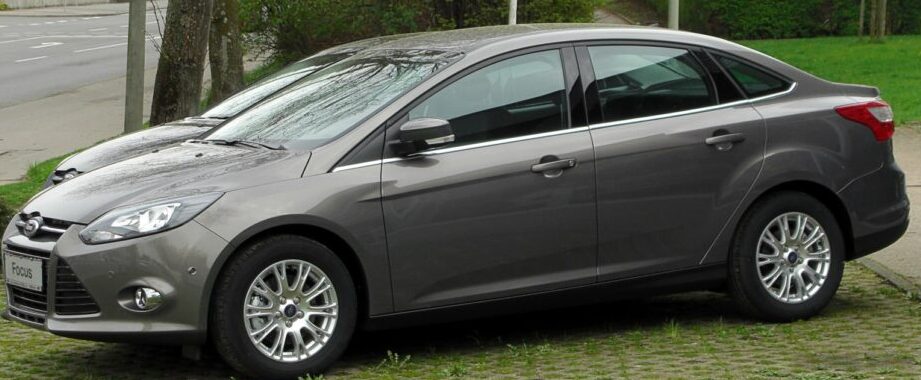
The Ford Focus III Sedan 2.0 TDCi, producing 140 horsepower, was a key variant in Ford’s global compact car lineup from 2010 to 2014. Positioned as a mid-range offering, it aimed to balance fuel efficiency with respectable performance, appealing to buyers seeking a practical and economical sedan. This model represented Ford’s continued commitment to diesel technology in the European market, and its introduction to other regions as consumer demand shifted. The Focus III generation, built on the C346 platform, saw significant improvements in ride quality, handling, and interior refinement compared to its predecessor.
Technical Specifications
| Brand | Ford |
| Model | Focus |
| Generation | Focus III Sedan |
| Type (Engine) | 2.0 TDCi (140 Hp) |
| Start of production | 2010 |
| End of production | 2014 |
| Powertrain Architecture | Internal Combustion engine |
| Body type | Sedan |
| Seats | 5 |
| Doors | 4 |
| Fuel consumption (urban) | 6.1 l/100 km (38.6 US mpg, 46.3 UK mpg, 16.4 km/l) |
| Fuel consumption (extra urban) | 4.1 l/100 km (57.4 US mpg, 68.9 UK mpg, 24.4 km/l) |
| Fuel consumption (combined) | 4.9 l/100 km (48 US mpg, 57.6 UK mpg, 20.4 km/l) |
| Fuel Type | Diesel |
| Acceleration 0 – 100 km/h | 9 sec |
| Acceleration 0 – 62 mph | 9 sec |
| Acceleration 0 – 60 mph | 8.6 sec |
| Maximum speed | 209 km/h (129.87 mph) |
| Power | 140 Hp |
| Engine layout | Front, Transverse |
| Engine Model/Code | UFDB |
| Engine configuration | Inline |
| Fuel injection system | Diesel Commonrail |
| Engine aspiration | Turbocharger, Intercooler |
| Engine oil capacity | 5.7 l (6.02 US qt, 5.02 UK qt) |
| Coolant capacity | 8.5 l (8.98 US qt, 7.48 UK qt) |
| Drivetrain Architecture | Front wheel drive |
| Number of gears | 6 |
| Gearbox type | Manual transmission |
| Assisting systems | ABS (Anti-lock braking system) |
| Steering type | Steering rack and pinion |
Powertrain & Engine Architecture
The heart of the Focus III Sedan 2.0 TDCi is the UFDB engine, a four-cylinder diesel powerplant. This engine is part of Ford’s Duratorq family, known for its robust construction and relatively good fuel economy. The 2.0-liter displacement provides a good balance between power and efficiency. The UFDB utilizes a common rail direct injection system, delivering fuel directly into the cylinders at extremely high pressure. This system, coupled with a variable geometry turbocharger and intercooler, optimizes combustion for increased power and reduced emissions. The engine features a 16-valve DOHC (Double Overhead Camshaft) valvetrain. The six-speed manual transmission was the standard offering for this variant, providing precise gear changes and contributing to the car’s overall efficiency. The transmission’s gear ratios were tuned to maximize torque delivery across a wide speed range.
Driving Characteristics
The 140 horsepower 2.0 TDCi engine in the Focus III Sedan delivers a respectable driving experience. Acceleration from 0 to 60 mph takes approximately 8.6 seconds, making it adequately quick for everyday driving and highway merging. The engine produces a substantial 236 lb-ft of torque, available from a relatively low 2,000 rpm, providing strong pulling power in various driving situations. Compared to the lower-powered 1.6 TDCi variants, the 2.0 TDCi offers noticeably more responsive acceleration and a more relaxed driving experience, particularly when fully loaded or tackling inclines. While not as sporty as the higher-output petrol versions, the 2.0 TDCi provides a good balance of performance and fuel economy. The six-speed manual transmission allows for precise control over the engine’s power band, and the gear ratios are well-matched to the engine’s torque curve.
Equipment & Trim Levels
The 2.0 TDCi variant of the Focus III Sedan typically came equipped with a solid set of standard features. These generally included air conditioning, power windows, power mirrors, a basic audio system with USB connectivity, and ABS brakes. Higher trim levels, such as Titanium, added features like alloy wheels, automatic climate control, a more advanced audio system, cruise control, and parking sensors. Interior upholstery was typically cloth, with leather options available on higher trims. Optional extras included a sunroof, navigation system, and upgraded safety features like side and curtain airbags. The dashboard layout was functional and well-designed, with clear instrumentation and intuitive controls.
Chassis & Braking
The Focus III Sedan features a MacPherson strut front suspension and a multi-link rear suspension. This setup provides a good balance between ride comfort and handling precision. The suspension was tuned to provide a stable and controlled ride, even when carrying a full load. Braking duties were handled by disc brakes on the front wheels and drum brakes on the rear wheels in many configurations, although some higher trim levels featured rear disc brakes. ABS (Anti-lock Braking System) was standard, enhancing braking performance and safety. The steering system utilizes a rack and pinion setup, providing precise and responsive steering feel. Stabilizer bars were fitted to both the front and rear axles to reduce body roll during cornering.
Market Reception & Comparison
The Ford Focus III Sedan 2.0 TDCi was generally well-received by automotive critics. It was praised for its fuel efficiency, comfortable ride, and spacious interior. The 2.0 TDCi engine was considered a good compromise between performance and economy, offering more power than the smaller diesel engines without sacrificing fuel efficiency. Compared to the petrol versions, the 2.0 TDCi offered significantly better fuel economy, making it an attractive option for drivers who covered long distances. However, some critics noted that the engine could be somewhat noisy compared to some of its competitors. In terms of reliability, the Duratorq engine family has a generally good reputation, although regular maintenance is crucial to ensure long-term durability.
Legacy
The Ford Focus III Sedan 2.0 TDCi remains a popular choice in the used car market, particularly in Europe and other regions where diesel vehicles are common. The Duratorq engine is known for its longevity and relatively low maintenance costs, making it a reliable option for budget-conscious buyers. While newer generations of the Focus have been introduced, the III generation continues to offer a good value proposition, providing a comfortable and economical driving experience. The 2.0 TDCi variant, in particular, is sought after by those who prioritize fuel efficiency and torque, making it a practical and versatile choice for a wide range of drivers. Properly maintained examples can still provide many years of reliable service.