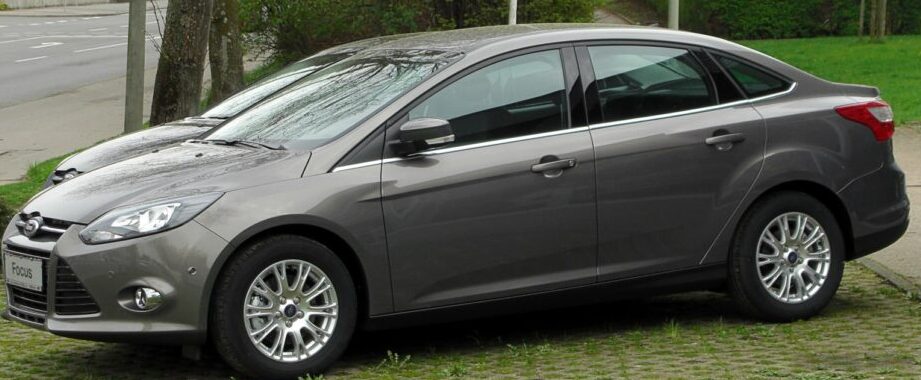
The Ford Focus III Sedan 2.0 TDCi, producing 163 horsepower, was a key variant in the third generation of the globally successful Ford Focus. Introduced in 2010 and continuing through 2014, this model represented Ford’s attempt to offer a fuel-efficient and practical sedan option within the compact car segment, particularly catering to markets where sedan body styles were preferred. It was positioned as a mid-range offering, bridging the gap between the lower-powered diesel options and the higher-performance gasoline variants. The Focus III, built on the C346 platform, aimed to improve upon its predecessors with enhanced refinement, technology, and driving dynamics.
Technical Specifications
| Brand | Ford |
| Model | Focus |
| Generation | Focus III Sedan |
| Type (Engine) | 2.0 TDCi (163 Hp) |
| Start of production | 2010 |
| End of production | 2014 |
| Powertrain Architecture | Internal Combustion engine |
| Body type | Sedan |
| Seats | 5 |
| Doors | 4 |
| Fuel consumption (urban) | 6.1 l/100 km (38.6 US mpg, 46.3 UK mpg, 16.4 km/l) |
| Fuel consumption (extra urban) | 4.1 l/100 km (57.4 US mpg, 68.9 UK mpg, 24.4 km/l) |
| Fuel consumption (combined) | 4.9 l/100 km (48 US mpg, 57.6 UK mpg, 20.4 km/l) |
| Fuel Type | Diesel |
| Acceleration 0 – 100 km/h | 8.7 sec |
| Acceleration 0 – 62 mph | 8.7 sec |
| Acceleration 0 – 60 mph | 8.3 sec |
| Maximum speed | 220 km/h (136.7 mph) |
| Power | 163 Hp |
| Engine layout | Front, Transverse |
| Engine Model/Code | TXDB |
| Engine configuration | Inline |
| Fuel injection system | Diesel Commonrail |
| Engine aspiration | Turbocharger, Intercooler |
| Engine oil capacity | 5.7 l (6.02 US qt, 5.02 UK qt) |
| Coolant capacity | 8.5 l (8.98 US qt, 7.48 UK qt) |
| Drivetrain Architecture | Front wheel drive |
| Number of gears | 6 |
| Gearbox type | Manual transmission |
| Assisting systems | ABS (Anti-lock braking system) |
| Steering type | Steering rack and pinion |
Powertrain & Engine Architecture
The heart of the Focus III Sedan 2.0 TDCi was the TXDB engine, a four-cylinder diesel engine displacing 1998cc. This engine belonged to Ford’s Duratorq family, known for its robust construction and relatively good fuel economy. The TXDB utilized a common rail direct injection system, delivering fuel at extremely high pressures for optimized combustion. A turbocharger with an intercooler was employed to increase power output and improve torque across the rev range. The engine featured four valves per cylinder (DOHC) and utilized a timing belt for valve actuation. The 2.0 TDCi engine produced 163 horsepower at 3,500 rpm and a substantial 258 lb-ft of torque at 2,000 rpm. This torque output was a key characteristic, providing strong pulling power for everyday driving and overtaking maneuvers. The engine was paired with a six-speed manual transmission, offering precise gear changes and contributing to the vehicle’s overall efficiency.
Driving Characteristics
The 2.0 TDCi engine provided a noticeably more spirited driving experience compared to the lower-powered 1.6 TDCi variants. The increased horsepower and torque allowed for quicker acceleration and more confident highway cruising. The six-speed manual transmission was well-matched to the engine’s characteristics, providing a good balance between performance and fuel economy. While not a sports car, the Focus III Sedan 2.0 TDCi offered a composed and stable ride, with predictable handling. The gear ratios were tuned to maximize fuel efficiency at cruising speeds, while still providing ample power for overtaking. Compared to the gasoline-powered Focus models, the 2.0 TDCi offered superior fuel economy and a broader torque curve, making it a more practical choice for drivers covering long distances.
Equipment & Trim Levels
The 2.0 TDCi variant of the Focus III Sedan typically came equipped with a reasonable level of standard features. These included air conditioning, power windows, power mirrors, a basic audio system with USB connectivity, and ABS brakes. Higher trim levels, such as the Titanium, added features like alloy wheels, automatic climate control, a more advanced audio system, rear parking sensors, and cruise control. Interior upholstery was typically cloth, with leather options available on higher trims. The dashboard layout was functional and well-designed, with clear instrumentation and intuitive controls. Optional extras included a sunroof, navigation system, and upgraded safety features.
Chassis & Braking
The Focus III Sedan utilized a MacPherson strut front suspension and a multi-link rear suspension, providing a good balance between ride comfort and handling precision. The suspension was tuned to be relatively compliant for everyday driving, while still offering good body control during cornering. The braking system consisted of ventilated front disc brakes and solid rear disc brakes. ABS (Anti-lock Braking System) was standard, enhancing braking performance and stability in emergency situations. The steering was a rack and pinion system, providing precise and responsive steering feel. Stabilizer bars were fitted to both the front and rear axles to reduce body roll during cornering.
Market Reception & Comparison
The Ford Focus III Sedan 2.0 TDCi was generally well-received by automotive critics. It was praised for its fuel efficiency, comfortable ride, and refined interior. The 2.0 TDCi engine was considered a strong performer, offering a good balance between power and economy. Compared to other compact sedans in its class, the Focus III Sedan 2.0 TDCi offered a competitive package, with a strong emphasis on practicality and driving dynamics. The 1.6 TDCi models were more affordable but lacked the performance of the 2.0-liter variant. The gasoline-powered Focus models offered a more engaging driving experience but were less fuel-efficient.
Legacy
The Ford Focus III Sedan 2.0 TDCi has proven to be a relatively reliable vehicle in the used car market. The Duratorq diesel engine is known for its durability, although regular maintenance is essential to prevent issues with the turbocharger and fuel injection system. Common issues reported by owners include problems with the dual-mass flywheel and the diesel particulate filter (DPF). Despite these potential issues, the 2.0 TDCi variant remains a popular choice for buyers seeking a fuel-efficient and practical compact sedan. Its combination of performance, economy, and reliability has ensured its continued presence on roads today.