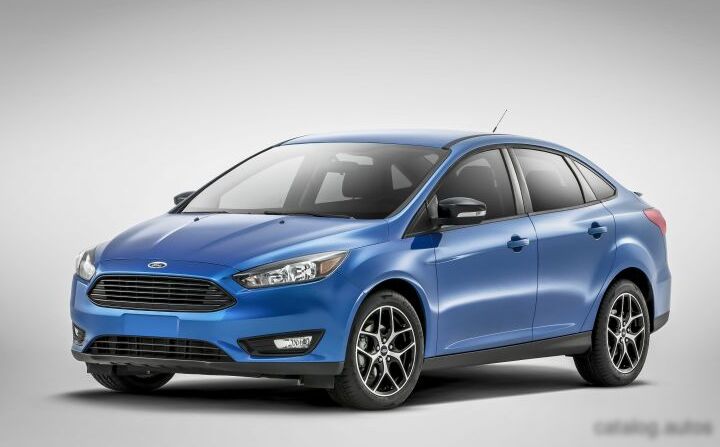
The Ford Focus III Sedan, specifically the facelifted version introduced in 2014, represented a significant step forward for Ford’s compact offerings in the global market. While the Focus had been a mainstay in Europe for decades, the third generation marked a concerted effort to create a truly global vehicle, with versions sold in North America, Asia, and beyond. The 1.0 EcoBoost 100 horsepower variant, produced from 2014 to 2018, served as an entry-level option, prioritizing fuel efficiency and affordability within the sedan body style. It was positioned as a practical choice for urban commuters and those seeking a cost-effective family vehicle.
Technical Specifications
| Brand | Ford |
| Model | Focus |
| Generation | Focus III Sedan (facelift 2014) |
| Type (Engine) | 1.0 EcoBoost (100 Hp) |
| Start of production | 2014 |
| End of production | 2018 |
| Powertrain Architecture | Internal Combustion engine |
| Body type | Sedan |
| Seats | 5 |
| Doors | 4 |
| Fuel consumption (urban) | 6.5 l/100 km (36.2 US mpg, 43.5 UK mpg, 15.4 km/l) |
| Fuel consumption (extra urban) | 4.2 l/100 km (56 US mpg, 67.3 UK mpg, 23.8 km/l) |
| Fuel consumption (combined) | 5 l/100 km (47 US mpg, 56.5 UK mpg, 20 km/l) |
| CO2 emissions | 115 g/km |
| Fuel Type | Petrol (Gasoline) |
| Acceleration 0 – 100 km/h | 12.6 sec |
| Acceleration 0 – 62 mph | 12.6 sec |
| Acceleration 0 – 60 mph | 12 sec |
| Maximum speed | 185 km/h (114.95 mph) |
| Emission standard | Euro 6 |
| Weight-to-power ratio | 13 kg/Hp, 76.7 Hp/tonne |
| Weight-to-torque ratio | 7.7 kg/Nm, 130.5 Nm/tonne |
| Power | 100 Hp @ 6000 rpm |
| Power per litre | 100.2 Hp/l |
| Torque | 170 Nm @ 1400-4000 rpm (125.39 lb.-ft. @ 1400-4000 rpm) |
| Engine layout | Front, Transverse |
| Engine Model/Code | M2DB, M2DC, SFDB |
| Engine displacement | 998 cm3 (60.9 cu. in.) |
| Number of cylinders | 3 |
| Engine configuration | Inline |
| Cylinder Bore | 71.9 mm (2.83 in.) |
| Piston Stroke | 82 mm (3.23 in.) |
| Compression ratio | 10:1 |
| Number of valves per cylinder | 4 |
| Fuel injection system | Direct injection |
| Engine aspiration | Turbocharger, Intercooler |
| Valvetrain | DOHC |
| Engine oil capacity | 4.1 l (4.33 US qt | 3.61 UK qt) |
| Coolant | 5.8 l (6.13 US qt | 5.1 UK qt) |
| Kerb Weight | 1303 kg (2872.62 lbs.) |
| Max. weight | 1900 kg (4188.78 lbs.) |
| Max load | 597 kg (1316.16 lbs.) |
| Trunk (boot) space – minimum | 372 l (13.14 cu. ft.) |
| Fuel tank capacity | 55 l (14.53 US gal | 12.1 UK gal) |
| Length | 4534 mm (178.5 in.) |
| Width | 1823 mm (71.77 in.) |
| Height | 1484 mm (58.43 in.) |
| Wheelbase | 2648 mm (104.25 in.) |
| Front track | 1544 mm (60.79 in.) |
| Rear (Back) track | 1559 mm (61.38 in.) |
| Minimum turning circle | 11 m (36.09 ft.) |
| Drivetrain Architecture | ICE, Front wheel drive |
| Drive wheel | Front wheel drive |
| Number of gears | 5 gears, manual transmission |
| Front suspension | Independent, McPherson with coil spring and anti-roll bar |
| Rear suspension | Independent multi-link suspension |
| Front brakes | Disc |
| Rear brakes | Disc |
| Assisting systems | ABS (Anti-lock braking system) |
| Steering type | Steering rack and pinion |
| Tires size | 205/55 R16; 215/50 R17 |
| Wheel rims size | 6.5J x 16; 7.0J x 17 |
INTRODUCTION
The 1.0 EcoBoost engine, introduced in the 2014 facelift of the Ford Focus III Sedan, was a key component of Ford’s strategy to offer fuel-efficient and technologically advanced vehicles to a wider audience. This three-cylinder, turbocharged engine was part of Ford’s EcoBoost family, known for combining direct injection, turbocharging, and variable valve timing to deliver impressive power and economy. The 100 horsepower version, paired with a five-speed manual transmission, was specifically targeted at buyers seeking a practical and affordable sedan. It occupied the entry-level position in the Focus Sedan lineup, below the more powerful 1.5L and 2.0L engine options.
Powertrain & Engine Architecture
The heart of this variant is the 1.0-liter EcoBoost engine, identified by engine codes M2DB, M2DC, and SFDB. This engine is a marvel of downsizing technology, utilizing a single-scroll turbocharger and direct fuel injection to maximize efficiency and power output from its small displacement. The engine features a cast iron cylinder block with an aluminum cylinder head, incorporating a double overhead camshaft (DOHC) valvetrain with four valves per cylinder. The direct injection system, operating at pressures up to 200 bar, ensures precise fuel delivery and optimized combustion. The five-speed manual transmission was the standard offering, chosen for its simplicity and contribution to fuel economy. The transmission’s gear ratios were tuned to provide adequate acceleration while prioritizing efficiency at highway speeds.
Driving Characteristics
The 1.0 EcoBoost 100 hp Focus Sedan offered a surprisingly capable driving experience, despite its modest power output. Acceleration from 0-60 mph took around 12 seconds, and top speed was limited to 115 mph. While not a performance-oriented vehicle, the engine’s 170 Nm (125 lb-ft) of torque, available from 1400-4000 rpm, provided sufficient grunt for everyday driving situations. The turbocharger did introduce a slight amount of turbo lag, but once spooled up, it delivered a noticeable boost in power. The five-speed manual transmission allowed drivers to keep the engine in its optimal power band, enhancing responsiveness. Compared to the higher-output 1.5L and 2.0L versions, this variant felt less refined and required more frequent gear changes, particularly when overtaking or climbing hills.
Equipment & Trim Levels
The 1.0 EcoBoost variant typically came with a base level of equipment, focusing on essential features. Standard amenities included air conditioning, power windows, power door locks, and a basic audio system with USB connectivity. Safety features such as ABS, electronic stability control, and multiple airbags were also standard. Interior upholstery was typically cloth, and the dashboard featured a straightforward design. Optional extras included alloy wheels, a more advanced audio system, and a rearview camera. Trim levels varied slightly depending on the market, but generally, this engine was offered in the base “S” or “SE” trims.
Chassis & Braking
The Focus III Sedan utilized a McPherson strut front suspension and an independent multi-link rear suspension, providing a comfortable and controlled ride. The suspension was tuned to balance handling and ride quality, making it suitable for a variety of road conditions. Brakes consisted of ventilated discs on all four wheels, providing adequate stopping power for the vehicle’s weight and performance. The steering system was a rack-and-pinion setup, offering precise and responsive steering feel. Stabilizer bars were included on both the front and rear axles to reduce body roll during cornering.
Market Reception & Comparison
The 1.0 EcoBoost Focus Sedan received generally positive reviews for its fuel efficiency and affordability. Critics praised the engine’s ability to deliver a reasonable level of performance while consuming very little fuel. However, some reviewers noted that the engine could feel strained when fully loaded or driving uphill. Compared to the 1.5L and 2.0L variants, the 1.0 EcoBoost offered significantly better fuel economy, but at the expense of performance. The 1.5L provided a better balance of power and efficiency, while the 2.0L was geared towards drivers prioritizing performance. In terms of reliability, the 1.0 EcoBoost engine proved to be generally reliable, although some owners reported issues with the timing belt system.
Legacy
The 1.0 EcoBoost engine has become a cornerstone of Ford’s powertrain strategy, and the 100 hp variant in the Focus III Sedan played a crucial role in establishing its reputation for fuel efficiency and innovation. In the used car market, these models remain popular due to their affordability and low running costs. While the engine’s long-term reliability has been generally good, potential buyers should be aware of the recommended maintenance schedule, particularly regarding the timing belt replacement. The 1.0 EcoBoost Focus Sedan represents a significant step forward in compact car technology, offering a compelling combination of efficiency, practicality, and affordability.