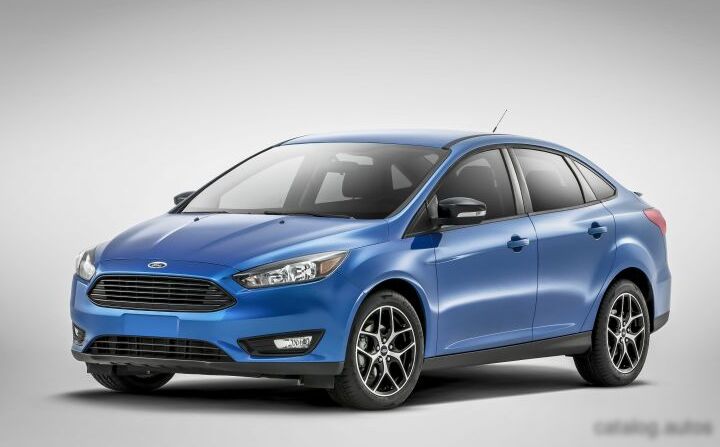
The Ford Focus III Sedan (facelift, 2014) 1.5 TDCi 120 horsepower variant, equipped with the PowerShift dual-clutch transmission, represents a significant offering within the global Ford Focus lineup. Introduced in 2014 as part of a mid-cycle refresh of the third-generation Focus, this model aimed to balance fuel efficiency with acceptable performance for the European and Asian markets, and was also available in limited quantities in North America. It occupied a mid-range position in the Focus sedan lineup, slotting between the lower-powered 1.6-liter engine options and the more potent, though less fuel-efficient, 1.5L EcoBoost gasoline variants. Production continued through 2018, with this specific configuration proving popular for its blend of practicality and running costs.
Technical Specifications
| Brand | Ford |
| Model | Focus |
| Generation | Focus III Sedan (facelift 2014) |
| Type (Engine) | 1.5 TDCi (120 Hp) PowerShift |
| Start of production | 2014 |
| End of production | 2018 |
| Powertrain Architecture | Internal Combustion engine |
| Body type | Sedan |
| Seats | 5 |
| Doors | 4 |
| Fuel consumption (urban) | 4.7 l/100 km (50 US mpg, 60.1 UK mpg, 21.3 km/l) |
| Fuel consumption (extra urban) | 3.9 l/100 km (60.3 US mpg, 72.4 UK mpg, 25.6 km/l) |
| Fuel consumption (combined) | 4.2 l/100 km (56 US mpg, 67.3 UK mpg, 23.8 km/l) |
| CO2 emissions | 109 g/km |
| Fuel Type | Diesel |
| Acceleration 0 – 100 km/h | 10.9 sec |
| Acceleration 0 – 62 mph | 10.9 sec |
| Acceleration 0 – 60 mph | 10.4 sec |
| Maximum speed | 193 km/h (119.92 mph) |
| Emission standard | Euro 6 |
| Weight-to-power ratio | 10.7 kg/Hp, 93.5 Hp/tonne |
| Weight-to-torque ratio | 4.3 kg/Nm, 233.8 Nm/tonne |
| Power | 120 Hp @ 3600 rpm |
| Power per litre | 80.1 Hp/l |
| Torque | 300 Nm @ 1750-2500 rpm (221.27 lb.-ft. @ 1750-2500 rpm) |
| Engine layout | Front, Transverse |
| Engine Model/Code | XWDA, XWDB, XWDC, XWDD, XWDE |
| Engine displacement | 1499 cm3 (91.47 cu. in.) |
| Number of cylinders | 4 |
| Engine configuration | Inline |
| Cylinder Bore | 73.5 mm (2.89 in.) |
| Piston Stroke | 88.3 mm (3.48 in.) |
| Compression ratio | 16:1 |
| Number of valves per cylinder | 2 |
| Fuel injection system | Diesel Commonrail |
| Engine aspiration | Turbocharger, Intercooler |
| Valvetrain | SOHC |
| Engine oil capacity | 3.85 l (4.07 US qt | 3.39 UK qt) |
| Coolant capacity | 7.3 l (7.71 US qt | 6.42 UK qt) |
| Kerb Weight | 1283 kg (2828.53 lbs.) |
| Max. weight | 1900 kg (4188.78 lbs.) |
| Max load | 617 kg (1360.25 lbs.) |
| Trunk (boot) space – minimum | 372 l (13.14 cu. ft.) |
| Fuel tank capacity | 53 l (14 US gal | 11.66 UK gal) |
| Max. roof load | 75 kg (165.35 lbs.) |
| Permitted trailer load with brakes (12%) | 1200 kg (2645.55 lbs.) |
| Permitted trailer load without brakes | 675 kg (1488.12 lbs.) |
| Length | 4534 mm (178.5 in.) |
| Width | 1823 mm (71.77 in.) |
| Width with mirrors folded | 1858 mm (73.15 in.) |
| Width including mirrors | 2010 mm (79.13 in.) |
| Height | 1484 mm (58.43 in.) |
| Wheelbase | 2648 mm (104.25 in.) |
| Front track | 1544-1559 mm (60.79 – 61.38 in.) |
| Rear (Back) track | 1534-1549 mm (60.39 – 60.98 in.) |
| Minimum turning circle | 11 m (36.09 ft.) |
| Drivetrain Architecture | Front wheel drive |
| Number of gears and type of gearbox | 6 gears, automatic transmission PowerShift |
| Front suspension | Independent, type McPherson with coil spring and anti-roll bar |
| Rear suspension | Independent multi-link spring suspension with stabilizer |
| Front brakes | Ventilated discs, 278×25 mm |
| Rear brakes | Drum, 228×40 mm |
| Assisting systems | ABS (Anti-lock braking system) |
| Steering type | Steering rack and pinion |
| Power steering | Electric Steering |
| Tires size | 205/55 R16; 215/50 R17 |
| Wheel rims size | 6.5J x 16; 7J x 17 |
Powertrain & Engine Architecture
The heart of this Focus variant is the 1.5-liter TDCi diesel engine, specifically utilizing engine codes XWDA, XWDB, XWDC, XWDD, and XWDE depending on the specific market and emissions regulations. This engine is a four-cylinder, inline configuration, featuring a turbocharger with intercooling to boost power and efficiency. The engine employs a common-rail direct fuel injection system, delivering fuel directly into the combustion chamber at extremely high pressure for optimized combustion. A single overhead camshaft (SOHC) controls the two valves per cylinder. The 16:1 compression ratio is typical for a diesel engine, contributing to its thermal efficiency. Paired with this engine is Ford’s PowerShift six-speed dual-clutch transmission (DCT). This transmission, while offering quicker shifts than a traditional automatic, was known for potential reliability issues, particularly concerning the clutch packs and transmission control module.
Driving Characteristics
The 120 horsepower and 300 Nm (221 lb-ft) of torque provided by the 1.5 TDCi engine, when coupled with the PowerShift transmission, resulted in a driving experience geared towards economy and usability rather than outright performance. Acceleration from 0-60 mph took around 10.4 seconds, and top speed was approximately 119.92 mph. The PowerShift transmission, while providing smooth shifts in normal driving, could exhibit some hesitation or jerkiness at lower speeds. Compared to the higher-output gasoline versions of the Focus, the 1.5 TDCi felt noticeably slower, but offered significantly better fuel economy. The gear ratios were tuned for maximizing fuel efficiency, meaning the engine often operated at lower RPMs during cruising, contributing to a quieter cabin experience. Compared to a manual transmission equipped with the same engine, the PowerShift offered convenience but sacrificed some driver engagement.
Equipment & Trim Levels
The 1.5 TDCi 120 hp PowerShift typically came equipped as a mid-range trim level. Standard features generally included air conditioning, power windows, power mirrors, a basic audio system with USB connectivity, and steel wheels with wheel covers. Higher trim levels offered upgrades such as alloy wheels, a more advanced infotainment system with touchscreen display, automatic climate control, rear parking sensors, and cruise control. Interior upholstery was typically cloth, with options for partial leather trim on higher-spec models. Optional extras included a panoramic sunroof, heated front seats, and a premium sound system.
Chassis & Braking
The Focus III sedan utilized an independent front suspension with McPherson struts and a multi-link independent rear suspension, providing a comfortable and controlled ride. The front brakes were ventilated discs measuring 278x25mm, while the rear brakes were drum brakes measuring 228x40mm. Anti-lock Braking System (ABS) was standard. Stabilizer bars were fitted to both the front and rear axles to reduce body roll during cornering. The suspension tuning was geared towards providing a balance between comfort and handling, making it suitable for everyday driving conditions.
Market Reception & Comparison
The 1.5 TDCi 120 hp PowerShift variant of the Focus III sedan received generally positive reviews for its fuel efficiency and practicality. Critics praised its comfortable ride and spacious interior. However, the PowerShift transmission was a recurring point of concern, with reports of reliability issues and occasional jerky shifting. Compared to the 1.6-liter gasoline engine options, the 1.5 TDCi offered significantly better fuel economy, but at the expense of performance. Compared to the more powerful 1.5 EcoBoost gasoline engine, the diesel offered superior torque at low RPMs, making it more suitable for city driving and hauling loads, but lacked the EcoBoost’s overall responsiveness.
Legacy
The 1.5 TDCi engine, while generally reliable, has shown some susceptibility to issues with the fuel injectors and turbocharger over the long term. The PowerShift transmission remains the biggest potential weak point, with ongoing concerns about clutch pack wear and TCM failures. In the used car market, this variant represents a relatively affordable option, but potential buyers should be aware of the potential transmission issues and factor in the cost of potential repairs. Despite these concerns, the 1.5 TDCi 120 hp PowerShift Focus III sedan remains a popular choice for those seeking a fuel-efficient and practical compact sedan.