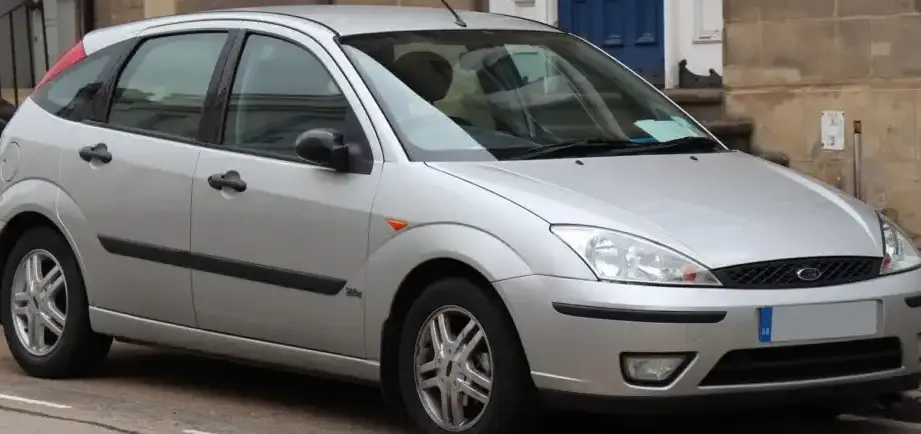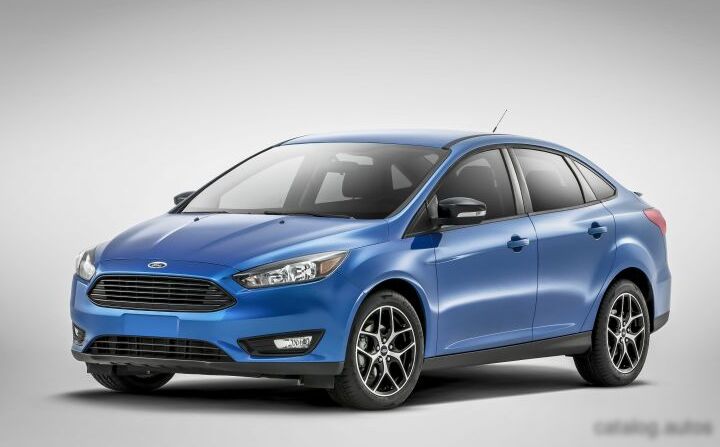
The Ford Focus III Sedan (facelift, 2014) 1.5 TDCi 120 horsepower variant, equipped with the Start/Stop system, represents a significant iteration within the global Ford Focus lineup. Introduced in 2014 and continuing through 2018 model years, this version was primarily aimed at the European market, where fuel efficiency and lower running costs were highly valued. It occupied a mid-range position within the Focus Sedan offerings, bridging the gap between the base engine options and the more powerful, performance-oriented trims. This model benefited from the mid-cycle refresh of the third-generation Focus, incorporating updated styling and improved technology.
Technical Specifications
| Brand | Ford |
| Model | Focus |
| Generation | Focus III Sedan (facelift 2014) |
| Type (Engine) | 1.5 TDCi (120 Hp) S&S |
| Start of production | 2014 |
| End of production | 2018 |
| Powertrain Architecture | Internal Combustion engine |
| Body type | Sedan |
| Seats | 5 |
| Doors | 4 |
| Fuel consumption (urban) | 4.3 l/100 km (54.7 US mpg, 65.7 UK mpg, 23.3 km/l) |
| Fuel consumption (extra urban) | 3.4 l/100 km (69.2 US mpg, 83.1 UK mpg, 29.4 km/l) |
| Fuel consumption (combined) | 3.8 l/100 km (61.9 US mpg, 74.3 UK mpg, 26.3 km/l) |
| CO2 emissions | 98 g/km |
| Fuel Type | Diesel |
| Acceleration 0 – 100 km/h | 10.6 sec |
| Acceleration 0 – 62 mph | 10.6 sec |
| Acceleration 0 – 60 mph | 10.1 sec |
| Maximum speed | 191 km/h (118.68 mph) |
| Emission standard | Euro 6 |
| Weight-to-power ratio | 11.3 kg/Hp, 88.9 Hp/tonne |
| Weight-to-torque ratio | 5 kg/Nm, 200 Nm/tonne |
| Power | 120 Hp @ 3600 rpm |
| Power per litre | 80.1 Hp/l |
| Torque | 270 Nm @ 1750-2500 rpm (199.14 lb.-ft. @ 1750-2500 rpm) |
| Engine layout | Front, Transverse |
| Engine Model/Code | XWDA, XWDB, XWDC, XWDD |
| Engine displacement | 1499 cm3 (91.47 cu. in.) |
| Number of cylinders | 4 |
| Engine configuration | Inline |
| Cylinder Bore | 73.5 mm (2.89 in.) |
| Piston Stroke | 88.3 mm (3.48 in.) |
| Compression ratio | 16:1 |
| Number of valves per cylinder | 2 |
| Fuel injection system | Diesel Commonrail |
| Engine aspiration | Turbocharger, Intercooler |
| Valvetrain | SOHC |
| Engine oil capacity | 3.85 l (4.07 US qt | 3.39 UK qt) |
| Coolant capacity | 7.3 l (7.71 US qt | 6.42 UK qt) |
| Kerb Weight | 1350 kg (2976.24 lbs.) |
| Max. weight | 1900 kg (4188.78 lbs.) |
| Max load | 550 kg (1212.54 lbs.) |
| Trunk (boot) space – minimum | 372 l (13.14 cu. ft.) |
| Fuel tank capacity | 53 l (14 US gal | 11.66 UK gal) |
| Length | 4534 mm (178.5 in.) |
| Width | 1823 mm (71.77 in.) |
| Height | 1484 mm (58.43 in.) |
| Wheelbase | 2648 mm (104.25 in.) |
| Front track | 1544 mm (60.79 in.) |
| Rear (Back) track | 1559 mm (61.38 in.) |
| Minimum turning circle | 11 m (36.09 ft.) |
| Drivetrain Architecture | Front wheel drive |
| Number of gears and type of gearbox | 6 gears, manual transmission |
| Front suspension | Independent, type McPherson with coil spring and anti-roll bar |
| Rear suspension | Independent multi-link suspension |
| Front brakes | Disc |
| Rear brakes | Disc |
| Assisting systems | ABS (Anti-lock braking system) |
| Steering type | Steering rack and pinion |
| Tires size | 205/55 R16; 215/50 R17 |
| Wheel rims size | 6.5J x 16; 7.0J x 17 |
Powertrain & Engine Architecture
The heart of this Focus variant is the 1.5-liter TDCi diesel engine, specifically utilizing engine codes XWDA, XWDB, XWDC, or XWDD depending on the specific market and emissions regulations. This engine is a four-cylinder, inline configuration, featuring a single overhead camshaft (SOHC) valvetrain with two valves per cylinder. A key feature is its turbocharger with intercooler, which significantly boosts power output and efficiency. The engine employs a Diesel Commonrail direct fuel injection system, delivering precise fuel metering for optimized combustion. The 16:1 compression ratio is typical for diesel engines, contributing to their inherent efficiency. The Start/Stop system, denoted by the “S&S” designation, automatically shuts off the engine when the vehicle is stationary (e.g., at traffic lights) to further reduce fuel consumption and emissions.
Driving Characteristics
The 120 horsepower output, coupled with 270 Nm (199 lb-ft) of torque, provides a reasonable balance between performance and economy. While not a sporty configuration, the engine delivers adequate acceleration for everyday driving situations. The peak torque, available from 1750-2500 rpm, ensures good responsiveness in typical driving scenarios. Compared to the higher-output 1.5 TDCi variants or the petrol engines, this version offers a more relaxed driving experience, prioritizing fuel efficiency over outright speed. The six-speed manual transmission allows for precise gear selection, although the gear ratios are tuned for economy rather than aggressive acceleration. The 0-60 mph time of around 10.1 seconds reflects this focus.
Equipment & Trim Levels
The 1.5 TDCi 120 S&S typically came equipped with a respectable level of standard features. These generally included air conditioning, power windows, power mirrors, a basic audio system with USB connectivity, and ABS brakes. Interior upholstery was usually cloth, with a functional, if not luxurious, dashboard layout. Optional extras could include alloy wheels, upgraded audio systems, parking sensors, and a navigation system. Trim levels varied by market, but this engine was often found in mid-range trims, offering a good balance of features and price.
Chassis & Braking
The Focus III Sedan utilizes an independent suspension setup, with McPherson struts at the front and a multi-link system at the rear. This configuration provides a comfortable ride and good handling characteristics. The chassis is relatively lightweight, contributing to the car’s overall efficiency. Brakes are disc brakes on all four wheels, providing adequate stopping power. ABS (Anti-lock Braking System) is standard, enhancing safety during emergency braking situations. Stabilizer bars are fitted to both the front and rear axles to reduce body roll during cornering.
Market Reception & Comparison
The 1.5 TDCi 120 S&S variant was generally well-received by critics for its fuel efficiency and low running costs. It was seen as a practical and sensible choice for drivers who prioritize economy over performance. Compared to the higher-powered diesel variants, it offered lower purchase price and insurance costs, but at the expense of acceleration. Against petrol-powered Focus models, the diesel offered significantly better fuel economy, making it an attractive option for high-mileage drivers. Reliability was generally good, although diesel particulate filter (DPF) issues could occur with infrequent long-distance driving.
Legacy
The 1.5 TDCi engine has proven to be a relatively durable and reliable powertrain. In the used car market, the 120 horsepower variant of the Focus III Sedan remains a popular choice due to its fuel efficiency and affordability. However, potential buyers should be aware of the potential for DPF issues and ensure that the vehicle has been properly maintained. The Focus III generation, as a whole, established a reputation for its well-rounded driving dynamics and practicality, and this 1.5 TDCi variant continues to represent a sensible and economical option for those seeking a compact sedan.