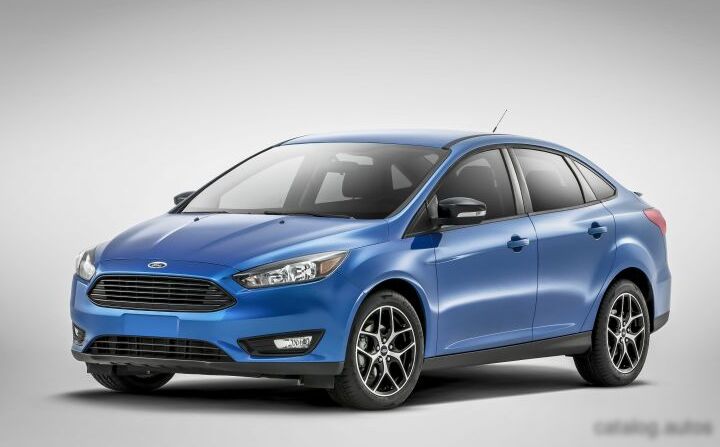
The Ford Focus III Sedan, specifically the 1.6 Ti-VCT (125 horsepower) variant produced from 2014 to 2018, represented a key offering in Ford’s global compact car lineup. This facelifted version of the third-generation Focus aimed to balance fuel efficiency, affordability, and practicality for the North American and European markets. Positioned as a mid-range trim, it slotted between the base 1.0L EcoBoost engine and the more powerful 2.0L options. The 1.6 Ti-VCT with a manual transmission was a popular choice for buyers seeking a reasonably efficient and capable sedan.
Technical Specifications
| Brand | Ford |
| Model | Focus |
| Generation | Focus III Sedan (facelift 2014) |
| Type (Engine) | 1.6 Ti-VCT (125 Hp) |
| Start of production | 2014 |
| End of production | 2018 |
| Powertrain Architecture | Internal Combustion engine |
| Body type | Sedan |
| Seats | 5 |
| Doors | 4 |
| Fuel consumption (urban) | 8.4 l/100 km (28 US mpg, 33.6 UK mpg, 11.9 km/l) |
| Fuel consumption (extra urban) | 4.7 l/100 km (50 US mpg, 60.1 UK mpg, 21.3 km/l) |
| Fuel consumption (combined) | 6 l/100 km (39.2 US mpg, 47.1 UK mpg, 16.7 km/l) |
| CO2 emissions | 139 g/km |
| Fuel Type | Petrol (Gasoline) |
| Acceleration 0 – 100 km/h | 11 sec |
| Acceleration 0 – 62 mph | 11 sec |
| Acceleration 0 – 60 mph | 10.5 sec |
| Maximum speed | 190 km/h (118.06 mph) |
| Emission standard | Euro 5 |
| Weight-to-power ratio | 10.3 kg/Hp, 97 Hp/tonne |
| Weight-to-torque ratio | 8.1 kg/Nm, 123.4 Nm/tonne |
| Power | 125 Hp @ 6000 rpm |
| Power per litre | 78.3 Hp/l |
| Torque | 159 Nm @ 4000 rpm (117.27 lb.-ft. @ 4000 rpm) |
| Engine layout | Front, Transverse |
| Engine Model/Code | PNDD |
| Engine displacement | 1596 cm3 (97.39 cu. in.) |
| Number of cylinders | 4 |
| Engine configuration | Inline |
| Cylinder Bore | 79 mm (3.11 in.) |
| Piston Stroke | 81.4 mm (3.2 in.) |
| Compression ratio | 11:1 |
| Number of valves per cylinder | 4 |
| Fuel injection system | Multi-port manifold injection |
| Engine aspiration | Naturally aspirated engine |
| Valvetrain | DOHC |
| Engine oil capacity | 4.1 l (4.33 US qt | 3.61 UK qt) |
| Coolant | 5.7 l (6.02 US qt | 5.02 UK qt) |
| Kerb Weight | 1289 kg (2841.76 lbs.) |
| Max. weight | 1825 kg (4023.44 lbs.) |
| Max load | 536 kg (1181.68 lbs.) |
| Trunk (boot) space – minimum | 372 l (13.14 cu. ft.) |
| Fuel tank capacity | 55 l (14.53 US gal | 12.1 UK gal) |
| Length | 4534 mm (178.5 in.) |
| Width | 1823 mm (71.77 in.) |
| Height | 1484 mm (58.43 in.) |
| Wheelbase | 2648 mm (104.25 in.) |
| Front track | 1544 mm (60.79 in.) |
| Rear (Back) track | 1559 mm (61.38 in.) |
| Minimum turning circle | 11 m (36.09 ft.) |
| Drivetrain Architecture | ICE, Front wheel drive |
| Number of gears | 5 |
| Gearbox type | Manual transmission |
| Front suspension | Independent, McPherson with coil spring and anti-roll bar |
| Rear suspension | Independent multi-link suspension |
| Front brakes | Disc |
| Rear brakes | Disc |
| Assisting systems | ABS |
| Steering type | Steering rack and pinion |
| Tires size | 205/55 R16; 215/50 R17 |
| Wheel rims size | 6.5J x 16; 7.0J x 17 |
Powertrain & Engine Architecture
The heart of this Focus variant is the 1.6-liter Ti-VCT inline-four cylinder engine, designated with the engine code PNDD. “Ti-VCT” stands for Twin Independent Variable Camshaft Timing, a technology Ford employed to optimize engine breathing and improve both power and fuel efficiency. The engine utilizes a multi-port fuel injection system, delivering fuel directly into the intake ports. The DOHC (Double Overhead Camshaft) valvetrain, coupled with the Ti-VCT system, allows for precise control of valve timing, enhancing performance across the rev range. This engine is naturally aspirated, meaning it doesn’t rely on a turbocharger or supercharger for forced induction. The 1.6L engine was known for its relatively simple design, contributing to its overall reliability. The standard transmission was a five-speed manual, offering a direct and engaging driving experience.
Driving Characteristics
The 125 hp and 159 Nm (117 lb-ft) of torque produced by the 1.6 Ti-VCT engine provided adequate, though not exhilarating, performance. Acceleration from 0-60 mph took around 10.5 seconds, and top speed was approximately 118 mph. Compared to the higher-output 2.0L versions of the Focus, this variant felt noticeably less powerful, particularly during highway overtaking maneuvers. However, the five-speed manual transmission allowed drivers to keep the engine in its optimal power band. The gear ratios were tuned for a balance between fuel economy and responsiveness. The 1.6L engine was generally considered smoother and more refined than the smaller 1.0L EcoBoost, but lacked the EcoBoost’s low-end torque.
Equipment & Trim Levels
The 1.6 Ti-VCT trim typically included standard features such as air conditioning, power windows and locks, a basic audio system with USB connectivity, and steel wheels with wheel covers. Higher trim levels offered upgrades like alloy wheels, a more advanced infotainment system with touchscreen display, automatic climate control, and upgraded interior upholstery. Optional extras included a sunroof, rear parking sensors, and a premium sound system. Interior materials were generally durable and functional, reflecting the car’s position as a mainstream, value-oriented offering.
Chassis & Braking
The Focus III Sedan featured an independent front suspension with McPherson struts and a multi-link independent rear suspension. This setup provided a comfortable ride and reasonably good handling characteristics. The front and rear brakes were both disc brakes, offering adequate stopping power for the vehicle’s weight and performance. ABS (Anti-lock Braking System) was standard. The suspension tuning was geared towards comfort rather than outright sportiness, making it well-suited for everyday driving. Stabilizer bars were included both front and rear to reduce body roll during cornering.
Market Reception & Comparison
The 1.6 Ti-VCT Focus Sedan received generally positive reviews, particularly for its fuel efficiency and comfortable ride. Critics noted that it wasn’t the most exciting car to drive, but it offered a good balance of practicality and affordability. Compared to the 1.0L EcoBoost, the 1.6L provided more power and a smoother driving experience, but at the cost of slightly lower fuel economy. The 2.0L versions offered significantly more performance, but were also more expensive. In terms of reliability, the 1.6 Ti-VCT engine proved to be relatively dependable, with few major issues reported.
Legacy
The Ford Focus III Sedan 1.6 Ti-VCT remains a popular choice in the used car market, particularly for buyers seeking an affordable and reliable compact sedan. The engine’s relatively simple design and proven track record contribute to its long-term durability. While not as sought-after as some of the higher-performance Focus variants, the 1.6 Ti-VCT offers a practical and economical transportation solution. Parts availability is generally good, and maintenance costs are reasonable. The car represents a solid, if unspectacular, entry point into the Ford Focus family.