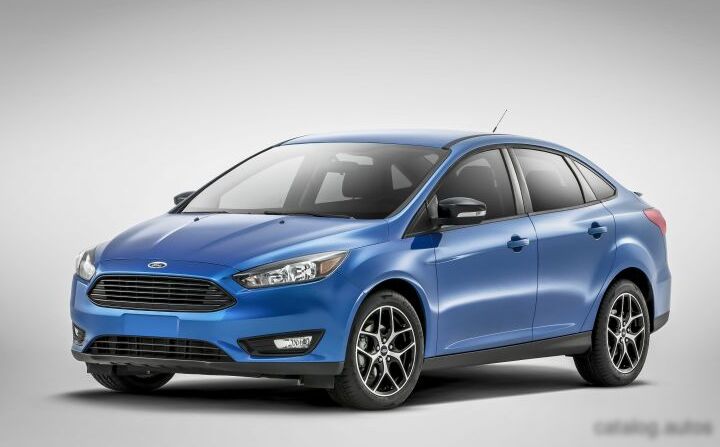
Technical Specifications
| Brand | Ford |
| Model | Focus |
| Generation | Focus III Sedan (facelift 2014) |
| Type (Engine) | 2.0 TDCi (150 Hp) PowerShift |
| Start of production | 2014 |
| End of production | 2018 |
| Powertrain Architecture | Internal Combustion engine |
| Body type | Sedan |
| Seats | 5 |
| Doors | 4 |
| Fuel consumption (urban) | 6.1 l/100 km (38.6 US mpg) |
| Fuel consumption (extra urban) | 4 l/100 km (58.8 US mpg) |
| Fuel consumption (combined) | 4.8 l/100 km (49 US mpg) |
| CO2 emissions | 124 g/km |
| Fuel Type | Diesel |
| Acceleration 0 – 100 km/h | 8.7 sec |
| Acceleration 0 – 62 mph | 8.7 sec |
| Acceleration 0 – 60 mph | 8.3 sec |
| Maximum speed | 208 km/h (129.25 mph) |
| Emission standard | Euro 6 |
| Weight-to-power ratio | 9.7 kg/Hp |
| Weight-to-torque ratio | 4 kg/Nm |
| Power | 150 Hp @ 3750 rpm |
| Torque | 370 Nm @ 2000-3250 rpm (272.9 lb.-ft.) |
| Engine layout | Front, Transverse |
| Engine Model/Code | T7DB |
| Engine displacement | 1997 cm3 (121.86 cu. in.) |
| Number of cylinders | 4 |
| Engine configuration | Inline |
| Cylinder Bore | 85 mm (3.35 in.) |
| Piston Stroke | 88 mm (3.46 in.) |
| Compression ratio | 16:1 |
| Number of valves per cylinder | 4 |
| Fuel injection system | Diesel Commonrail |
| Engine aspiration | Turbocharger, Intercooler |
| Valvetrain | DOHC |
| Engine oil capacity | 6.1 l (6.45 US qt | 5.37 UK qt) |
| Coolant | 8 l (8.45 US qt | 7.04 UK qt) |
| Kerb Weight | 1462 kg (3223.16 lbs.) |
| Max. weight | 2050 kg (4519.48 lbs.) |
| Max load | 588 kg (1296.32 lbs.) |
| Trunk (boot) space – minimum | 372 l (13.14 cu. ft.) |
| Fuel tank capacity | 60 l (15.85 US gal | 13.2 UK gal) |
| Length | 4534 mm (178.5 in.) |
| Width | 1823 mm (71.77 in.) |
| Height | 1484 mm (58.43 in.) |
| Wheelbase | 2648 mm (104.25 in.) |
| Front track | 1544 mm (60.79 in.) |
| Rear (Back) track | 1559 mm (61.38 in.) |
| Minimum turning circle | 11 m (36.09 ft.) |
| Drive wheel | Front wheel drive |
| Number of gears | 6 |
| Gearbox type | automatic transmission PowerShift |
| Front suspension | Independent, type McPherson with coil spring and anti-roll bar |
| Rear suspension | Independent multi-link suspension |
| Front brakes | Disc |
| Rear brakes | Disc |
| Tires size | 205/55 R16; 215/50 R17 |
| Wheel rims size | 6.5J x 16; 7.0J x 17 |
The 2014-2018 Ford Focus III Sedan 2.0 TDCi PowerShift represented a significant step in offering a fuel-efficient and reasonably powerful diesel option in the compact sedan class. Built on the global C-platform (1HX0/A3), this variant was designed to appeal to drivers seeking lower running costs without sacrificing everyday usability. The facelift brought updated styling, improved interior materials, and enhanced technology compared to the pre-2014 models. The PowerShift transmission, a six-speed dual-clutch unit, was a key selling point, promising quicker shifts and improved fuel economy compared to a traditional automatic.
Powertrain & Engine Architecture
At the heart of this Focus variant lies the Ford T7DB 2.0-liter turbocharged diesel engine. This engine is part of the Duratorq family and utilizes a common-rail direct injection system, delivering fuel at extremely high pressure for optimized combustion. The engine features a single turbocharger with an intercooler to increase air density and boost power output. The DOHC (Double Overhead Camshaft) valvetrain, with four valves per cylinder, further enhances breathing and efficiency. The engine produces 150 horsepower at 3750 rpm and a substantial 370 Nm (272.9 lb.-ft.) of torque between 2000 and 3250 rpm. The PowerShift transmission is a six-speed automated manual transmission. It uses two separate clutches – one for odd gears and one for even gears – allowing for seamless and rapid gear changes. This design mimics the feel of a manual transmission but without the need for a clutch pedal.
Driving Characteristics
The 2.0 TDCi PowerShift Focus Sedan offered a noticeably different driving experience compared to the gasoline-powered versions or the lower-powered diesel options. The abundant torque available from low engine speeds provided strong acceleration in everyday driving situations, making overtaking and merging onto highways effortless. While not a sports car, the 8.3-second 0-60 mph acceleration was respectable for its class. The PowerShift transmission, when functioning optimally, delivered quick and smooth gear changes, contributing to a more engaging driving experience. However, some owners reported occasional jerkiness or hesitation from the transmission, particularly at low speeds. The gear ratios were tuned for a balance of fuel efficiency and performance, with a relatively tall sixth gear for highway cruising.
Equipment & Trim Levels
The 2.0 TDCi PowerShift typically came equipped as a mid-range trim level, offering a good balance of features and value. Standard equipment generally included air conditioning, power windows and locks, a basic audio system with USB connectivity, and alloy wheels. Higher trim levels added features such as a touchscreen infotainment system with navigation, automatic climate control, heated front seats, and parking sensors. Interior upholstery was typically cloth, with leather options available as an upgrade. Safety features included ABS, electronic stability control, and multiple airbags.
Chassis & Braking
The Focus III Sedan utilized an independent front suspension with McPherson struts and a multi-link independent rear suspension. This setup provided a comfortable ride quality while maintaining good handling characteristics. The front and rear brakes were both disc brakes, offering adequate stopping power for the vehicle’s weight and performance. Anti-lock Braking System (ABS) was standard. The suspension tuning was geared towards providing a balance between comfort and handling, making it suitable for both city driving and longer journeys.
Market Reception & Comparison
The 2.0 TDCi PowerShift Focus Sedan was generally well-received by automotive critics, who praised its fuel efficiency, strong torque output, and comfortable ride. However, the PowerShift transmission was a point of contention, with some reviewers noting its occasional hesitation and jerkiness. Compared to the 1.0 EcoBoost gasoline engine, the 2.0 TDCi offered significantly more torque and better fuel economy, especially on longer trips. Compared to the higher-output gasoline engines, the diesel provided a more relaxed and efficient driving experience, albeit with slightly less overall power. Reliability of the PowerShift transmission was a concern for some owners, with reports of clutch failures and software glitches.
Legacy
The Ford Focus III Sedan 2.0 TDCi PowerShift remains a relatively common sight on the used car market. While the PowerShift transmission’s reliability has been a concern, well-maintained examples can provide years of reliable service. The engine itself is generally considered robust and durable. The combination of fuel efficiency, practicality, and reasonable performance continues to make this variant an attractive option for budget-conscious buyers seeking a compact sedan. However, potential buyers should be aware of the potential issues with the PowerShift transmission and thoroughly inspect any vehicle before purchase.