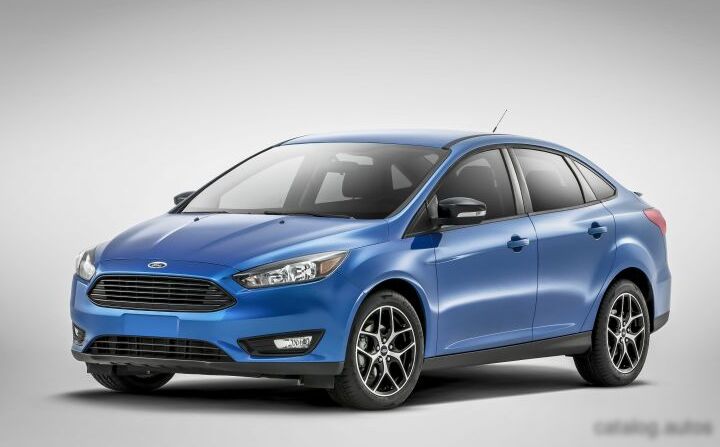
The Ford Focus III Sedan, specifically the 2.0 TDCi variant with the PowerShift automatic transmission and Start/Stop System (S&S), was a key offering in Ford’s European and global lineup from 2014 to 2018. This model represented a mid-cycle refresh of the third-generation Focus, known internally as the Mk3, and aimed to provide a balance of fuel efficiency, performance, and practicality within the compact sedan segment. Positioned as a mid-range to upper-mid-range trim, it offered a step up in power and refinement compared to the lower-displacement engine options while remaining more accessible than the performance-oriented ST model.
Technical Specifications
| Brand | Ford |
| Model | Focus |
| Generation | Focus III Sedan (facelift 2014) |
| Type (Engine) | 2.0 TDCi (150 Hp) PowerShift S&S |
| Start of production | 2014 |
| End of production | 2018 |
| Powertrain Architecture | Internal Combustion engine |
| Body type | Sedan |
| Seats | 5 |
| Doors | 4 |
| Fuel consumption (urban) | 5.2 l/100 km (45.2 US mpg, 54.3 UK mpg, 19.2 km/l) |
| Fuel consumption (extra urban) | 4 l/100 km (58.8 US mpg, 70.6 UK mpg, 25 km/l) |
| Fuel consumption (combined) | 4.4 l/100 km (53.5 US mpg, 64.2 UK mpg, 22.7 km/l) |
| CO2 emissions | 115 g/km |
| Fuel Type | Diesel |
| Acceleration 0 – 100 km/h | 8.7 sec |
| Acceleration 0 – 62 mph | 8.7 sec |
| Acceleration 0 – 60 mph | 8.3 sec |
| Maximum speed | 208 km/h (129.25 mph) |
| Emission standard | Euro 6 |
| Weight-to-power ratio | 9.7 kg/Hp, 102.6 Hp/tonne |
| Weight-to-torque ratio | 4 kg/Nm, 253.1 Nm/tonne |
| Power | 150 Hp @ 3750 rpm |
| Torque | 370 Nm @ 2000-3250 rpm (272.9 lb.-ft. @ 2000-3250 rpm) |
| Engine layout | Front, Transverse |
| Engine Model/Code | T7DB |
| Engine displacement | 1997 cm3 (121.86 cu. in.) |
| Number of cylinders | 4 |
| Engine configuration | Inline |
| Cylinder Bore | 85 mm (3.35 in.) |
| Piston Stroke | 88 mm (3.46 in.) |
| Compression ratio | 16:1 |
| Number of valves per cylinder | 4 |
| Fuel injection system | Diesel Commonrail |
| Engine aspiration | Turbocharger, Intercooler |
| Valvetrain | DOHC |
| Engine oil capacity | 6.1 l (6.45 US qt | 5.37 UK qt) |
| Coolant | 8 l (8.45 US qt | 7.04 UK qt) |
| Engine systems | Start & Stop System, Particulate filter |
| Kerb Weight | 1462 kg (3223.16 lbs.) |
| Max. weight | 2050 kg (4519.48 lbs.) |
| Max load | 588 kg (1296.32 lbs.) |
| Trunk (boot) space – minimum | 372 l (13.14 cu. ft.) |
| Fuel tank capacity | 60 l (15.85 US gal | 13.2 UK gal) |
| Length | 4534 mm (178.5 in.) |
| Width | 1823 mm (71.77 in.) |
| Height | 1484 mm (58.43 in.) |
| Wheelbase | 2648 mm (104.25 in.) |
| Front track | 1544 mm (60.79 in.) |
| Rear (Back) track | 1559 mm (61.38 in.) |
| Minimum turning circle | 11 m (36.09 ft.) |
| Drivetrain Architecture | ICE, Front wheel drive |
| Drive wheel | Front wheel drive |
| Number of gears | 6 gears, automatic transmission PowerShift |
| Front suspension | Independent, McPherson with coil spring and anti-roll bar |
| Rear suspension | Independent multi-link suspension |
| Front brakes | Disc |
| Rear brakes | Disc |
| Assisting systems | ABS (Anti-lock braking system) |
| Steering type | Steering rack and pinion |
| Tires size | 205/55 R16; 215/50 R17 |
| Wheel rims size | 6.5J x 16; 7.0J x 17 |
INTRODUCTION
The 2.0 TDCi PowerShift model of the Ford Focus III Sedan (facelift) arrived in 2014 as part of a broader update to the Mk3 platform (1HX0/A3). Ford aimed to enhance the Focus’s appeal with revised styling, improved interior materials, and updated technology. The 2.0-liter turbodiesel engine, paired with the six-speed PowerShift dual-clutch transmission, offered a compelling combination of fuel economy and performance, targeting buyers who frequently undertake longer journeys or require a vehicle capable of carrying loads. This variant was particularly popular in Europe, where diesel engines held a significant market share, but was also offered in other regions globally.
Powertrain & Engine Architecture
At the heart of this Focus variant lies the Ford T7DB 2.0-liter inline-four turbodiesel engine. This engine is part of the Duratorq family and utilizes a common-rail direct fuel injection system, delivering fuel at extremely high pressure for optimized combustion. The engine code ‘T7DB’ signifies a specific calibration for the European market, adhering to stringent emissions regulations. The engine features a double overhead camshaft (DOHC) valvetrain with four valves per cylinder, enhancing breathing and contributing to its power output. A turbocharger with an intercooler further boosts performance by forcing more air into the cylinders. The PowerShift transmission, a six-speed dual-clutch transmission (DCT), provides automated gear changes while maintaining a degree of driver control. Unlike a traditional automatic, PowerShift offers quicker shifts and improved fuel efficiency. The Start/Stop system automatically shuts off the engine when the vehicle is stationary, further reducing fuel consumption and emissions.
Driving Characteristics
The 2.0 TDCi PowerShift Focus Sedan delivered a refined driving experience. The engine produced 150 horsepower at 3750 rpm and a substantial 370 Nm (272.9 lb-ft) of torque between 2000 and 3250 rpm. This torque band provided strong acceleration in everyday driving situations, making overtaking and merging onto highways relatively effortless. While not a sports car, the 0-60 mph time of around 8.3 seconds was respectable for a diesel-powered sedan. The PowerShift transmission generally offered smooth and quick gear changes, although some drivers reported occasional hesitation at low speeds. Compared to the lower-powered 1.6 TDCi variants, the 2.0 TDCi offered a noticeable improvement in performance, while the manual transmission versions of the 2.0 TDCi provided a more engaging driving experience but at the cost of some convenience.
Equipment & Trim Levels
The 2.0 TDCi PowerShift typically came equipped with a generous level of standard features. These often included air conditioning, power windows, power mirrors, a basic audio system with USB connectivity, and alloy wheels. Higher trim levels, such as Titanium, added features like automatic climate control, a more advanced infotainment system with touchscreen display, rear parking sensors, and upgraded interior upholstery. Optional extras included navigation, a panoramic sunroof, and leather seats. Interior materials were generally of good quality, with a focus on durability and practicality.
Chassis & Braking
The Focus III Sedan utilized an independent front suspension with McPherson struts and a multi-link independent rear suspension. This setup provided a comfortable ride while maintaining good handling characteristics. The front and rear brakes were both disc brakes, offering adequate stopping power. Anti-lock Braking System (ABS) was standard, enhancing safety during emergency braking situations. Stabilizer bars were fitted to both the front and rear axles to reduce body roll during cornering.
Market Reception & Comparison
The 2.0 TDCi PowerShift Focus Sedan was generally well-received by automotive critics. It was praised for its fuel efficiency, comfortable ride, and refined engine. However, the PowerShift transmission received some criticism due to occasional jerky shifts and reports of reliability issues in some early production units. Compared to the 1.6 TDCi models, the 2.0 TDCi offered a significant performance boost, making it a more suitable choice for drivers who frequently travel long distances or carry passengers and luggage. Fuel economy remained competitive, averaging around 53.5 US mpg in combined driving.
Legacy
The Ford Focus III Sedan 2.0 TDCi PowerShift remains a relatively common sight on used car markets. The Duratorq engine is known for its durability, although regular maintenance is crucial. The PowerShift transmission remains the biggest potential concern, with some owners reporting issues with clutch pack wear and mechatronic unit failures. However, many examples have proven reliable with proper servicing. Overall, this variant represents a well-rounded and practical compact sedan that offers a good balance of fuel efficiency, performance, and comfort.