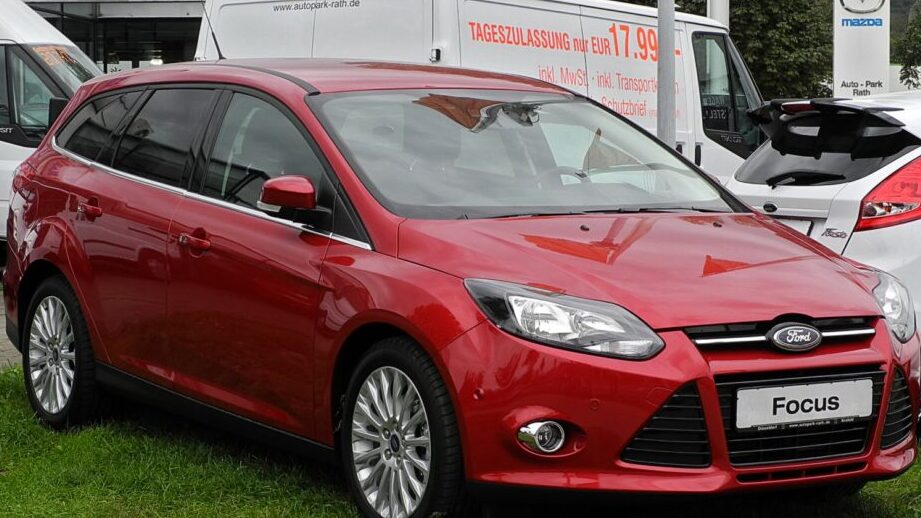
The Ford Focus III Wagon 1.6 EcoBoost (182 hp) was a variant of the third-generation Ford Focus, produced between 2010 and 2014. Positioned as a mid-range offering within the Focus Wagon lineup, it combined a relatively powerful turbocharged engine with a practical, family-oriented body style. This model aimed to provide a balance between performance and fuel efficiency, appealing to buyers seeking a versatile vehicle for both daily commuting and longer journeys. It was primarily sold in the European market, where the station wagon body style remained highly popular.
Technical Specifications
| Brand | Ford |
| Model | Focus |
| Generation | Focus III Wagon |
| Type (Engine) | 1.6 EcoBoost (182 Hp) |
| Start of production | 2010 |
| End of production | 2014 |
| Powertrain Architecture | Internal Combustion engine |
| Body type | Station wagon (estate) |
| Seats | 5 |
| Doors | 5 |
| Fuel consumption (urban) | 7.7 l/100 km (30.5 US mpg) |
| Fuel consumption (extra urban) | 5 l/100 km (47 US mpg) |
| Fuel consumption (combined) | 6 l/100 km (39.2 US mpg) |
| CO2 emissions | 139 g/km |
| Fuel Type | Petrol (Gasoline) |
| Acceleration 0 – 100 km/h | 8.1 sec |
| Acceleration 0 – 62 mph | 8.1 sec |
| Acceleration 0 – 60 mph | 7.7 sec |
| Maximum speed | 222 km/h (137.94 mph) |
| Emission standard | Euro 5 |
| Weight-to-power ratio | 7.5 kg/Hp |
| Weight-to-torque ratio | 5.7 kg/Nm |
| Power | 182 Hp @ 5700 rpm |
| Power per litre | 114 Hp/l |
| Torque | 240 Nm @ 1600-5000 rpm (177.01 lb.-ft.) |
| Engine layout | Front, Transverse |
| Engine Model/Code | JTDA, JTDB |
| Engine displacement | 1596 cm3 (97.39 cu. in.) |
| Number of cylinders | 4 |
| Engine configuration | Inline |
| Cylinder Bore | 79 mm (3.11 in.) |
| Piston Stroke | 81.4 mm (3.2 in.) |
| Compression ratio | 10:1 |
| Number of valves per cylinder | 4 |
| Fuel injection system | Direct injection |
| Engine aspiration | Turbocharger, Intercooler |
| Valvetrain | DOHC |
| Engine oil capacity | 4.1 l (4.33 US qt | 3.61 UK qt) |
| Coolant capacity | 6.3 l (6.66 US qt | 5.54 UK qt) |
| Kerb Weight | 1357 kg (2991.67 lbs.) |
| Max. weight | 1900 kg (4188.78 lbs.) |
| Max load | 543 kg (1197.11 lbs.) |
| Trunk (boot) space – minimum | 490 l (17.3 cu. ft.) |
| Trunk (boot) space – maximum | 1516 l (53.54 cu. ft.) |
| Fuel tank capacity | 55 l (14.53 US gal | 12.1 UK gal) |
| Length | 4556 mm (179.37 in.) |
| Width | 1823 mm (71.77 in.) |
| Height | 1505 mm (59.25 in.) |
| Wheelbase | 2648 mm (104.25 in.) |
| Front track | 1544/1559 mm (60.79 in.) |
| Rear (Back) track | 1534/1549 mm (60.39 in.) |
| Minimum turning circle | 11 m (36.09 ft.) |
| Drivetrain | Front wheel drive |
| Number of gears | 6 gears, manual transmission |
| Braking System | ABS (Anti-lock braking system) |
| Steering type | Steering rack and pinion |
| Tires size | 205/55 R16; 205/55 R16; 215/55 R16; 215/50 R17; 235/40 R18 |
| Wheel rims size | 6.5J x 16; 7.0J x 16; 7.0J x 17; 8.0J x 18 |
INTRODUCTION
The Ford Focus III Wagon 1.6 EcoBoost, launched in 2010, represented a significant step forward in the Focus range. Built on the global C-segment platform (also known as the 1HX0/A3 platform), it offered a more refined driving experience and improved interior quality compared to its predecessors. The 1.6 EcoBoost engine was a key component of Ford’s strategy to offer smaller, turbocharged engines that delivered both performance and fuel efficiency. The wagon body style, popular in Europe, provided increased cargo capacity and practicality, making it a compelling option for families and those with active lifestyles. This particular variant, with its 182 horsepower output, sat comfortably in the middle of the Focus Wagon lineup, offering a step up in performance from the base 1.0 EcoBoost models while remaining more accessible than the higher-performance ST version.
Powertrain & Engine Architecture
The heart of the Focus III Wagon 1.6 EcoBoost is the JTDA or JTDB engine code, a 1.6-liter inline-four cylinder engine. This engine is a member of Ford’s EcoBoost family, characterized by direct fuel injection and turbocharging. The direct injection system, operating at pressures up to 200 bar, ensures precise fuel delivery and optimized combustion. The engine utilizes a twin-independent variable camshaft timing (Ti-VCT) system, allowing for precise control of valve timing to maximize performance and efficiency across the rev range. The turbocharger, coupled with an intercooler, provides increased air intake, boosting power output. The 1.6 EcoBoost engine produces 182 horsepower at 5700 rpm and 240 Nm (177 lb-ft) of torque between 1600 and 5000 rpm. The engine is transversely mounted in the front of the vehicle. The standard transmission for this variant was a six-speed manual gearbox, offering precise shifts and good control. While an automatic transmission was available in some markets, it wasn’t as common with this specific engine.
Driving Characteristics
The 1.6 EcoBoost engine provided a noticeable performance upgrade over the lower-powered engines in the Focus Wagon range. Acceleration from 0 to 62 mph (0-100 km/h) took approximately 8.1 seconds, making it a reasonably quick vehicle for everyday driving. The turbocharger provides a surge of power in the mid-range, making overtaking maneuvers easy and confident. The six-speed manual transmission is well-matched to the engine’s characteristics, offering a good balance between responsiveness and fuel efficiency. Compared to the 1.0 EcoBoost, the 1.6 EcoBoost felt significantly more powerful, especially at higher speeds. However, it didn’t offer the same level of outright performance as the Focus ST. The suspension setup provided a comfortable ride, while still offering decent handling characteristics. The steering was precise and well-weighted, providing good feedback to the driver.
Equipment & Trim Levels
The Focus III Wagon 1.6 EcoBoost was typically offered in mid-range trim levels, such as Titanium or Zetec. Standard equipment generally included air conditioning, power windows, power mirrors, a CD/MP3 stereo system, and alloy wheels. Higher trim levels added features such as automatic climate control, a touchscreen infotainment system, rear parking sensors, and cruise control. Optional extras included a panoramic sunroof, leather upholstery, and a premium sound system. Interior upholstery was typically cloth, although leather options were available. The dashboard layout was modern and functional, with a clear instrument cluster and intuitive controls.
Chassis & Braking
The Focus III Wagon featured a MacPherson strut front suspension and a multi-link rear suspension. This setup provided a good balance between ride comfort and handling. The front brakes were typically ventilated discs, while the rear brakes were either discs or drums, depending on the trim level and market. Anti-lock Braking System (ABS) was standard, along with Electronic Stability Control (ESC). The steering system was a rack and pinion type, providing precise and responsive steering. Wheel sizes ranged from 16 to 18 inches, depending on the trim level.
Market Reception & Comparison
The Ford Focus III Wagon 1.6 EcoBoost was generally well-received by automotive critics. It was praised for its combination of performance, fuel efficiency, and practicality. The 1.6 EcoBoost engine was considered a strong performer, offering a good balance between power and economy. Compared to the 1.0 EcoBoost, the 1.6 EcoBoost offered significantly more power, but at the expense of slightly higher fuel consumption. Compared to the diesel-powered Focus Wagons, the 1.6 EcoBoost offered a more refined driving experience, but with slightly lower fuel economy. The Focus Wagon, in general, was considered a strong competitor in the C-segment wagon market, offering a compelling alternative to rivals such as the Volkswagen Golf Estate and the Opel Astra Sports Tourer.
Legacy
The 1.6 EcoBoost engine proved to be a relatively reliable powertrain, although some owners have reported issues with the turbocharger and fuel injectors. Regular maintenance, including oil changes and spark plug replacements, is crucial for ensuring long-term reliability. Today, the Focus III Wagon 1.6 EcoBoost remains a popular choice in the used car market, offering a practical and affordable option for families and individuals seeking a versatile vehicle. Its combination of performance, fuel efficiency, and practicality continues to make it a compelling choice, even years after its production ended.