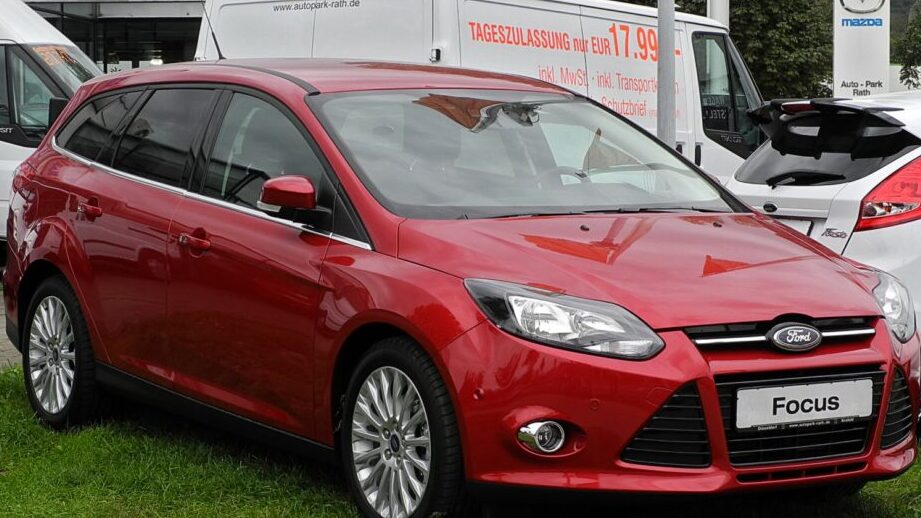
The Ford Focus III Wagon 2.0 TDCi, producing 140 horsepower, was a significant variant within the third generation Focus lineup, manufactured between 2010 and 2014. Positioned as a mid-range offering, it catered to buyers seeking a balance between fuel efficiency, practicality, and reasonable performance in a compact estate car. This model played a key role in Ford’s European strategy, offering a versatile vehicle for families and individuals needing ample cargo space combined with diesel economy. While the Focus III was sold globally, the wagon variant, and particularly the 2.0 TDCi engine, saw its strongest sales in Europe.
Technical Specifications
| Brand | Ford |
| Model | Focus |
| Generation | Focus III Wagon |
| Type (Engine) | 2.0 TDCi (140 Hp) |
| Start of production | 2010 |
| End of production | 2014 |
| Powertrain Architecture | Internal Combustion engine |
| Body type | Station wagon (estate) |
| Seats | 5 |
| Doors | 5 |
| Fuel consumption (urban) | 6.3 l/100 km (37.3 US mpg, 44.8 UK mpg, 15.9 km/l) |
| Fuel consumption (extra urban) | 4.2 l/100 km (56 US mpg, 67.3 UK mpg, 23.8 km/l) |
| Fuel consumption (combined) | 5 l/100 km (47 US mpg, 56.5 UK mpg, 20 km/l) |
| CO2 emissions | 129 g/km |
| Fuel Type | Diesel |
| Acceleration 0 – 100 km/h | 9.1 sec |
| Acceleration 0 – 62 mph | 9.1 sec |
| Acceleration 0 – 60 mph | 8.6 sec |
| Maximum speed | 207 km/h (128.62 mph) |
| Emission standard | Euro 5 |
| Weight-to-power ratio | 10.4 kg/Hp, 95.9 Hp/tonne |
| Weight-to-torque ratio | 4.6 kg/Nm, 219.2 Nm/tonne |
| Power | 140 Hp @ 3750 rpm |
| Power per litre | 70.1 Hp/l |
| Torque | 320 Nm @ 1750-2750 rpm (236.02 lb.-ft. @ 1750-2750 rpm) |
| Engine layout | Front, Transverse |
| Engine Model/Code | UFDB |
| Engine displacement | 1997 cm3 (121.86 cu. in.) |
| Number of cylinders | 4 |
| Engine configuration | Inline |
| Cylinder Bore | 85 mm (3.35 in.) |
| Piston Stroke | 88 mm (3.46 in.) |
| Compression ratio | 16:1 |
| Number of valves per cylinder | 4 |
| Fuel injection system | Diesel Commonrail |
| Engine aspiration | Turbocharger, Intercooler |
| Valvetrain | DOHC |
| Engine oil capacity | 5.7 l (6.02 US qt | 5.02 UK qt) |
| Coolant | 8.5 l (8.98 US qt | 7.48 UK qt) |
| Kerb Weight | 1460 kg (3218.75 lbs.) |
| Max. weight | 2050 kg (4519.48 lbs.) |
| Max load | 590 kg (1300.73 lbs.) |
| Trunk (boot) space – minimum | 490 l (17.3 cu. ft.) |
| Trunk (boot) space – maximum | 1516 l (53.54 cu. ft.) |
| Fuel tank capacity | 60 l (15.85 US gal | 13.2 UK gal) |
| Length | 4556 mm (179.37 in.) |
| Width | 1823 mm (71.77 in.) |
| Height | 1505 mm (59.25 in.) |
| Wheelbase | 2648 mm (104.25 in.) |
| Front track | 1544/1559 mm (60.79 in.) |
| Rear (Back) track | 1534/1549 mm (60.39 in.) |
| Minimum turning circle | 11 m (36.09 ft.) |
| Drivetrain Architecture | Front wheel drive |
| Number of gears | 6 gears, manual transmission |
Powertrain & Engine Architecture
The heart of the Focus III Wagon 2.0 TDCi was the UFDB engine, a four-cylinder diesel utilizing common rail direct injection. This engine was part of Ford’s Duratorq family, known for its robustness and efficiency. The 1997cc displacement was achieved with a bore of 85mm and a stroke of 88mm, operating at a compression ratio of 16:1. A turbocharger with an intercooler was employed to boost power and torque, delivering 140 horsepower at 3750 rpm and a substantial 320 Nm (236 lb-ft) of torque between 1750 and 2750 rpm. The engine featured a double overhead camshaft (DOHC) valvetrain with four valves per cylinder. The UFDB engine met Euro 5 emission standards, incorporating a diesel particulate filter (DPF) to reduce harmful emissions. The six-speed manual transmission was the standard offering, providing a good balance between fuel economy and drivability.
Driving Characteristics
The 2.0 TDCi engine in the Focus Wagon provided a noticeable step up in performance compared to the lower-powered 1.6-liter diesel options. While not a sports car, the 140 hp output and ample torque allowed for comfortable cruising on highways and confident overtaking maneuvers. The six-speed manual transmission was well-matched to the engine’s characteristics, offering precise shifts and allowing the driver to keep the engine in its optimal power band. The gear ratios were tuned for fuel efficiency, but still provided enough punch for everyday driving. Compared to the petrol versions, the 2.0 TDCi offered significantly better fuel economy, making it a popular choice for high-mileage drivers. The increased weight of the diesel engine and associated components did slightly impact handling compared to lighter petrol models, but the Focus III’s well-tuned suspension minimized this effect.
Equipment & Trim Levels
The 2.0 TDCi variant of the Focus Wagon was typically offered in mid-range trim levels, such as ‘Trend’ or ‘Titanium’ in many European markets. Standard equipment generally included air conditioning, power windows, power mirrors, a CD/MP3 stereo system, and alloy wheels. Higher trim levels added features like automatic climate control, a premium audio system, parking sensors, and rain-sensing wipers. Interior upholstery was typically cloth, with options for leather upgrades. Safety features included ABS brakes, electronic stability control, and multiple airbags. Optional extras included a panoramic sunroof, navigation system, and heated front seats.
Chassis & Braking
The Focus III Wagon utilized a MacPherson strut front suspension and a multi-link rear suspension, providing a comfortable ride and good handling characteristics. The 2.0 TDCi models, due to their increased weight, often featured slightly stiffer springs and dampers compared to lower-powered variants. Braking systems typically consisted of ventilated front discs and either disc or drum brakes on the rear, depending on the specific trim level. Anti-lock Braking System (ABS) and Electronic Stability Control (ESC) were standard features, enhancing safety and control. Steering was rack and pinion, providing precise and responsive handling.
Market Reception & Comparison
The Ford Focus III Wagon 2.0 TDCi was generally well-received by automotive critics. It was praised for its fuel efficiency, spacious interior, and comfortable ride. Critics noted that the diesel engine provided ample power for everyday driving, but some found the engine noise to be slightly intrusive. Compared to other estate cars in its class, such as the Volkswagen Passat Variant and Opel Astra Sports Tourer, the Focus offered a compelling combination of value, practicality, and driving dynamics. The 2.0 TDCi variant offered better fuel economy than the petrol engines, but at a slightly higher purchase price. Reliability was generally good, although some owners reported issues with the DPF system, a common problem with modern diesel engines.
Legacy
The Ford Focus III Wagon 2.0 TDCi remains a popular choice in the used car market, particularly in Europe. The UFDB engine is known for its durability, and with proper maintenance, can provide many years of reliable service. However, potential buyers should be aware of the potential for DPF issues and ensure that the vehicle has been regularly serviced. The Focus III Wagon’s practicality, fuel efficiency, and relatively affordable price make it a sensible option for families and individuals seeking a versatile and economical estate car. The 2.0 TDCi variant, with its balance of power and economy, continues to be a desirable configuration within the Focus III lineup.