Technical Specifications
| Brand | Ford |
| Model | Focus |
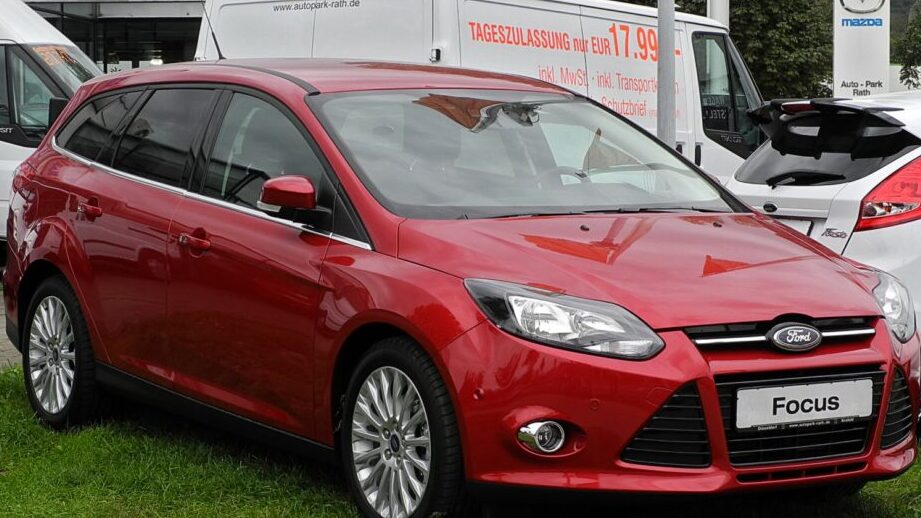
| Generation | Focus III Wagon |
| Type (Engine) | 2.0 TDCi (140 Hp) Automatic |
| Start of production | 2010 |
| End of production | 2014 |
| Powertrain Architecture | Internal Combustion engine |
| Body type | Station wagon (estate) |
| Seats | 5 |
| Doors | 5 |
| Fuel consumption (urban) | 6.8 l/100 km (34.6 US mpg, 41.5 UK mpg, 14.7 km/l) |
| Fuel consumption (extra urban) | 4.4 l/100 km (53.5 US mpg, 64.2 UK mpg, 22.7 km/l) |
| Fuel consumption (combined) | 5.3 l/100 km (44.4 US mpg, 53.3 UK mpg, 18.9 km/l) |
| CO2 emissions | 139 g/km |
| Fuel Type | Diesel |
| Acceleration 0 – 100 km/h | 9.7 sec |
| Acceleration 0 – 62 mph | 9.7 sec |
| Acceleration 0 – 60 mph | 9.2 sec |
| Maximum speed | 205 km/h (127.38 mph) |
| Emission standard | Euro 5 |
| Weight-to-power ratio | 10.5 kg/Hp, 95.2 Hp/tonne |
| Weight-to-torque ratio | 4.6 kg/Nm, 217.5 Nm/tonne |
| Power | 140 Hp @ 3750 rpm |
| Power per litre | 70.1 Hp/l |
| Torque | 320 Nm @ 1750-2750 rpm (236.02 lb.-ft. @ 1750-2750 rpm) |
| Engine layout | Front, Transverse |
| Engine Model/Code | UFDB |
| Engine displacement | 1997 cm3 (121.86 cu. in.) |
| Number of cylinders | 4 |
| Engine configuration | Inline |
| Cylinder Bore | 85 mm (3.35 in.) |
| Piston Stroke | 88 mm (3.46 in.) |
| Compression ratio | 16:1 |
| Number of valves per cylinder | 4 |
| Fuel injection system | Diesel Commonrail |
| Engine aspiration | Turbocharger, Intercooler |
| Valvetrain | DOHC |
| Engine oil capacity | 5.7 l (6.02 US qt | 5.02 UK qt) |
| Coolant | 8.5 l (8.98 US qt | 7.48 UK qt) |
| Kerb Weight | 1471 kg (3243 lbs.) |
| Max. weight | 2050 kg (4519.48 lbs.) |
| Max load | 579 kg (1276.48 lbs.) |
| Trunk (boot) space – minimum | 490 l (17.3 cu. ft.) |
| Trunk (boot) space – maximum | 1516 l (53.54 cu. ft.) |
| Fuel tank capacity | 60 l (15.85 US gal | 13.2 UK gal) |
| Length | 4556 mm (179.37 in.) |
| Width | 1823 mm (71.77 in.) |
| Height | 1505 mm (59.25 in.) |
| Wheelbase | 2648 mm (104.25 in.) |
| Front track | 1544/1559 mm (60.79 in.) |
| Rear (Back) track | 1534/1549 mm (60.39 in.) |
| Minimum turning circle | 11 m (36.09 ft.) |
| Drivetrain Architecture | Front wheel drive |
| Number of gears | 6 |
| Gearbox type | Automatic transmission |
The Ford Focus III Wagon 2.0 TDCi Automatic, produced between 2010 and 2014, was a significant offering in the European compact estate market. Part of the third generation of the globally successful Focus, this variant combined the practicality of a station wagon with a fuel-efficient diesel engine and the convenience of an automatic transmission. It occupied a mid-range position within the Focus Wagon lineup, appealing to buyers seeking a balance between economy, comfort, and cargo capacity. This model was primarily sold in Europe, where diesel-powered wagons were – and continue to be – a popular choice for families and businesses.
Powertrain & Engine Architecture
The heart of this Focus Wagon is the 2.0-liter TDCi diesel engine, specifically the UFDB engine code. This engine is a four-cylinder, inline configuration, utilizing a common-rail direct injection system. This system, supplied by Bosch, allowed for precise fuel delivery and optimized combustion, contributing to both power and efficiency. The engine features a turbocharger with an intercooler, boosting power output and improving throttle response. The double overhead camshaft (DOHC) valvetrain, with four valves per cylinder, further enhances breathing and performance. The six-speed automatic transmission, a conventional torque converter type, was chosen for its smoothness and ease of use. While not offering the lightning-fast shifts of a dual-clutch transmission, it provided a comfortable driving experience, particularly in urban environments. The transmission was programmed to prioritize fuel efficiency, with relatively early upshifts.
Driving Characteristics
The 2.0 TDCi Automatic Focus Wagon delivered a respectable, if not exhilarating, driving experience. With 140 horsepower and 320 Nm (236 lb-ft) of torque, acceleration from 0-60 mph took around 9.2 seconds. The automatic transmission, while smooth, did slightly diminish the engine’s potential compared to the six-speed manual version. The gear ratios were tuned for fuel economy, meaning the engine didn’t always feel as responsive as it could be. However, the ample torque available from 1750 rpm provided sufficient pulling power for everyday driving and overtaking maneuvers. The Focus Wagon’s well-tuned suspension offered a good balance between comfort and handling, making it a pleasant vehicle for long journeys. The steering was precise and well-weighted, providing a confident feel behind the wheel.
Equipment & Trim Levels
The 2.0 TDCi Automatic variant typically came equipped with a reasonable level of standard features. These included air conditioning, power windows, power mirrors, a CD/MP3 stereo system, and alloy wheels. Higher trim levels, such as Titanium, added features like automatic climate control, rain-sensing wipers, rear parking sensors, and upgraded interior trim. Interior upholstery was typically cloth, with leather options available as an extra. The dashboard layout was functional and well-designed, with clear instrumentation. Optional extras included a navigation system, a panoramic sunroof, and heated front seats.
Chassis & Braking
The Focus Wagon’s chassis featured independent front suspension with MacPherson struts and a multi-link rear suspension. This setup provided a comfortable ride and good handling characteristics. The braking system consisted of ventilated front discs and either disc or drum brakes on the rear, depending on the trim level. Anti-lock Braking System (ABS) was standard, enhancing safety and control during emergency braking. Stabilizer bars were fitted to both the front and rear axles to reduce body roll during cornering.
Market Reception & Comparison
The Ford Focus III Wagon 2.0 TDCi Automatic was generally well-received by automotive critics. It was praised for its fuel efficiency, comfortable ride, and spacious interior. However, some reviewers noted that the automatic transmission could feel a little sluggish at times, and that the engine lacked the outright performance of some of its rivals. Compared to the 1.6 TDCi variants, the 2.0 TDCi offered significantly more power and torque, making it a more capable all-rounder. It also provided better fuel economy than the petrol-powered models. In terms of reliability, the 2.0 TDCi engine proved to be generally robust, although regular servicing was essential to prevent issues with the diesel particulate filter (DPF).
Legacy
The Ford Focus III Wagon 2.0 TDCi Automatic remains a popular choice in the used car market today. Its combination of practicality, fuel efficiency, and affordability makes it an attractive option for families and individuals alike. The 2.0 TDCi engine, when properly maintained, is known for its longevity and reliability. However, potential buyers should be aware of the potential for DPF issues, particularly if the vehicle has primarily been used for short journeys. Overall, the Focus Wagon 2.0 TDCi Automatic represents a well-rounded and dependable vehicle that continues to offer good value for money.