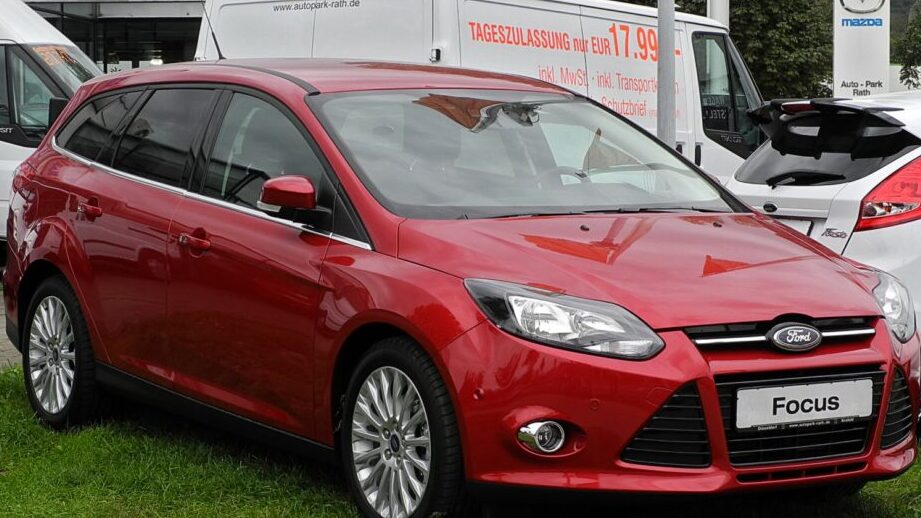
The Ford Focus III Wagon 2.0 TDCi, producing 163 horsepower, was a significant offering in the European Ford lineup from 2010 to 2014. Positioned as a mid-range option within the third-generation Focus wagon series (internally designated as the Mk3), it catered to buyers seeking a balance of fuel efficiency, practicality, and performance. This variant aimed to provide a more refined driving experience than the lower-powered diesel options, while remaining more economical than the petrol-powered versions. The Focus Mk3, built on the C-segment global platform (shared with models like the Mazda 3 and Volvo S40/V50), represented a substantial leap forward in terms of design, technology, and driving dynamics for Ford in Europe.
Technical Specifications
| Brand | Ford |
| Model | Focus |
| Generation | Focus III Wagon |
| Type (Engine) | 2.0 TDCi (163 Hp) |
| Start of production | 2010 year |
| End of production | 2014 year |
| Powertrain Architecture | Internal Combustion engine |
| Body type | Station wagon (estate) |
| Seats | 5 |
| Doors | 5 |
| Fuel consumption (economy) – urban | 6.3 l/100 km (37.3 US mpg, 44.8 UK mpg, 15.9 km/l) |
| Fuel consumption (economy) – extra urban | 4.2 l/100 km (56 US mpg, 67.3 UK mpg, 23.8 km/l) |
| Fuel consumption (economy) – combined | 5 l/100 km (47 US mpg, 56.5 UK mpg, 20 km/l) |
| CO2 emissions | 129 g/km |
| Fuel Type | Diesel |
| Acceleration 0 – 100 km/h | 8.8 sec |
| Acceleration 0 – 62 mph | 8.8 sec |
| Acceleration 0 – 60 mph | 8.4 sec |
| Maximum speed | 218 km/h (135.46 mph) |
| Emission standard | Euro 5 |
| Weight-to-power ratio | 9 kg/Hp, 111.6 Hp/tonne |
| Weight-to-torque ratio | 4.3 kg/Nm, 232.9 Nm/tonne |
| Power | 163 Hp @ 3750 rpm |
| Power per litre | 81.6 Hp/l |
| Torque | 340 Nm @ 2000-3250 rpm (250.77 lb.-ft. @ 2000-3250 rpm) |
| Engine layout | Front, Transverse |
| Engine Model/Code | TXDB |
| Engine displacement | 1997 cm3 (121.86 cu. in.) |
| Number of cylinders | 4 |
| Engine configuration | Inline |
| Cylinder Bore | 85 mm (3.35 in.) |
| Piston Stroke | 88 mm (3.46 in.) |
| Compression ratio | 16:1 |
| Number of valves per cylinder | 4 |
| Fuel injection system | Diesel Commonrail |
| Engine aspiration | Turbocharger, Intercooler |
| Valvetrain | DOHC |
| Engine oil capacity | 5.7 l (6.02 US qt | 5.02 UK qt) |
| Coolant | 8.5 l (8.98 US qt | 7.48 UK qt) |
| Kerb Weight | 1460 kg (3218.75 lbs.) |
| Max. weight | 2050 kg (4519.48 lbs.) |
| Max load | 590 kg (1300.73 lbs.) |
| Trunk (boot) space – minimum | 490 l (17.3 cu. ft.) |
| Trunk (boot) space – maximum | 1516 l (53.54 cu. ft.) |
| Fuel tank capacity | 60 l (15.85 US gal | 13.2 UK gal) |
| Length | 4556 mm (179.37 in.) |
| Width | 1823 mm (71.77 in.) |
| Height | 1505 mm (59.25 in.) |
| Wheelbase | 2648 mm (104.25 in.) |
| Front track | 1544/1559 mm (60.79 in.) |
| Rear (Back) track | 1534/1549 mm (60.39 in.) |
| Minimum turning circle | 11 m (36.09 ft.) |
| Drivetrain Architecture | The Internal combustion engine (ICE) drives the front wheels of the vehicle. |
| Drive wheel | Front wheel drive |
| Number of gears and type of gearbox | 6 gears, manual transmission |
| Assisting systems | ABS (Anti-lock braking system) |
| Steering type | Steering rack and pinion |
| Tires size | 205/55 R16; 205/55 R16; 215/55 R16; 215/50 R17; 235/40 R18 |
| Wheel rims size | 6.5J x 16; 7.0J x 16; 7.0J x 17; 8.0J x 18 |
Powertrain & Engine Architecture
The heart of the Focus III Wagon 2.0 TDCi was the TXDB engine, a four-cylinder diesel utilizing common-rail direct injection. This engine belonged to the Duratorq family, known for its robust construction and relatively good refinement. The 1997cc displacement was achieved with a bore of 85mm and a stroke of 88mm, operating at a compression ratio of 16:1. The engine featured a single turbocharger with an intercooler, boosting power output to 163 hp at 3750 rpm and a substantial 340 Nm (250.77 lb-ft) of torque between 2000 and 3250 rpm. The fuel injection system was a high-pressure common rail system, allowing for precise fuel delivery and contributing to both performance and fuel efficiency. The engine also incorporated a diesel particulate filter (DPF) to meet stringent Euro 5 emission standards. The 6-speed manual transmission was the standard offering, providing a good balance between fuel economy and driver engagement.
Driving Characteristics
The 2.0 TDCi 163 hp engine provided a noticeable step up in performance compared to the lower-powered 1.6-liter TDCi variants. Acceleration from 0-100 km/h (0-62 mph) took approximately 8.8 seconds, making it a reasonably quick estate car for everyday use. The readily available torque meant strong pulling power in higher gears, making overtaking maneuvers relatively effortless. While not a sports car, the 2.0 TDCi offered a more relaxed and confident driving experience, particularly when fully loaded or on long journeys. The manual transmission’s gear ratios were well-matched to the engine’s powerband, allowing for efficient cruising and responsive acceleration. Compared to the petrol engines, the diesel offered significantly better fuel economy, but lacked the same level of responsiveness and engine refinement.
Equipment & Trim Levels
The 2.0 TDCi variant typically came in higher trim levels, such as Zetec or Titanium. Standard equipment generally included air conditioning, electric front windows, a CD/radio system, alloy wheels, and ABS brakes. Higher-spec Titanium models added features like dual-zone climate control, rear parking sensors, automatic headlights and wipers, and upgraded interior trim. Optional extras included a panoramic sunroof, leather upholstery, and a navigation system. Interior upholstery was typically cloth on Zetec models, with leather options available on Titanium trims. The dashboard layout was functional and well-designed, with a clear instrument cluster and logically placed controls.
Chassis & Braking
The Focus III Wagon featured independent front suspension with MacPherson struts and a multi-link rear suspension. This setup provided a good balance between ride comfort and handling. The 2.0 TDCi models, being heavier than their lower-powered counterparts, often featured slightly stiffer suspension components to maintain stability. Braking systems consisted of ventilated front discs and either disc or drum brakes on the rear, depending on the trim level. ABS (Anti-lock Braking System) was standard across the range. Steering was via a rack and pinion system, providing precise and responsive control.
Market Reception & Comparison
The Ford Focus III Wagon 2.0 TDCi was generally well-received by automotive critics. It was praised for its fuel efficiency, spacious interior, and comfortable ride. The 2.0 TDCi engine was considered a good compromise between performance and economy, making it a popular choice for fleet buyers and private customers alike. Compared to the 1.6 TDCi, the 2.0 TDCi offered a noticeable performance boost, but at a slightly higher price point. Against competitors like the Volkswagen Golf Estate and Opel/Vauxhall Astra Sports Tourer, the Focus offered a compelling package with a strong emphasis on driving dynamics and practicality.
Legacy
The Duratorq 2.0 TDCi engine proved to be a reliable and durable unit, although, like all modern diesels, it was not immune to issues with the DPF and turbocharger. Proper maintenance, including regular oil changes and DPF regeneration, was crucial for long-term reliability. In the used car market, the Focus III Wagon 2.0 TDCi remains a popular choice, offering a good balance of value, practicality, and fuel efficiency. Its robust engine and well-rounded driving characteristics continue to appeal to buyers seeking a dependable and versatile estate car.