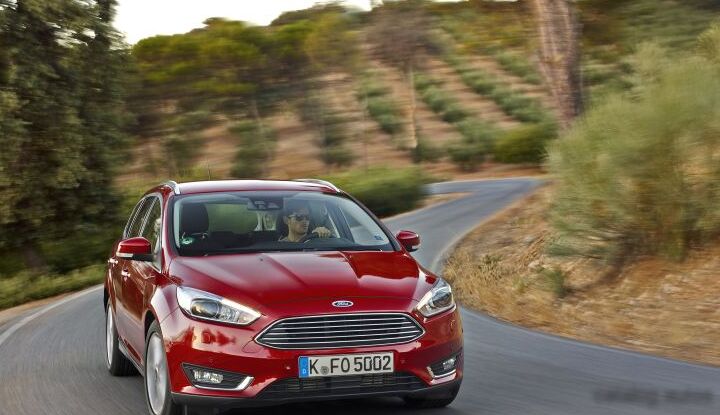
The Ford Focus III Wagon, specifically the facelifted version produced from 2014 to 2018, represented a significant evolution of Ford’s globally successful compact family car. Within the third generation (Mk3) Focus range, the 1.5 EcoBoost 150 horsepower variant occupied a middle ground, offering a balance between fuel efficiency, performance, and affordability. This model aimed to appeal to buyers seeking a practical and reasonably equipped wagon without the higher costs associated with the more powerful or luxury-oriented trims. It was primarily marketed in Europe and other global markets where the station wagon body style remained popular, offering a compelling alternative to hatchbacks and small SUVs.
Technical Specifications
| Brand | Ford |
| Model | Focus |
| Generation | Focus III Wagon (facelift 2014) |
| Type (Engine) | 1.5 EcoBoost (150 Hp) |
| Start of production | 2014 |
| End of production | 2018 |
| Powertrain Architecture | Internal Combustion engine |
| Body type | Station wagon (estate) |
| Seats | 5 |
| Doors | 5 |
| Fuel consumption (urban) | 8 l/100 km (29.4 US mpg, 35.3 UK mpg, 12.5 km/l) |
| Fuel consumption (extra urban) | 4.7 l/100 km (50 US mpg, 60.1 UK mpg, 21.3 km/l) |
| Fuel consumption (combined) | 5.9 l/100 km (39.9 US mpg, 47.9 UK mpg, 16.9 km/l) |
| CO2 emissions | 137 g/km |
| Fuel Type | Petrol (Gasoline) |
| Acceleration 0 – 100 km/h | 9.1 sec |
| Acceleration 0 – 62 mph | 9.1 sec |
| Acceleration 0 – 60 mph | 8.6 sec |
| Maximum speed | 210 km/h (130.49 mph) |
| Emission standard | Euro 6 |
| Weight-to-power ratio | 10.2 kg/Hp, 98.4 Hp/tonne |
| Weight-to-torque ratio | 6.4 kg/Nm, 157.5 Nm/tonne |
| Power | 150 Hp @ 6000 rpm |
| Power per litre | 100.1 Hp/l |
| Torque | 240 Nm @ 1600-4000 rpm (177.01 lb.-ft. @ 1600-4000 rpm) |
| Engine layout | Front, Transverse |
| Engine Model/Code | M8DA, M8DB |
| Engine displacement | 1499 cm3 (91.47 cu. in.) |
| Number of cylinders | 4 |
| Engine configuration | Inline |
| Cylinder Bore | 79 mm (3.11 in.) |
| Piston Stroke | 76.4 mm (3.01 in.) |
| Compression ratio | 10:1 |
| Number of valves per cylinder | 4 |
| Fuel injection system | Direct injection |
| Engine aspiration | Turbocharger, Intercooler |
| Valvetrain | DOHC |
| Engine oil capacity | 4.1 l (4.33 US qt | 3.61 UK qt) |
| Coolant | 5.8 l (6.13 US qt | 5.1 UK qt) |
| Kerb Weight | 1524 kg (3359.84 lbs.) |
| Max. weight | 1900 kg (4188.78 lbs.) |
| Max load | 376 kg (828.94 lbs.) |
| Trunk (boot) space – minimum | 476 l (16.81 cu. ft.) |
| Trunk (boot) space – maximum | 1502 l (53.04 cu. ft.) |
| Fuel tank capacity | 55 l (14.53 US gal | 12.1 UK gal) |
| Length | 4556 mm (179.37 in.) |
| Width | 1823 mm (71.77 in.) |
| Height | 1505 mm (59.25 in.) |
| Wheelbase | 2648 mm (104.25 in.) |
| Front track | 1544 mm (60.79 in.) |
| Rear (Back) track | 1559 mm (61.38 in.) |
| Minimum turning circle | 11 m (36.09 ft.) |
| Drivetrain Architecture | ICE, Front wheel drive |
| Drive wheel | Front wheel drive |
| Number of gears | 6 gears, manual transmission |
| Front suspension | Independent, McPherson with coil spring and anti-roll bar |
| Rear suspension | Independent multi-link suspension |
| Front brakes | Disc |
| Rear brakes | Disc |
| Assisting systems | ABS (Anti-lock braking system) |
| Steering type | Steering rack and pinion |
| Tires size | 205/55 R16; 215/50 R17 |
| Wheel rims size | 6.5J x 16; 7.0J x 17 |
Powertrain & Engine Architecture
The heart of this Focus variant is the 1.5-liter EcoBoost inline-four cylinder engine, specifically utilizing the M8DA or M8DB engine code. This engine is a member of Ford’s EcoBoost family, characterized by its combination of direct fuel injection, turbocharging, and variable valve timing. The direct injection system delivers fuel directly into the combustion chamber, improving efficiency and reducing emissions. The single scroll turbocharger, coupled with an intercooler, provides a noticeable boost in power and torque. The engine features a double overhead camshaft (DOHC) valvetrain with four valves per cylinder, optimizing airflow for enhanced performance. The 1.5 EcoBoost engine produces 150 horsepower at 6000 rpm and 240 Nm (177 lb-ft) of torque between 1600 and 4000 rpm. This broad torque curve contributes to good drivability in everyday situations. The engine is transversely mounted at the front of the vehicle, driving the front wheels. The 6-speed manual transmission was standard, offering precise gear changes and a relatively engaging driving experience.
Driving Characteristics
The 1.5 EcoBoost 150 hp Focus Wagon offered a respectable level of performance for its class. Acceleration from 0 to 62 mph (0-100 km/h) took approximately 9.1 seconds, making it adequately quick for most daily driving scenarios. While not as sporty as the higher-output versions of the Focus, the 1.5 EcoBoost provided sufficient power for overtaking and highway cruising. The turbocharger did introduce a slight amount of turbo lag, but the broad torque band minimized this effect. The 6-speed manual transmission was well-matched to the engine, allowing drivers to keep the engine in its optimal power range. Compared to the 1.0 EcoBoost engine, the 1.5 offered a more relaxed driving experience, particularly when fully loaded or on inclines. It also provided a noticeable improvement in performance over the diesel options, although at the expense of fuel economy.
Equipment & Trim Levels
The 1.5 EcoBoost variant typically came equipped with a reasonable level of standard features. These generally included air conditioning, power windows, power mirrors, a basic audio system with USB connectivity, and stability control. Higher trim levels, such as Titanium, added features like alloy wheels, a more advanced infotainment system with touchscreen display, automatic climate control, and parking sensors. Optional extras included a panoramic sunroof, leather upholstery, and a premium sound system. Interior upholstery was typically cloth, with higher trims offering partial leather options. The dashboard layout was functional and well-designed, with a focus on ergonomics.
Chassis & Braking
The Focus III Wagon utilized an independent front suspension with McPherson struts and a multi-link independent rear suspension. This setup provided a good balance between ride comfort and handling. The front and rear brakes were both disc brakes, offering adequate stopping power. Anti-lock Braking System (ABS) was standard. The suspension was tuned to provide a comfortable ride without sacrificing too much handling precision. Stabilizer bars were fitted to both the front and rear axles to reduce body roll during cornering.
Market Reception & Comparison
The 1.5 EcoBoost Focus Wagon was generally well-received by automotive critics. It was praised for its fuel efficiency, comfortable ride, and spacious interior. However, some reviewers noted that the engine could feel a bit strained when pushed hard. Compared to the 1.0 EcoBoost, the 1.5 offered more power and refinement, making it a better choice for those who frequently carry passengers or travel long distances. Compared to the diesel variants, the 1.5 EcoBoost offered a quieter and smoother driving experience, but with slightly higher fuel consumption. The 1.5 EcoBoost represented a sweet spot in the Focus range, offering a good balance of performance, economy, and practicality.
Legacy
The 1.5 EcoBoost engine proved to be a relatively reliable powertrain, although some owners have reported issues with the turbocharger and fuel injectors. Regular maintenance, including oil changes and timely replacement of wear items, is crucial for ensuring long-term reliability. In the used car market, the 1.5 EcoBoost Focus Wagon remains a popular choice, offering a practical and affordable option for families and individuals seeking a versatile and fuel-efficient vehicle. Its combination of space, comfort, and reasonable performance continues to make it a compelling proposition.