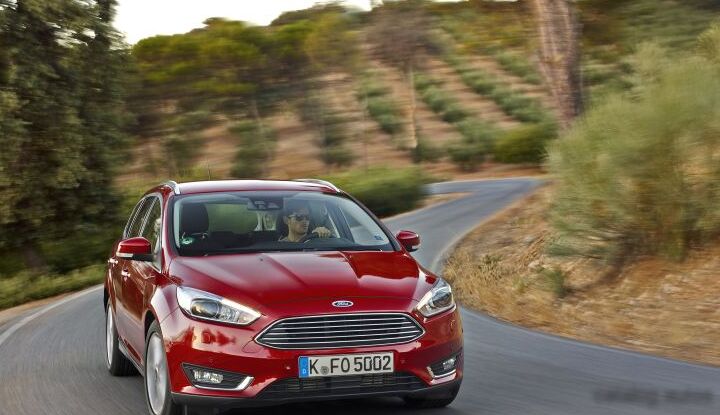
The Ford Focus III Wagon, specifically the facelifted version produced from 2014 to 2018, represented a significant evolution of Ford’s compact family car. Within the third generation (Mk3) Focus range, the 1.5 EcoBoost 150 horsepower (S&S – Smart Start/Stop) variant occupied a middle ground, offering a balance between fuel efficiency, performance, and equipment. This model was primarily aimed at the European market, where wagons (estate cars) remained a popular body style, and sought to appeal to buyers needing practicality without sacrificing driving enjoyment. It built upon the success of the Mk3 platform (C346), known for its improved dynamics and interior quality compared to its predecessor.
Technical Specifications
| Brand | Ford |
| Model | Focus |
| Generation | Focus III Wagon (facelift 2014) |
| Type (Engine) | 1.5 EcoBoost (150 Hp) S&S |
| Start of production | 2014 |
| End of production | 2018 |
| Powertrain Architecture | Internal Combustion engine |
| Body type | Station wagon (estate) |
| Seats | 5 |
| Doors | 5 |
| Fuel consumption (urban) | 7.1 l/100 km (33.1 US mpg, 39.8 UK mpg, 14.1 km/l) |
| Fuel consumption (extra urban) | 4.7 l/100 km (50 US mpg, 60.1 UK mpg, 21.3 km/l) |
| Fuel consumption (combined) | 5.6 l/100 km (42 US mpg, 50.4 UK mpg, 17.9 km/l) |
| CO2 emissions | 128 g/km |
| Fuel Type | Petrol (Gasoline) |
| Acceleration 0 – 100 km/h | 9.1 sec |
| Acceleration 0 – 62 mph | 9.1 sec |
| Acceleration 0 – 60 mph | 8.6 sec |
| Maximum speed | 210 km/h (130.49 mph) |
| Emission standard | Euro 6 |
| Weight-to-power ratio | 10.4 kg/Hp, 96 Hp/tonne |
| Weight-to-torque ratio | 6.5 kg/Nm, 153.6 Nm/tonne |
| Power | 150 Hp @ 6000 rpm |
| Power per litre | 100.1 Hp/l |
| Torque | 240 Nm @ 1600-4000 rpm (177.01 lb.-ft. @ 1600-4000 rpm) |
| Engine layout | Front, Transverse |
| Engine Model/Code | M8DA, M8DB |
| Engine displacement | 1499 cm3 (91.47 cu. in.) |
| Number of cylinders | 4 |
| Engine configuration | Inline |
| Cylinder Bore | 79 mm (3.11 in.) |
| Piston Stroke | 76.4 mm (3.01 in.) |
| Compression ratio | 10:1 |
| Number of valves per cylinder | 4 |
| Fuel injection system | Direct injection |
| Engine aspiration | Turbocharger, Intercooler |
| Valvetrain | DOHC |
| Engine oil capacity | 4.1 l (4.33 US qt | 3.61 UK qt) |
| Coolant | 5.8 l (6.13 US qt | 5.1 UK qt) |
| Kerb Weight | 1563 kg (3445.83 lbs.) |
| Max. weight | 1900 kg (4188.78 lbs.) |
| Max load | 337 kg (742.96 lbs.) |
| Trunk (boot) space – minimum | 476 l (16.81 cu. ft.) |
| Trunk (boot) space – maximum | 1502 l (53.04 cu. ft.) |
| Fuel tank capacity | 55 l (14.53 US gal | 12.1 UK gal) |
| Length | 4556 mm (179.37 in.) |
| Width | 1823 mm (71.77 in.) |
| Height | 1505 mm (59.25 in.) |
| Wheelbase | 2648 mm (104.25 in.) |
| Front track | 1544 mm (60.79 in.) |
| Rear (Back) track | 1559 mm (61.38 in.) |
| Minimum turning circle | 11 m (36.09 ft.) |
| Drivetrain Architecture | ICE, Front wheel drive |
| Number of gears | 6 |
| Gearbox type | Manual transmission |
| Front suspension | Independent, McPherson with coil spring and anti-roll bar |
| Rear suspension | Independent multi-link suspension |
| Front brakes | Disc |
| Rear brakes | Disc |
| Assisting systems | ABS (Anti-lock braking system) |
| Steering type | Steering rack and pinion |
| Tires size | 205/55 R16; 215/50 R17 |
| Wheel rims size | 6.5J x 16; 7.0J x 17 |
Powertrain & Engine Architecture
The heart of this Focus variant is the 1.5-liter EcoBoost engine, part of Ford’s range of turbocharged, direct-injection gasoline engines. Specifically, the M8DA and M8DB engine codes denote variations within this family. This engine utilizes a single-scroll turbocharger with an integrated exhaust manifold, contributing to quicker response and improved low-end torque. Direct fuel injection, operating at pressures up to 200 bar, ensures precise fuel delivery and efficient combustion. The engine features a dual overhead camshaft (DOHC) valvetrain with four valves per cylinder, optimizing gas flow. The Smart Start/Stop system, indicated by the “S&S” designation, automatically shuts off the engine when the vehicle is stationary (e.g., at traffic lights) to reduce fuel consumption and emissions. The engine is transversely mounted, driving the front wheels. The six-speed manual transmission was the standard offering, providing a good balance of fuel economy and driver engagement. Gear ratios were tuned to maximize the engine’s torque output, providing adequate acceleration in everyday driving situations.
Driving Characteristics
The 1.5 EcoBoost 150 hp engine, paired with the six-speed manual transmission, delivered a respectable driving experience. While not overtly sporty, it offered sufficient power for comfortable cruising and overtaking. Acceleration from 0-60 mph took around 8.6 seconds, making it competitive within its class. The turbocharger provided a noticeable boost in power from around 1600 rpm, offering a usable powerband for most driving scenarios. Compared to the higher-output 1.5 EcoBoost variants (182 hp), this version felt less eager to rev, but it compensated with improved fuel economy. Against diesel alternatives like the 1.6 TDCi, the EcoBoost offered a more responsive and refined driving experience, albeit with slightly higher fuel costs. The manual gearbox was generally well-matched to the engine, with smooth shifts and a precise feel.
Equipment & Trim Levels
The 1.5 EcoBoost 150 hp model typically fell into the mid-range of the Focus Wagon lineup. Standard equipment generally included air conditioning, power windows, power mirrors, a basic audio system with USB connectivity, and stability control. Higher trim levels, such as Titanium, added features like alloy wheels, a more advanced infotainment system with touchscreen display, automatic climate control, and parking sensors. Optional extras included a panoramic sunroof, leather upholstery, and a premium sound system. Interior upholstery was typically cloth, with a functional and durable design. The dashboard layout was clean and modern, with intuitive controls.
Chassis & Braking
The Focus III Wagon utilized an independent front suspension with McPherson struts and a multi-link independent rear suspension. This setup provided a good balance of ride comfort and handling precision. The front suspension incorporated a stabilizer bar to reduce body roll during cornering. Braking duties were handled by disc brakes on all four wheels, providing adequate stopping power. Anti-lock Braking System (ABS) was standard, enhancing safety. Steering was via a rack and pinion system, offering precise and responsive control.
Market Reception & Comparison
The 1.5 EcoBoost 150 hp Focus Wagon received generally positive reviews from automotive critics. It was praised for its fuel efficiency, comfortable ride, and practical wagon body style. However, some reviewers noted that the engine could feel slightly strained when fully loaded or driving uphill. Compared to the 1.0 EcoBoost engine, the 1.5 offered more power and refinement, but at a slightly higher price point. Against competitors like the Volkswagen Golf Estate and Opel Astra Sports Tourer, the Focus Wagon was considered a strong contender, offering a compelling combination of value, practicality, and driving dynamics.
Legacy
The 1.5 EcoBoost engine, in its various iterations, proved to be a relatively reliable powertrain. While some early examples experienced issues with timing belt durability (addressed in later revisions), the engine generally held up well over time. The Focus III Wagon, including the 1.5 EcoBoost variant, remains a popular choice in the used car market, offering a practical and affordable option for families. Its combination of fuel efficiency, space, and driving enjoyment continues to appeal to buyers seeking a versatile and reliable compact wagon.