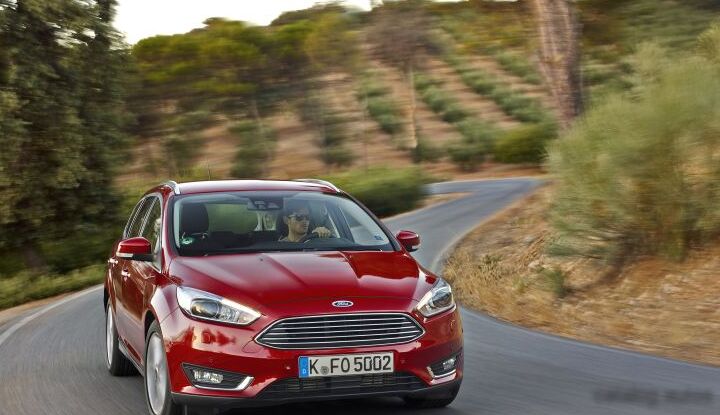
The Ford Focus III Wagon, specifically the facelifted version produced from 2014 to 2018, represented a significant evolution of Ford’s globally successful compact family car. Within the third generation (2011-2018) Focus lineup, the 1.5 EcoBoost variant, producing 182 horsepower, occupied a mid-to-upper position, offering a balance of performance and fuel efficiency. This model aimed to appeal to buyers seeking a practical wagon with a more engaging driving experience than the base engine options. The facelift brought revised styling, updated technology, and refinements to the chassis, solidifying the Focus’s position as a competitive offering in the European and increasingly, North American, compact wagon segment.
Technical Specifications
| Brand | Ford |
| Model | Focus |
| Generation | Focus III Wagon (facelift 2014) |
| Type (Engine) | 1.5 EcoBoost (182 Hp) |
| Start of production | 2014 |
| End of production | 2018 |
| Powertrain Architecture | Internal Combustion engine |
| Body type | Station wagon (estate) |
| Seats | 5 |
| Doors | 5 |
| Fuel consumption (urban) | 8 l/100 km (29.4 US mpg, 35.3 UK mpg, 12.5 km/l) |
| Fuel consumption (extra urban) | 4.7 l/100 km (50 US mpg, 60.1 UK mpg, 21.3 km/l) |
| Fuel consumption (combined) | 5.9 l/100 km (39.9 US mpg, 47.9 UK mpg, 16.9 km/l) |
| CO2 emissions | 137 g/km |
| Fuel Type | Petrol (Gasoline) |
| Acceleration 0 – 100 km/h | 8.8 sec |
| Acceleration 0 – 62 mph | 8.8 sec |
| Acceleration 0 – 60 mph | 8.4 sec |
| Maximum speed | 220 km/h (136.7 mph) |
| Emission standard | Euro 6 |
| Weight-to-power ratio | 8.4 kg/Hp, 119.4 Hp/tonne |
| Weight-to-torque ratio | 6.4 kg/Nm, 157.5 Nm/tonne |
| Power | 182 Hp @ 6000 rpm |
| Power per litre | 121.4 Hp/l |
| Torque | 240 Nm @ 1600-5000 rpm (177.01 lb.-ft. @ 1600-5000 rpm) |
| Engine layout | Front, Transverse |
| Engine Model/Code | M9DA, M9DB, M9DG, M9DH |
| Engine displacement | 1499 cm3 (91.47 cu. in.) |
| Number of cylinders | 4 |
| Engine configuration | Inline |
| Cylinder Bore | 79 mm (3.11 in.) |
| Piston Stroke | 76.4 mm (3.01 in.) |
| Compression ratio | 10:1 |
| Number of valves per cylinder | 4 |
| Fuel injection system | Direct injection |
| Engine aspiration | Turbocharger, Intercooler |
| Valvetrain | DOHC |
| Engine oil capacity | 4.1 l (4.33 US qt | 3.61 UK qt) |
| Coolant | 5.8 l (6.13 US qt | 5.1 UK qt) |
| Kerb Weight | 1524 kg (3359.84 lbs.) |
| Max. weight | 1900 kg (4188.78 lbs.) |
| Max load | 376 kg (828.94 lbs.) |
| Trunk (boot) space – minimum | 476 l (16.81 cu. ft.) |
| Trunk (boot) space – maximum | 1502 l (53.04 cu. ft.) |
| Fuel tank capacity | 55 l (14.53 US gal | 12.1 UK gal) |
| Length | 4556 mm (179.37 in.) |
| Width | 1823 mm (71.77 in.) |
| Height | 1505 mm (59.25 in.) |
| Wheelbase | 2648 mm (104.25 in.) |
| Front track | 1544 mm (60.79 in.) |
| Rear (Back) track | 1559 mm (61.38 in.) |
| Minimum turning circle | 11 m (36.09 ft.) |
| Drivetrain Architecture | The Internal combustion engine (ICE) drives the front wheels of the vehicle. |
| Drive wheel | Front wheel drive |
| Number of gears and type of gearbox | 6 gears, manual transmission |
| Front suspension | Independent, type McPherson with coil spring and anti-roll bar |
| Rear suspension | Independent multi-link suspension |
| Front brakes | Disc |
| Rear brakes | Disc |
| Assisting systems | ABS (Anti-lock braking system) |
| Steering type | Steering rack and pinion |
| Tires size | 205/55 R16; 215/50 R17 |
| Wheel rims size | 6.5J x 16; 7.0J x 17 |
INTRODUCTION
The 1.5 EcoBoost engine in the 2014-2018 Ford Focus III Wagon facelift was a key component in Ford’s strategy to offer a range of efficient and powerful engine options. Positioned as a step up from the 1.0 EcoBoost and 1.6 Ti-VCT engines, it provided a noticeable performance increase without sacrificing fuel economy. This variant was primarily sold in Europe, where the wagon body style is highly popular, but also saw limited availability in North America. The Focus III, built on the C-segment 1HX0/A3 platform, aimed to deliver a more refined and sophisticated driving experience compared to its predecessors.
Powertrain & Engine Architecture
The 1.5 EcoBoost engine (engine codes M9DA, M9DB, M9DG, M9DH) is a turbocharged, direct-injection four-cylinder petrol engine. Its compact size and lightweight construction were central to Ford’s EcoBoost philosophy. The engine utilizes a twin-scroll turbocharger, which improves responsiveness by separating exhaust pulses, reducing turbo lag. Direct injection allows for precise fuel delivery, optimizing combustion efficiency and power output. The engine features a double overhead camshaft (DOHC) valvetrain with four valves per cylinder, further enhancing breathing and performance. The 1.5L engine paired with a 6-speed manual transmission was the most common configuration, although a 6-speed automatic transmission was also offered. The automatic transmission featured a torque converter and aimed to provide smooth and efficient gear changes.
Driving Characteristics
The 182 hp and 240 Nm (177 lb-ft) of torque delivered by the 1.5 EcoBoost engine provided a noticeably more spirited driving experience compared to the lower-powered Focus variants. Acceleration from 0-60 mph took approximately 8.4 seconds, and the car felt responsive in everyday driving situations. The turbocharger provided a noticeable boost in power from around 1600 rpm, offering good mid-range acceleration for overtaking and merging onto highways. While not as outright sporty as the Focus ST, the 1.5 EcoBoost offered a good balance between performance and practicality. The 6-speed manual transmission provided precise shifts, while the automatic, though smooth, could feel slightly less engaging. Compared to the 1.0 EcoBoost, the 1.5 offered significantly more power, but at the expense of slightly higher fuel consumption.
Equipment & Trim Levels
The 1.5 EcoBoost variant was typically offered in mid-to-high trim levels, such as Titanium or ST-Line. Standard equipment often included air conditioning, power windows, power mirrors, a touchscreen infotainment system with Bluetooth connectivity, and alloy wheels. Higher trim levels added features like leather upholstery, heated front seats, a sunroof, and advanced driver-assistance systems such as lane departure warning and automatic emergency braking. Optional extras included a navigation system, premium sound system, and parking sensors. Interior upholstery was typically cloth on lower trims and leather on higher trims. Dashboard configurations were consistent across the range, with a focus on a clean and modern design.
Chassis & Braking
The Focus III Wagon featured an independent front suspension with McPherson struts and a multi-link independent rear suspension. This setup provided a comfortable ride while maintaining good handling characteristics. The 1.5 EcoBoost models typically featured slightly stiffer suspension tuning compared to the base models to better manage the increased power. Braking systems consisted of disc brakes on all four wheels, providing adequate stopping power. Anti-lock Braking System (ABS) was standard. Stabilizer bars were fitted to both the front and rear axles to reduce body roll during cornering. The wagon’s weight, around 1524 kg (3359.84 lbs), was managed effectively by the suspension and braking systems.
Market Reception & Comparison
The 1.5 EcoBoost Focus Wagon received generally positive reviews from automotive critics. It was praised for its blend of performance, fuel efficiency, and practicality. Critics noted that the engine provided ample power for everyday driving and long-distance journeys. Fuel economy was considered competitive for its class, averaging around 39.9 US mpg in combined driving. Compared to the 1.0 EcoBoost, the 1.5 offered a more refined and powerful driving experience, but with a slight increase in fuel consumption. The 1.6 Ti-VCT engine offered a simpler, naturally aspirated alternative, but lacked the torque and responsiveness of the EcoBoost. Reliability reports were generally positive, with few major issues reported with the 1.5 EcoBoost engine itself.
Legacy
The 1.5 EcoBoost engine proved to be a reliable and durable powertrain. While not without its minor quirks, such as potential carbon buildup on the intake valves (common to direct-injection engines), it generally offered good long-term reliability. In the used car market, the 1.5 EcoBoost Focus Wagon holds its value reasonably well, particularly well-maintained examples with a full service history. It remains a popular choice for buyers seeking a practical, efficient, and enjoyable-to-drive compact wagon. The engine’s technology, including direct injection and turbocharging, paved the way for future Ford EcoBoost engines and helped establish Ford as a leader in fuel-efficient powertrain technology.