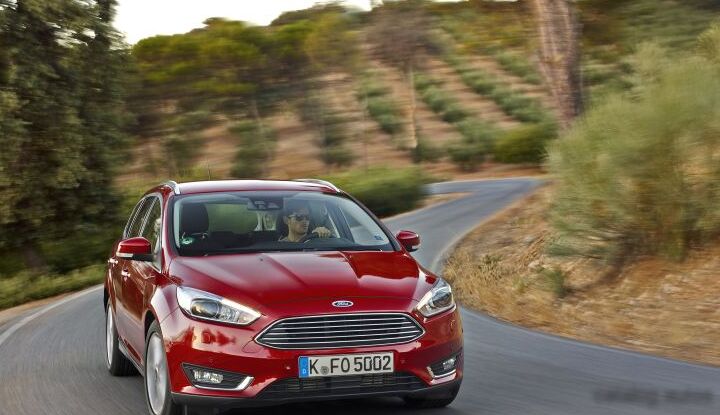
The Ford Focus III Wagon 1.5 TDCi ECOnetic, produced from 2014 to 2018, represented a fuel-efficient option within the third generation Focus lineup. This variant, part of the facelifted Mk3 range, was specifically designed for European markets prioritizing low running costs and reduced emissions. Positioned as an entry-level to mid-range offering, it catered to buyers seeking practicality and economy in a compact estate car. The “ECOnetic” designation signified Ford’s commitment to maximizing fuel efficiency through aerodynamic enhancements and optimized powertrain calibration. It sat below the higher-powered diesel variants and the petrol models in terms of performance, but offered a compelling value proposition for those prioritizing fuel economy.
Technical Specifications
| Brand | Ford |
| Model | Focus |
| Generation | Focus III Wagon (facelift 2014) |
| Type (Engine) | 1.5 TDCi ECOnetic (105 Hp) |
| Start of production | 2014 |
| End of production | 2018 |
| Powertrain Architecture | Internal Combustion engine |
| Body type | Station wagon (estate) |
| Seats | 5 |
| Doors | 5 |
| Fuel consumption (urban) | 3.9 l/100 km (60.3 US mpg, 72.4 UK mpg, 25.6 km/l) |
| Fuel consumption (extra urban) | 3.1 l/100 km (75.9 US mpg, 91.1 UK mpg, 32.3 km/l) |
| Fuel consumption (combined) | 3.4 l/100 km (69.2 US mpg, 83.1 UK mpg, 29.4 km/l) |
| CO2 emissions | 88 g/km |
| Fuel Type | Diesel |
| Acceleration 0 – 100 km/h | 12.1 sec |
| Acceleration 0 – 62 mph | 12.1 sec |
| Acceleration 0 – 60 mph | 11.5 sec |
| Maximum speed | 187 km/h (116.2 mph) |
| Emission standard | Euro 6 |
| Weight-to-power ratio | 12.4 kg/Hp, 80.8 Hp/tonne |
| Weight-to-torque ratio | 4.8 kg/Nm, 207.9 Nm/tonne |
| Power | 105 Hp @ 3600 rpm |
| Power per litre | 70 Hp/l |
| Torque | 270 Nm @ 1750 rpm (199.14 lb.-ft. @ 1750 rpm) |
| Engine layout | Front, Transverse |
| Engine Model/Code | AEDA, XXDB |
| Engine displacement | 1499 cm3 (91.47 cu. in.) |
| Number of cylinders | 4 |
| Engine configuration | Inline |
| Cylinder Bore | 73.5 mm (2.89 in.) |
| Piston Stroke | 88.3 mm (3.48 in.) |
| Number of valves per cylinder | 2 |
| Fuel injection system | Diesel Commonrail |
| Engine aspiration | Turbocharger, Intercooler |
| Valvetrain | SOHC |
| Engine oil capacity | 3.85 l (4.07 US qt | 3.39 UK qt) |
| Coolant capacity | 7.3 l (7.71 US qt | 6.42 UK qt) |
| Kerb Weight | 1299 kg (2863.8 lbs.) |
| Max. weight | 1900 kg (4188.78 lbs.) |
| Max load | 601 kg (1324.98 lbs.) |
| Trunk (boot) space – minimum | 476 l (16.81 cu. ft.) |
| Trunk (boot) space – maximum | 1502 l (53.04 cu. ft.) |
| Fuel tank capacity | 53 l (14 US gal | 11.66 UK gal) |
| Permitted trailer load (braked) | 400 kg (881.85 lbs.) |
| Permitted trailer load (unbraked) | 400 kg (881.85 lbs.) |
| Length | 4560 mm (179.53 in.) |
| Width | 1823 mm (71.77 in.) |
| Width with mirrors folded | 1858 mm (73.15 in.) |
| Width including mirrors | 2010 mm (79.13 in.) |
| Height | 1469 mm (57.83 in.) |
| Minimum turning circle | 11 m (36.09 ft.) |
| Drivetrain Architecture | Front wheel drive |
| Number of gears | 6 |
| Gearbox type | Manual transmission |
| Front suspension | Independent type McPherson, Transverse stabilizer |
| Rear suspension | Independent multi-link suspension, Transverse stabilizer |
| Front brakes | Disc |
| Rear brakes | Disc |
| Assisting systems | ABS (Anti-lock braking system) |
| Steering type | Steering rack and pinion |
| Power steering | Hydraulic Steering |
| Tires size | 205/55 R16 |
| Wheel rims size | 6.5J x 16 |
Powertrain & Engine Architecture
The heart of the Focus III Wagon 1.5 TDCi ECOnetic is the 1.5-liter Duratorq diesel engine, specifically the AEDA or XXDB engine code depending on the market and year. This engine is a four-cylinder, inline configuration, utilizing a single overhead camshaft (SOHC) valvetrain with two valves per cylinder. A key feature is its turbocharger with intercooler, which enhances power output and efficiency. The engine employs a common-rail direct fuel injection system, delivering fuel directly into the combustion chamber at high pressure for optimized combustion. This system, coupled with precise electronic control, contributes to the engine’s fuel efficiency and reduced emissions. The 6-speed manual transmission was standard, chosen for its efficiency and driver engagement. The engine’s relatively small displacement and turbocharging contribute to a broad torque curve, providing usable power across a wide range of engine speeds.
Driving Characteristics
The 105 horsepower and 270 Nm (199 lb-ft) of torque delivered by the 1.5 TDCi engine resulted in a driving experience focused on economy rather than outright performance. Acceleration from 0-60 mph took around 11.5 to 12.1 seconds, and top speed was approximately 116 mph. The manual gearbox, with its well-spaced ratios, allowed drivers to keep the engine in its optimal torque band for efficient cruising and overtaking. Compared to the higher-output diesel variants (like the 1.6 TDCi), the 1.5 TDCi felt less responsive, particularly at higher engine speeds. However, its lighter weight and optimized aerodynamics made it surprisingly nimble in urban environments. The focus was on maximizing fuel economy, and the engine’s calibration reflected this, prioritizing efficiency over spirited acceleration.
Equipment & Trim Levels
The ECOnetic trim level typically included features geared towards fuel efficiency and practicality. Standard equipment often included air conditioning, power windows, a basic audio system with USB connectivity, and alloy wheels. Safety features such as ABS, electronic stability control, and multiple airbags were standard. Interior upholstery was typically cloth, with a functional and durable design. Optional extras included features like a touchscreen infotainment system, rear parking sensors, and cruise control. The ECOnetic trim generally represented a good balance of features for the price, appealing to buyers who prioritized value and economy.
Chassis & Braking
The Focus III Wagon utilized an independent front suspension with McPherson struts and a transverse stabilizer, providing a comfortable ride and predictable handling. The rear suspension employed an independent multi-link setup, also with a transverse stabilizer, further enhancing ride quality and stability. Disc brakes were fitted on all four wheels, providing adequate stopping power for the vehicle’s weight and performance. The hydraulic power steering offered a responsive and precise feel. The suspension tuning was geared towards comfort and efficiency, rather than sporty handling, reflecting the ECOnetic trim’s focus on fuel economy.
Market Reception & Comparison
The Ford Focus III Wagon 1.5 TDCi ECOnetic was generally well-received by critics for its exceptional fuel economy and low running costs. It was often praised for its practicality and comfortable ride. However, some reviewers noted its lack of outright performance compared to higher-powered variants. Compared to the 1.6 TDCi models, the 1.5 TDCi offered similar fuel economy but with slightly less power. Against petrol-powered Focus models, the 1.5 TDCi provided significantly better fuel economy, making it a compelling choice for high-mileage drivers. Its reliability was generally considered good, with the Duratorq engine proving to be a robust and durable unit.
Legacy
The 1.5 TDCi engine, while not known for being a performance powerhouse, has proven to be a reliable and fuel-efficient powerplant. In the used car market, the Focus III Wagon 1.5 TDCi ECOnetic represents a sensible and affordable option for buyers seeking a practical and economical estate car. Maintenance costs are generally reasonable, and parts availability is good. While older examples may require attention to common diesel engine components like the fuel injectors and turbocharger, the engine’s overall durability ensures that well-maintained examples can provide many years of reliable service. The ECOnetic variant remains a popular choice for those prioritizing fuel efficiency and low running costs in a compact estate car.