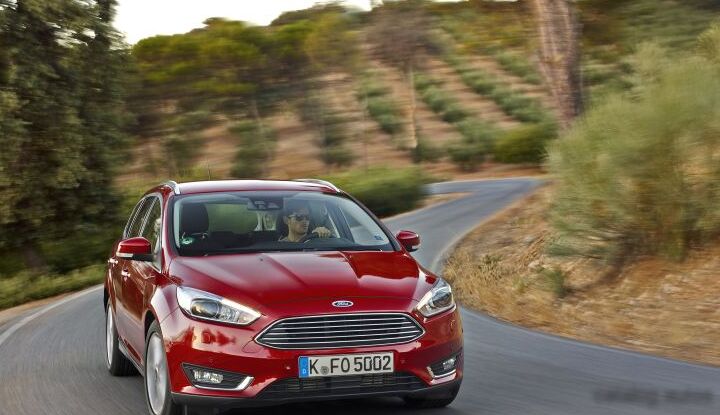
The Ford Focus III Wagon (facelift, 2014) 1.6 TDCi, producing 115 horsepower, represented a key offering in Ford’s European lineup during its production run from 2014 to 2015. Positioned as a fuel-efficient and practical option within the third generation Focus range (Mk3), this variant aimed to balance affordability with the versatility of a station wagon body style. It was a significant model for Ford in Europe, where compact wagons remained popular, offering a compelling alternative to hatchbacks and larger estates. This specific configuration utilized a manual transmission, catering to drivers prioritizing fuel economy and control. The facelift brought styling updates and revised technology compared to earlier Mk3 models.
Technical Specifications
| Brand | Ford |
| Model | Focus |
| Generation | Focus III Wagon (facelift 2014) |
| Type (Engine) | 1.6 TDCi (115 Hp) |
| Start of production | 2014 |
| End of production | 2015 |
| Powertrain Architecture | Internal Combustion engine |
| Body type | Station wagon (estate) |
| Seats | 5 |
| Doors | 5 |
| Fuel consumption (urban) | 5.7 l/100 km (41.3 US mpg, 49.6 UK mpg, 17.5 km/l) |
| Fuel consumption (extra urban) | 3.7 l/100 km (63.6 US mpg, 76.3 UK mpg, 27 km/l) |
| Fuel consumption (combined) | 4.5 l/100 km (52.3 US mpg, 62.8 UK mpg, 22.2 km/l) |
| CO2 emissions | 117 g/km |
| Fuel Type | Diesel |
| Acceleration 0 – 100 km/h | 11 sec |
| Acceleration 0 – 62 mph | 11 sec |
| Acceleration 0 – 60 mph | 10.5 sec |
| Maximum speed | 193 km/h (119.92 mph) |
| Emission standard | Euro 6 |
| Weight-to-power ratio | 13.3 kg/Hp, 74.9 Hp/tonne |
| Weight-to-torque ratio | 5.7 kg/Nm, 175.9 Nm/tonne |
| Power | 115 Hp @ 3600 rpm |
| Power per litre | 73.7 Hp/l |
| Torque | 270 Nm @ 1750-2500 rpm (199.14 lb.-ft. @ 1750-2500 rpm) |
| Engine layout | Front, Transverse |
| Engine Model/Code | T1DA, T1DB |
| Engine displacement | 1560 cm3 (95.2 cu. in.) |
| Number of cylinders | 4 |
| Engine configuration | Inline |
| Cylinder Bore | 75 mm (2.95 in.) |
| Piston Stroke | 88.3 mm (3.48 in.) |
| Compression ratio | 16:1 |
| Number of valves per cylinder | 2 |
| Fuel injection system | Diesel Commonrail |
| Engine aspiration | Turbocharger, Intercooler |
| Valvetrain | DOHC |
| Engine oil capacity | 3.85 l (4.07 US qt | 3.39 UK qt) |
| Coolant capacity | 7.3 l (7.71 US qt | 6.42 UK qt) |
| Kerb Weight | 1535 kg (3384.1 lbs.) |
| Max. weight | 1900 kg (4188.78 lbs.) |
| Max load | 365 kg (804.69 lbs.) |
| Trunk (boot) space – minimum | 476 l (16.81 cu. ft.) |
| Trunk (boot) space – maximum | 1502 l (53.04 cu. ft.) |
| Fuel tank capacity | 53 l (14 US gal | 11.66 UK gal) |
| Length | 4556 mm (179.37 in.) |
| Width | 1823 mm (71.77 in.) |
| Height | 1505 mm (59.25 in.) |
| Wheelbase | 2648 mm (104.25 in.) |
| Front track | 1544 mm (60.79 in.) |
| Rear track | 1559 mm (61.38 in.) |
| Minimum turning circle | 11 m (36.09 ft.) |
| Drivetrain Architecture | Front wheel drive |
| Number of gears | 6 gears, manual transmission |
| Front suspension | Independent, type McPherson with coil spring and anti-roll bar |
| Rear suspension | Independent multi-link suspension |
| Front brakes | Disc |
| Rear brakes | Disc |
| Assisting systems | ABS (Anti-lock braking system) |
| Steering type | Steering rack and pinion |
| Tires size | 205/55 R16; 215/50 R17 |
| Wheel rims size | 6.5J x 16; 7.0J x 17 |
INTRODUCTION
The 2014-2015 Ford Focus III Wagon 1.6 TDCi (115 hp) was a crucial variant within the facelifted Mk3 Focus range. Building upon the success of the Mk2, the Mk3 Focus aimed to offer a more sophisticated driving experience and improved fuel efficiency. The wagon body style, popular in Europe, provided increased practicality without sacrificing the Focus’s renowned handling characteristics. This particular engine and transmission combination was designed to appeal to buyers seeking a balance between running costs and usability, serving as an entry-level or mid-range option depending on optional equipment. It was built on the C170 platform, also known as the global C-car platform, shared with other Ford and Mazda vehicles.
Powertrain & Engine Architecture
The heart of this Focus variant is the 1.6-liter TDCi diesel engine, identified by engine codes T1DA or T1DB. This engine is a four-cylinder, inline configuration featuring a turbocharger with intercooling and a common-rail direct fuel injection system. The common-rail system, operating at high pressure, ensures precise fuel delivery for optimized combustion and reduced emissions. The engine utilizes a double overhead camshaft (DOHC) valvetrain with two valves per cylinder. The 115 horsepower output is achieved at 3600 rpm, while peak torque of 270 Nm (199 lb-ft) is available between 1750 and 2500 rpm, providing good low-end grunt for everyday driving. The engine is transversely mounted at the front of the vehicle. The six-speed manual transmission was the standard offering, providing a good spread of gears for both fuel efficiency and performance. The gear ratios were tuned to maximize fuel economy while still allowing for responsive acceleration.
Driving Characteristics
The 1.6 TDCi 115 hp engine, paired with the manual transmission, delivered a practical and economical driving experience. Acceleration from 0-60 mph took around 10.5 seconds, and 0-100 km/h in 11 seconds, making it adequate for most driving situations, though not particularly sporty. The engine’s strong low-end torque made it feel more responsive than the figures suggest, particularly in urban environments. Compared to higher-output versions of the Focus, such as those with the 1.5 EcoBoost petrol engine or the 1.6 TDCi with increased power, this variant prioritized fuel efficiency over outright performance. The manual transmission allowed for greater driver control, but required more driver involvement than the available automatic options. The gear ratios were well-matched to the engine’s torque curve, providing smooth and predictable power delivery.
Equipment & Trim Levels
The 1.6 TDCi 115 hp Focus Wagon was typically offered in several trim levels, varying by market. Standard equipment generally included air conditioning, power windows, power mirrors, a basic audio system with USB connectivity, and ABS brakes. Higher trim levels added features such as alloy wheels, a more advanced audio system with touchscreen display, cruise control, automatic headlights and rain-sensing wipers, and parking sensors. Interior upholstery was typically cloth, with options for upgraded materials on higher trims. Optional extras included a panoramic sunroof, heated seats, and a navigation system. The dashboard layout was typical of the Mk3 Focus, with a focus on ergonomics and ease of use.
Chassis & Braking
The Focus Mk3 Wagon utilized an independent suspension system on both the front and rear axles. The front suspension employed a McPherson strut design with a coil spring and anti-roll bar, while the rear featured a multi-link setup. This configuration provided a good balance between ride comfort and handling precision. Brakes were disc brakes on all four wheels, providing adequate stopping power. ABS (Anti-lock Braking System) was standard, enhancing safety during emergency braking situations. The steering system was a rack and pinion type, offering precise and responsive steering feel. Tire sizes varied depending on the trim level, with 205/55 R16 and 215/50 R17 being common options.
Market Reception & Comparison
The Ford Focus III Wagon 1.6 TDCi (115 hp) was generally well-received by automotive critics as a practical and fuel-efficient option. It was praised for its comfortable ride, responsive handling, and spacious interior. However, some critics noted that the engine could feel strained when fully loaded or driving uphill. Compared to the petrol-powered versions, the 1.6 TDCi offered significantly better fuel economy, making it a popular choice for drivers covering long distances. Compared to other diesel variants in the Focus lineup, such as the 1.6 TDCi with higher power output, this version offered a more affordable entry point. Its fuel economy figures were competitive with other compact wagons in its class.
Legacy
The 1.6 TDCi engine, while generally reliable, has been known to exhibit some issues with the diesel particulate filter (DPF) and the fuel injection system, particularly on vehicles that have primarily been used for short journeys. Regular maintenance, including timely oil changes and DPF regeneration, is crucial for ensuring long-term reliability. In the used car market, the Focus III Wagon 1.6 TDCi (115 hp) remains a popular choice due to its affordability, practicality, and fuel efficiency. It represents a good value proposition for buyers seeking a reliable and economical family car. The Mk3 Focus, in general, has established a reputation for being a well-rounded and dependable vehicle, and this variant continues to hold its own in the used car market.