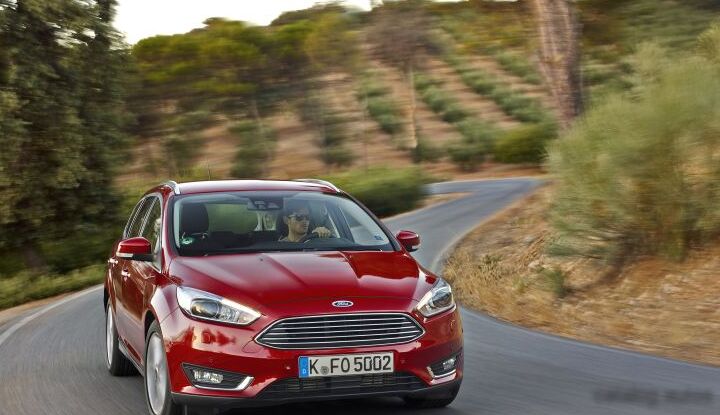
The Ford Focus III Wagon, particularly the facelifted version introduced in 2014, represented a significant evolution of Ford’s globally successful compact family car. Offered in a variety of configurations, the 1.6 TDCi 95 horsepower variant occupied an important position as an entry-level diesel option, primarily aimed at buyers prioritizing fuel efficiency and practicality. This version was particularly popular in European markets where diesel engines held a substantial share of the automotive landscape, and offered a compelling alternative to petrol-powered models.
Technical Specifications
| Brand | Ford |
| Model | Focus |
| Generation | Focus III Wagon (facelift 2014) |
| Type (Engine) | 1.6 TDCi (95 Hp) |
| Start of production | 2014 |
| End of production | 2015 |
| Powertrain Architecture | Internal Combustion engine |
| Body type | Station wagon (estate) |
| Seats | 5 |
| Doors | 5 |
| Fuel consumption (urban) | 5.7 l/100 km (41.3 US mpg, 49.6 UK mpg, 17.5 km/l) |
| Fuel consumption (extra urban) | 3.7 l/100 km (63.6 US mpg, 76.3 UK mpg, 27 km/l) |
| Fuel consumption (combined) | 4.5 l/100 km (52.3 US mpg, 62.8 UK mpg, 22.2 km/l) |
| CO2 emissions | 117 g/km |
| Fuel Type | Diesel |
| Acceleration 0 – 100 km/h | 12.7 sec |
| Acceleration 0 – 62 mph | 12.7 sec |
| Acceleration 0 – 60 mph | 12.1 sec |
| Maximum speed | 180 km/h (111.85 mph) |
| Emission standard | Euro 6 |
| Weight-to-power ratio | 16.1 kg/Hp, 62.1 Hp/tonne |
| Weight-to-torque ratio | 7.1 kg/Nm, 140.5 Nm/tonne |
| Power | 95 Hp @ 3800 rpm |
| Power per litre | 60.9 Hp/l |
| Torque | 215 Nm @ 1750 rpm (158.58 lb.-ft. @ 1750 rpm) |
| Engine layout | Front, Transverse |
| Engine Model/Code | TZJA, T3DA, T3DB |
| Engine displacement | 1560 cm3 (95.2 cu. in.) |
| Number of cylinders | 4 |
| Engine configuration | Inline |
| Cylinder Bore | 75 mm (2.95 in.) |
| Piston Stroke | 88.3 mm (3.48 in.) |
| Compression ratio | 16:1 |
| Number of valves per cylinder | 2 |
| Fuel injection system | Diesel Commonrail |
| Engine aspiration | Turbocharger, Intercooler |
| Valvetrain | DOHC |
| Engine oil capacity | 3.85 l (4.07 US qt | 3.39 UK qt) |
| Coolant capacity | 7.3 l (7.71 US qt | 6.42 UK qt) |
| Kerb Weight | 1530 kg (3373.07 lbs.) |
| Max. weight | 1900 kg (4188.78 lbs.) |
| Max load | 370 kg (815.71 lbs.) |
| Trunk (boot) space – minimum | 476 l (16.81 cu. ft.) |
| Trunk (boot) space – maximum | 1502 l (53.04 cu. ft.) |
| Fuel tank capacity | 53 l (14 US gal | 11.66 UK gal) |
| Length | 4556 mm (179.37 in.) |
| Width | 1823 mm (71.77 in.) |
| Height | 1505 mm (59.25 in.) |
| Wheelbase | 2648 mm (104.25 in.) |
| Front track | 1544 mm (60.79 in.) |
| Rear track | 1559 mm (61.38 in.) |
| Minimum turning circle | 11 m (36.09 ft.) |
| Drivetrain | Front wheel drive |
| Number of gears | 6 gears, manual transmission |
| Front suspension | Independent, type McPherson with coil spring and anti-roll bar |
| Rear suspension | Independent multi-link suspension |
| Front brakes | Disc |
| Rear brakes | Drum |
| Assisting systems | ABS (Anti-lock braking system) |
| Steering type | Steering rack and pinion |
| Tires size | 205/55 R16; 215/50 R17 |
| Wheel rims size | 6.5J x 16; 7.0J x 17 |
Positioning and Market Role
The 1.6 TDCi 95 hp Focus Wagon served as the entry point into the diesel wagon range for the Focus III facelift. It was positioned below the more powerful 1.6 TDCi 115 hp and the 2.0 TDCi variants. This trim level targeted buyers who valued fuel economy above outright performance. Families needing a practical and economical vehicle for daily commutes and longer journeys were a key demographic. The wagon body style itself was particularly popular in Europe, where estate cars (wagons) traditionally held a stronger market share than in North America, offering increased cargo capacity compared to the hatchback version.
Engine and Mechanical Details
The 1.6 TDCi engine, part of Ford’s Duratorq family, was a four-cylinder diesel utilizing common-rail direct injection and a turbocharger with intercooling. This combination allowed for a reasonable balance between power and fuel efficiency. The 95 horsepower output, while not particularly high, provided adequate performance for everyday driving. The engine’s torque peak of 215 Nm (158.58 lb-ft) at 1750 rpm was more significant, offering good pulling power for overtaking and carrying loads. The engine featured a relatively high compression ratio of 16:1, typical for diesel engines, contributing to its efficiency. The manual transmission, with six forward gears, helped to optimize fuel consumption and provide a more engaging driving experience than an automatic.
Comparison with Other Variants
Compared to the higher-powered 1.6 TDCi 115 hp variant, the 95 hp model offered a noticeable difference in performance. The 115 hp version provided quicker acceleration and a more relaxed driving experience, particularly when fully loaded or on inclines. However, it also came with a slightly higher price tag and marginally lower fuel economy. The 2.0 TDCi models, offering significantly more power (typically around 140-163 hp), were aimed at drivers who frequently towed trailers or covered long distances at high speeds. These models were also generally equipped with more premium features.
In terms of maintenance, the 1.6 TDCi engine was generally considered reliable, but like all modern diesels, it was susceptible to issues with the diesel particulate filter (DPF) if not driven on longer journeys periodically. The DPF required regular regeneration, which involved burning off accumulated soot. Short trips and frequent stop-start driving could lead to DPF clogging, resulting in reduced performance and potentially expensive repairs. The drum brakes on the rear wheels, compared to disc brakes on higher trims, offered slightly less stopping power but were more cost-effective to maintain.
Technology and Features
The 2014 facelift of the Focus III brought with it several technological updates, even on the base 1.6 TDCi model. These included Ford’s SYNC infotainment system, offering Bluetooth connectivity and voice control. Safety features such as ABS, electronic stability control, and multiple airbags were standard. While not as comprehensively equipped as higher-spec models, the 1.6 TDCi Wagon provided a good level of practicality and convenience for its price point. The independent rear suspension, a feature carried over from previous Focus generations, contributed to a comfortable ride and good handling characteristics.
Legacy
The Ford Focus III Wagon 1.6 TDCi 95 hp represented a well-rounded and practical choice for buyers seeking an economical and versatile family car. Its fuel efficiency, combined with the practicality of the wagon body style, made it a popular choice in European markets. While not the most powerful or luxurious version of the Focus, it offered a compelling value proposition and contributed to the overall success of the Focus III generation.